

Table of Contents
- Quick Comparison: High Performance Basketball Training Gear
- Shooting Form Trainers and Return Machines
- Weighted and Oversized Training Balls for Ball Handling
- Defensive Dummies and Footwork Aids for Skill Development
- Choosing the Best Portable Basketball Hoop for Training
- In-Ground Basketball System Benefits for a Home Training Court
- How to Build a Training Setup in Carbondale, Illinois
- Frequently Asked Questions
Last Updated: September 14, 2026
Quick Comparison: High Performance Basketball Training Gear
High performance basketball training gear adds resistance, structure, or repetition to skill work. Sports Vista USA stocks form trainers, weighted balls, defensive dummies, and rebounders that turn a driveway or gym into a development setup.
Effective gear does one of three things: forces better mechanics, adds resistance, or multiplies repetitions.
| Training Need | Gear Type | Rep Range | Best For |
|---|---|---|---|
| Shooting form | Elbow brace, hand-placement ball | 50-100 shots | Guards, developing shooters |
| Ball handling | Weighted ball, oversized ball | 10-15 min | Primary ball handlers |
| Finishing vs. length | Defensive dummy | 20-30 reps | Wings, post players |
| Repetition volume | Toss Back rebounder | 15-20 min | Solo workouts, PE classes |
| Home court base | Portable or in-ground hoop | Daily | Families, schools |
Most players need only two or three. Buying all five at once is a common mistake, the gear sits unused because the training plan never caught up.

Shooting Form Trainers and Return Machines
Shooting form trainers and return machines attack the two biggest constraints on shooting improvement: inconsistent mechanics and lost repetitions. A form trainer guides the shooting arm so the elbow, wrist, and release repeat; a return machine feeds the ball back so the player never breaks rhythm chasing a rebound.
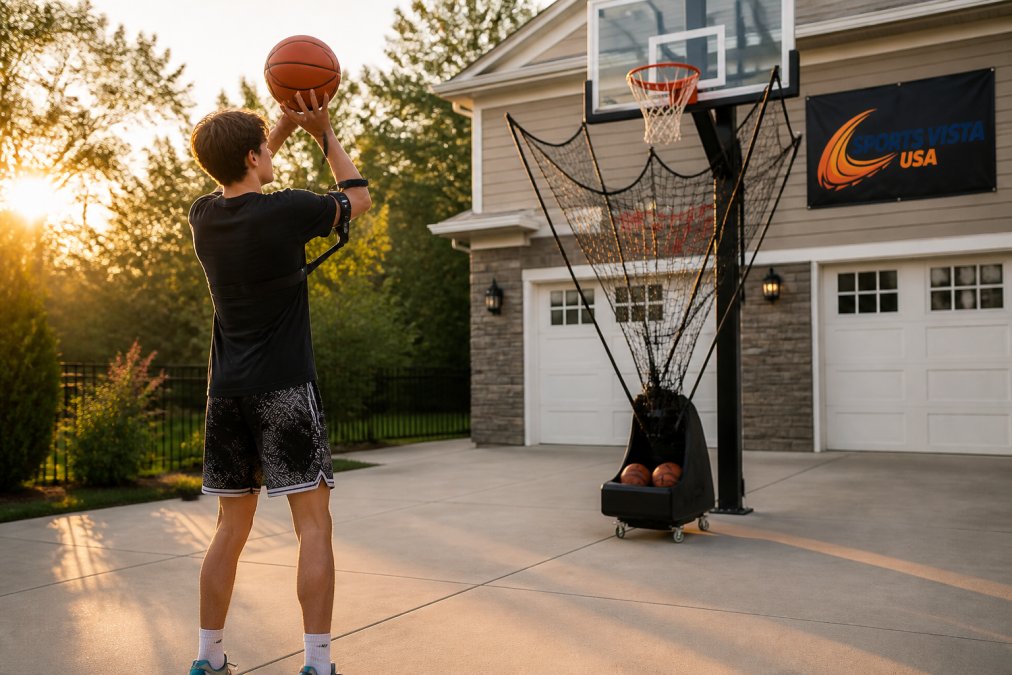
How the two tools divide the work
A shooting block has three phases, each with a job:
- Mechanics phase (form trainer only). Close-range reps where the brace holds the shooting arm at roughly 90 degrees. No rebounder needed, the player is close enough to retrieve the ball and the goal is deliberate, slow repetition, not volume.
- Volume phase (rebounder only). Remove the brace and let the return ramp feed catch-and-shoot reps from multiple spots. This is where the repetition count climbs.
- Transfer phase (both, or neither). Game-speed reps off the move. Most coaches pull the trainer off here so the player is not relying on the brace, and keep the rebounder running to preserve pace.
A common pattern: 50-100 guided reps, then 15-20 minutes of rebounder-fed volume, then a short transfer block.
Hoopsbasket Shooting Correction Machine
The Hoopsbasket Shooting Correction Machine is a form-focused device with a reversible elbow brace that positions the shooting arm at roughly 90 degrees, plus adjustable resistance. One unit covers right- and left-handed shooters, indoors or outdoors.
This is the pick for coaches running individual or small-group workouts who want structured, repeatable form reps rather than free shooting. It is a training aid, not a guarantee, results depend on coaching, technique, and volume.
Hoopsbasket Shooting Correction Machine - Basketball Training
Hoopsbasket Custom Shooting Trainer and Gared Toss Back Rebounds
The Hoopsbasket Custom Basketball Shooting Trainer solves the rebound problem instead of the mechanics problem. Its return ramp rotates up to 180 degrees, so a player can shoot from different spots without repositioning the unit, and it fits most home hoops and many indoor systems.
For programs that need mobility and drill variety, the Gared Varsity Toss Back® is the stronger rebounder. Its 38" x 51" frame adjusts from 4'5" to 7'4", covering youth through varsity athletes, and the roll-around base with casters moves between stations. The Master Toss Back® is the economical version for PE programs and individual workouts.

| Tool | Job in the session | Adjustability | Best fit |
|---|---|---|---|
| Hoopsbasket Shooting Correction Machine | Mechanics | Reversible brace, adjustable resistance | Coaches, structured form blocks |
| Hoopsbasket Custom Shooting Trainer | Rebounding + spot variety | 180-degree rotating ramp | Home hoops, indoor systems |
| Gared Varsity Toss Back® | Rebounding + mobility | 4'5" to 7'4" frame, casters | Schools, team practices |
| Gared Master Toss Back® | Rebounding on a budget | Folding frame, suction-cup legs | PE programs, solo workouts |
What most guides leave out: the drill, not the device
A form trainer does not fix a shot on its own, the value comes from what you do between reps. Two structures work:
- Brace-and-release ladder. Ten reps at close range with the brace, ten without, then five from the elbow and five from the wing. The brace sets the feel; the unbraced reps test whether it stuck.
- Rebounder circuit. Use the rotating ramp to cycle through five spots, corner, wing, top, wing, corner, for a set number of makes rather than a set number of shots. Makes force focus; shot counts reward chucking.
For a home court, the rebounder is usually the higher-value first purchase because it multiplies every future session. The form trainer is the second buy, earning its place when mechanics, not volume, are the bottleneck.
Weighted and Oversized Training Balls for Ball Handling
Weighted and oversized training balls build ball handling, passing, and touch by making the ball harder to control than a regulation basketball. Train with something more demanding, then return to a game ball and everything feels slower and more secure.
HoopsKing Weighted Indoor Basketball
The HoopsKing Weighted Indoor Basketball adds resistance to pound dribbles, crossovers, passing, and short-range form work. It comes in a men's 29.5" size at 3 lb. and a women's 28.5" size at 2.75 lb., both with a composite leather cover, and includes a 25-minute weighted workout via QR code.
The added weight makes it unsuitable for high-volume work with younger players, supervise youth use and keep volume sensible.
Big Shot 33-Inch and Hands On Shooter Training Balls
The HoopsKing Big Shot 33" Training Basketball is oversized rather than weighted, with a 33" circumference that forces a higher shooting arc and more precise touch while staying close to a standard men's ball in weight. It ships with online access to a training video, and comes in rubber or composite leather.
For developing players learning hand placement, the HoopsKing Hands On Shooter Indoor Basketball prints visual guides on the ball showing where the shooting hand and guide hand belong. It comes in 27.5" and 28.5" sizes for right- and left-handed shooters.
| Ball | Type | Sizes | Best For |
|---|---|---|---|
| HoopsKing Weighted | Resistance | 29.5", 28.5" | Strength and control |
| Big Shot 33" | Oversized | 33" | Shooting arc, touch |
| Hands On Shooter | Hand-placement guide | 27.5", 28.5" | Beginners, youth |
| Hustle Composite | Standard game ball | 29.5", 28.5", 27.5" | Return to regulation |
The Hustle Indoor/Outdoor Composite Basketball is the ball players return to after resistance work. Its sponge PVC cover and deep channels handle gym and blacktop, and the butyl bladder holds air between sessions.
Defensive Dummies and Footwork Aids for Skill Development
Defensive dummies give players a stationary defender to read against, the closest most solo workouts get to game-speed decision making. The HoopsKing D-Fender Basketball Defensive Dummy Mannequin uses a steel frame and weighted steel base, so no sand or water filling is needed, and its Velcro-fastened limbs adjust up to 180 degrees to change passing lanes and shooting windows.
The value of a dummy is in the drill design, not the product. Two D-Fenders at different angles create a read-and-react station; one set up for repeated shots is just shooting with an obstacle.
- Shooting over length: set the arms high, work on arc and release point
- Passing around a defender: angle the limbs to shrink the window
- Finishing through contact: place the dummy at the block for layup and floater work
- Spacing reads: use two units to force a decision between drive and kick
The mesh body folds down for storage, which matters if your training space doubles as a garage.
Choosing the Best Portable Basketball Hoop for Training
The best portable basketball hoop for training has a large enough backboard and a stable base to survive real repetition, not just casual shooting. Portability matters when you rent, move frequently, or need to clear the driveway, but the tradeoff is base stability under aggressive play.
Three things decide whether a portable unit holds up to training use:
- Backboard size and material: larger boards in acrylic or tempered glass bank shots more predictably than small composite boards
- Base capacity: a deeper base holds more ballast and resists tipping during drives and rebounding work
- Pole gauge and adjustment range: a thicker pole flexes less, and a wide height range lets one unit serve a youth player and an adult
For families in Carbondale running driveway workouts, a portable system is usually the right first purchase because it moves with the household. If the goal is a permanent training station and the property allows it, an in-ground system is the better long-term answer.
In-Ground Basketball System Benefits for a Home Training Court
In-ground basketball system benefits come down to stability and consistency. A direct-buried or anchor-set pole does not move, so rim height stays true and the backboard does not shake on bank shots or hard rebounds. That consistency makes repeatable form work possible, a portable base that shifts under a hard drive changes rim height mid-session.
The practical advantages for a home training court:
- No ballast to refill and no base to crack
- Higher rim heights available for dunk and rim work
- Cleaner court footprint with no base to trip over
- Better wind resistance than a portable unit
The tradeoff is installation: an in-ground system requires digging, concrete, and a placement decision you cannot easily reverse. For schools, churches, parks, and recreation departments in southern Illinois, in-ground and institutional goals are the standard for exactly this reason.
Match the system to the athlete, not the catalog page
The right in-ground setup for a 10-year-old is not the right setup for a varsity wing or a college program. Segment by who is actually shooting on it:
| Athlete level | Ball size | Backboard target | Height range to plan for | Gear priority |
|---|---|---|---|---|
| Youth (under 12) | 27.5" | Smaller board, composite or acrylic | Low rim settings up to 10' | Adjustability first; skip weighted balls |
| Middle school | 28.5" | Mid-size acrylic | Full 10' with room to grow | Adjustable in-ground or sturdy portable |
| High school / varsity | 29.5" | Large acrylic or tempered glass | Fixed 10' | Stability and board size over portability |
| College / pro-style training | 29.5" | Tempered glass, regulation size | Fixed 10' | Institutional-grade pole and board |
Two rules fall out of that table. First, youth players should train with a 27.5" ball and skip weighted balls entirely, added resistance is a technique risk before mechanics are set. Second, weighted and resistance gear belongs with players who have an established technical base.
Where the hoop decision meets the training plan
An in-ground system is the right call when the court is permanent and the property allows it. A portable system is the right call when you rent, move frequently, or need to clear the driveway. The mistake is buying the hoop last: the goal determines ball size, ball size determines training gear, and training gear determines how much space you need around the court.
For a school, church, park, or recreation department, the calculus flips: institutional goals and in-ground systems are built for shared, high-volume use, and the equipment list should be sized to the program rather than a single athlete. Sports Vista USA carries in-ground and portable basketball hoops, adjustable systems, institutional goals, and backboards, so the same catalog covers a driveway in Carbondale and a gym floor. Browse the basketball hoop selection at Sports Vista USA to match the system to the athletes who will actually use it.
How to Build a Training Setup in Carbondale, Illinois
A workable training setup in Carbondale starts with the hoop, then adds gear in the order that fixes your biggest weakness, keeping every purchase in use instead of stacked in a corner.
- Set the hoop first. Choose portable or in-ground based on whether the court is permanent. Everything else depends on this decision.
- Add a rebounder if you train alone. The Gared Master Toss Back® or Varsity Toss Back® removes the rebound bottleneck that kills solo shooting volume.
- Add a weighted ball for handling. Ten to fifteen minutes of weighted dribbling before a workout builds control without adding a separate session.
- Add a form trainer if mechanics are the issue. The Hoopsbasket Shooting Correction Machine fits coaches running structured shooting blocks.
- Add a defensive dummy for finishing work. The D-Fender turns a solo workout into a decision-making drill.
Southern Illinois weather limits outdoor training for part of the year, so gear that moves between a driveway and an indoor gym holds more value than single-surface equipment. If you are searching for basketball training gear near me in Carbondale, the deciding factor is usually whether the equipment works in both settings.

Wearable tech pairs well with plyometric and conditioning work, but the data only matters if it changes the next session. Use a heart rate monitor or jump tracker to confirm a vertical jump block is loading the legs, not as a scoreboard.
Building a training setup that actually gets used is harder than buying the equipment. Sports Vista USA carries the full range for home courts and facilities, including in-ground and portable basketball hoops, adjustable systems, institutional goals, backboards, and training equipment like weighted balls, rebounders, and defensive dummies. If you are outfitting a driveway in Carbondale or a school gym, the team can help you match equipment to the athletes using it. Check out the basketball training and court equipment selection at Sports Vista USA and build the setup around your actual training plan.
Frequently Asked Questions
What gear is essential for a high-performance basketball workout?
A complete high performance basketball training gear setup covers shooting, ball handling, and defensive work. Start with a form trainer or return machine for shooting reps, add a weighted or oversized ball for ball handling, and use a defensive dummy for finishing and passing drills. Sports Vista USA carries all of these, from the Hoopsbasket Shooting Correction Machine at $1,599.00 to the HoopsKing D-Fender at $89.99.
What are the benefits of using professional-grade basketball training aids?
Professional-grade aids let players get more repetitions without a partner. A return machine like the Hoopsbasket Custom Shooting Trainer sends made and missed shots back so shooters keep working instead of chasing rebounds. Weighted balls add resistance to dribbling and passing, while defensive dummies create game-like obstacles. Together they build skill acquisition faster than solo drills with a regulation ball alone.
How do I choose the best portable basketball hoop for a training setup?
Match the hoop to your training volume and space. Portable systems let you move the goal and adjust height, which suits driveway workouts and multi-use courts. Check the backboard size, since larger boards support bank shots and form work. For heavy daily training, an in-ground system offers more stability, while a portable hoop remains the flexible option for shared spaces.
What are the main in-ground basketball system benefits for home training?
In-ground systems deliver a rock-solid base with no movement on hard cuts or dunk attempts, which matters for repetition training and game-speed simulation. They hold their height setting and rim position over years of use, and they free up court space since there is no portable base to work around. For dedicated home courts, that stability supports consistent shooting form.
Can I improve basketball skills at home with limited space?
Yes. Ball handling drills with a weighted ball need only a few feet of clearance. The HoopsKing Weighted Indoor Basketball, at $53.00 in men's and women's sizes, adds resistance to pound dribbles and crossovers indoors. Pair it with a shooting aid like the silicone shooting corrector at $108.00, and save court time for full-speed reps on your hoop.


Leave a comment
This site is protected by hCaptcha and the hCaptcha Privacy Policy and Terms of Service apply.