


Table of Contents
- What Makes a Quality Pickleball Court Surface Paint
- Pickleball Court Paint for Concrete Surfaces
- Pickleball Court Paint for Asphalt Surfaces
- Pickleball Court Surface Preparation: The Foundation for Lasting Paint
- Pickleball Court Color Combinations and Ball Visibility
- Common Mistakes to Avoid When Painting Your Residential Court
- How to Choose the Right Paint System for Your Home Court
- Frequently Asked Questions
Last Updated: October 10, 2026
What Makes a Quality Pickleball Court Surface Paint
Quality pickleball court surface paints do more than just add color. It needs to provide consistent ball bounce, reliable player traction, and durability against weather and foot traffic. The best paints for residential courts combine high-solid acrylic coatings with non-skid additives that keep players safe while maintaining playability season after season.
The paint system you choose directly affects how the court plays and how long it lasts. Poor choices lead to slippery surfaces, unpredictable bounce, and peeling within 1-2 years.
Concrete and asphalt require different preparation and coating approaches. A paint that works on concrete may fail on asphalt if you don't account for substrate movement and moisture.
Pickleball Court Paint for Concrete Surfaces
Concrete is the preferred substrate for residential courts because it's stable and provides a reliable base for high-performance coatings. Choosing the right product requires understanding coverage, application method, and durability trade-offs.
High-solid acrylic coatings bond effectively to concrete when properly prepared, filling small voids and improving adhesion.
Coverage and Application Planning for Concrete Courts
Most residential concrete courts range from 400-600 square feet. High-solid acrylic coatings typically cover 300-400 square feet per gallon per coat. A standard court usually requires two coats, meaning 2-4 gallons of paint total, plus primer if the concrete is new or unsealed.
Roller application provides good control but may show lap marks. Spray application covers faster and delivers uniform finish but requires equipment rental and skill. Many homeowners combine both methods for best results.
Most acrylic coatings require 4-8 hours between coats; full cure takes 24-48 hours. Avoid painting during high humidity or when rain is forecast.
Concrete Condition and Preparation Impact on Paint Performance
Concrete must be clean, dry, and free of sealers or coatings before new paint is applied. Pressure wash at 2000-3000 PSI to remove dirt, algae, and loose material, then allow 48 hours of dry weather for the surface to cure completely. Moisture trapped under paint causes adhesion failure and peeling within months.
Fill cracks wider than 1/8 inch with concrete filler. If the concrete has existing sealers or coatings, abrade or sand the surface to improve adhesion.
Allow at least 28 days of curing for new concrete. A moisture meter reading below 4% indicates readiness for coating.
Why Concrete Outperforms Asphalt for Residential Courts
Concrete requires higher upfront cost and longer installation time than asphalt, but delivers extended service life and lower maintenance for homeowners planning to keep their court long-term.
Pickleball Court Paint for Asphalt Surfaces
Asphalt is more porous and expands/contracts more with temperature changes. The best coatings are flexible and breathable, accommodating substrate movement while delivering reliable ball bounce and traction.
Flexible Acrylic Coatings: The Right Choice for Asphalt
Rigid paints fail on asphalt because they can't accommodate seasonal expansion and contraction. Flexible acrylic coatings are designed to move with the substrate and include additives that improve elasticity and adhesion.
Primer or bonding agent is recommended for asphalt courts. It ensures paint grips the surface and resists peeling from temperature stress. Skipping primer is a common reason for premature failure.
Coverage, Application, and Maintenance Planning for Asphalt Courts
Asphalt courts typically require 2-4 gallons for two coats on a standard 400-600 square foot court. Asphalt's porosity means coverage is often lower, plan for 250-350 square feet per gallon versus 300-400 on concrete.
Use roller or spray application, but paint during cooler parts of the day or in spring and fall. Avoid painting when asphalt surface temperature exceeds 85°F.
Allow 6-12 hours between coats and 48-72 hours before play. In humid conditions, add extra drying time.
Why Asphalt Courts Require More Frequent Repainting
Inspect asphalt courts annually for cracks and peeling. Fill cracks with asphalt patch material before they spread.
When Asphalt Makes Sense for Residential Courts
Asphalt is faster and easier to install initially, making it popular for budget-conscious homeowners. However, total cost of ownership over 10 years often exceeds upfront concrete installation cost.
If you prefer a low-maintenance court that plays consistently for years, concrete is the better choice despite higher initial cost.
Pickleball Court Surface Preparation: The Foundation for Lasting Paint
Surface preparation is crucial for paint longevity. Proper prep is a key investment in court longevity.
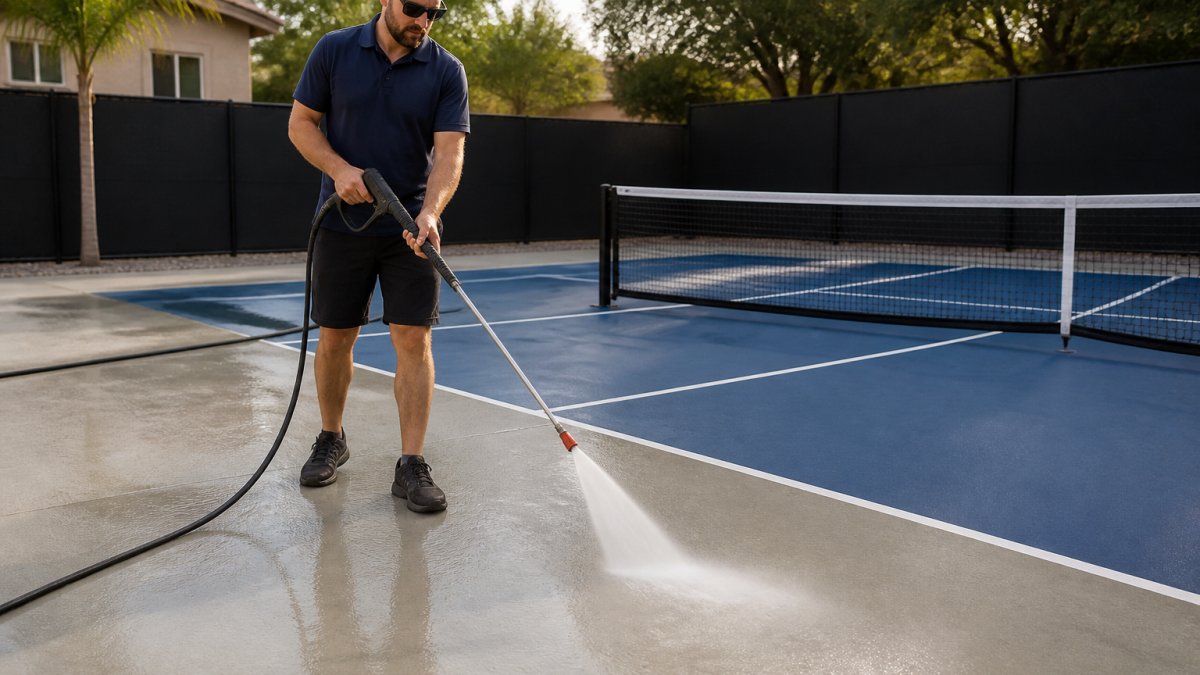
Use a pressure washer to remove dirt, algae, moss, and loose material. For concrete, use 2000-3000 PSI. For asphalt, use 1500-2000 PSI to avoid divots.
After pressure washing, let the surface dry completely. Moisture trapped under paint causes adhesion failure and peeling. In humid climates, allow 48 hours of dry weather after washing before painting. Check the surface with a moisture meter if you have one, moisture content should be below 4% for concrete.
Inspect the surface for cracks, potholes, or damaged areas. Fill cracks in concrete with concrete filler and allow it to cure fully. For asphalt, use asphalt patch material to fill holes or soft spots. These repairs prevent water from getting under the paint and causing failure.
If the court has existing paint or sealers, you may need to strip or abrade the surface. Some coatings don't bond well over old paint, especially if it's peeling or chalking. Light sanding or grinding improves adhesion for new coatings. For courts with heavy existing paint, consider grinding the surface to expose fresh substrate.
Pickleball Court Color Combinations and Ball Visibility
The colors you choose affect both playability and aesthetics. The best pickleball court color combinations maximize ball visibility while creating a court you enjoy looking at. Standard combinations pair a playing surface color with a court surround and line colors that make the ball stand out.
Most residential courts use a blue or green playing surface with a contrasting surround. Blue courts with green or tan surrounds create excellent contrast for yellow pickleball visibility. Green courts with blue or burgundy surrounds also work well. The key is choosing colors that make the yellow ball pop visually.
Court lines should contrast sharply with the playing surface. White lines on a blue court are crisp and easy to see. Yellow lines on a green court also provide good contrast. Avoid color combinations where the line color blends into the playing surface, this creates confusion during play.
Darker playing surfaces (forest green, navy blue) provide better ball visibility than lighter colors. Light courts reflect more heat and can be uncomfortable for players in summer, while darker courts absorb heat and can get too warm. For Carbondale courts, a medium-tone blue or green balances visibility and heat absorption.
The surround color serves both functional and aesthetic purposes. It frames the playing area and helps define the court boundaries. Lighter surrounds (tan, light gray) make courts feel more open. Darker surrounds (dark green, burgundy) make courts feel more enclosed and formal.
Common Mistakes to Avoid When Painting Your Residential Court
Understanding what not to do is as important as knowing what to do.
Painting over existing sealers without preparation is a common failure. Old sealers create a slick surface that new paint can't bond to. The result is peeling paint within months. Always strip or abrade old sealers before applying new paint.
Using paint designed for other applications, like deck paint or exterior house paint, is another mistake. Pickleball courts need high-solid acrylic coatings formulated for sports surfaces. These products include non-skid additives and flexibility that house paint lacks. Court-specific paints are worth the investment.
Applying paint in the wrong conditions causes adhesion problems. Paint in temperatures between 50-85°F with low humidity. Painting in direct sun or when rain is forecast invites failure. Allow proper drying time between coats, rushing this step leads to poor adhesion and peeling.
Skipping the primer or bonding agent on asphalt courts is a false economy. These products cost less than the topcoat but improve adhesion dramatically. Skipping them often leads to premature peeling that requires a complete repaint.
Using the wrong non-skid additive or applying it unevenly creates safety hazards. Uneven texture leads to slippery spots and inconsistent ball bounce. Follow manufacturer guidance for additive amounts and mixing. Apply coatings evenly with a roller or sprayer to ensure consistent texture.
How to Choose the Right Paint System for Your Home Court
Selecting the right pickleball court surface paints system requires evaluating your substrate, climate, budget, and maintenance tolerance. A systematic approach prevents costly mistakes.
Start by identifying your substrate. Is your court concrete or asphalt? This determines which coatings will perform best. Concrete courts can use a wider range of products. Asphalt courts need flexible, breathable coatings that accommodate substrate movement.
Consider your climate and weather exposure. Courts in humid climates with significant temperature swings need flexible coatings with good adhesion. Carbondale's freeze-thaw cycles and summer heat require paints that handle seasonal stress. UV resistance matters too, darker playing surfaces fade less than lighter ones.
Evaluate your maintenance capacity. Some coatings require annual sealing or regular maintenance. Others need only occasional cleaning and minor repairs. If you prefer low-maintenance options, choose systems rated for longer life with minimal upkeep.
Think about ball bounce and play consistency. High-quality acrylic coatings with proper non-skid additives deliver the most consistent ball response. Budget paints or poor application techniques lead to unpredictable bounce and player frustration.
Review coverage and application requirements. Some coatings require two or three coats. Others work as single-coat systems. Calculate the total material needed based on your court size. Sports Vista USA can help you determine quantities for your specific court dimensions.
| Factor | Concrete Courts | Asphalt Courts |
|---|---|---|
| Paint Type | High-solid acrylic | Flexible acrylic |
| Prep Work | Pressure wash, fill cracks | Pressure wash, patch soft spots |
| Primer Needed | Optional | Recommended |
| Expected Lifespan | 4-5 years | 2-3 years |
| Best For | Long-term durability | Budget-conscious installations |
| Maintenance | Annual inspection | Seasonal repairs likely |
Choosing the right pickleball court surface paint for your residential court in Carbondale or elsewhere comes down to matching the product to your substrate, climate, and expectations. Concrete courts with quality acrylic coatings deliver the longest service life. Asphalt courts need flexible, breathable systems that accommodate seasonal movement. Proper surface preparation is non-negotiable, it's the difference between a court that lasts three years and one that lasts five.
Sports Vista USA carries court equipment and accessories to complete your residential court setup. Whether you're building a new court or maintaining an existing one, we can help you find the right products and guidance for your specific situation. Check out our pickleball court systems and accessories to explore options that fit your needs.
Frequently Asked Questions
Can you paint a pickleball court on concrete?
Yes, concrete is one of the best substrates for pickleball court surface paint. Concrete provides a stable, durable base that holds acrylic coatings well when properly prepared. The surface must be clean, free of cracks, and sealed before application. Concrete courts offer excellent longevity and consistent ball bounce when painted with quality acrylic coating systems designed for sports surfaces.
What colors work well for a home pickleball court?
The best pickleball court color combinations balance player safety and ball visibility. Blue or green playing surfaces with contrasting court lines and surround colors are popular choices. Lighter court surrounds improve ball contrast and reduce glare, making it easier to track the ball during play. Choose colors that complement your residential setting while prioritizing visibility and player safety during both day and evening play.
How do you prepare a concrete surface for pickleball court paint?
Proper surface preparation is essential for paint adhesion and durability. Clean the concrete thoroughly with a pressure washer to remove dirt, algae, and debris. Allow the surface to dry completely. Fill any cracks or divots with appropriate concrete repair compound. Sand or grind the surface to improve coating adhesion, then apply a primer or sealer as recommended by the paint manufacturer. This foundation ensures your pickleball court paint lasts for years.
What is the difference between acrylic coating and other pickleball court paints?
Acrylic coating systems are the industry standard for pickleball courts because they offer excellent durability, traction, and weather resistance. High-solid acrylic coatings provide superior ball bounce consistency and non-skid properties compared to single-layer paints. Acrylic systems also cure faster, resist UV damage, and maintain color vibrancy over time. They're specifically formulated for sports surfaces, making them ideal for residential courts that see regular play.


Leave a comment
This site is protected by hCaptcha and the hCaptcha Privacy Policy and Terms of Service apply.