


Table of Contents
- Understand Portable Pickleball Net System Basics
- Portable Pickleball Net Dimensions and Regulation Standards
- Key Portable Pickleball Net System Features to Evaluate
- Portable vs Permanent Pickleball Net: Which Is Right for You
- Setup, Assembly, and Ease of Use
- Portable Pickleball Net Storage Bag and Transport Options
- Select the Right System for Your Needs
- Conclusion
- Frequently Asked Questions
Last Updated: October 7, 2026
Understand Portable Pickleball Net System Basics
A portable pickleball net system is a lightweight, collapsible frame with an attached net designed for quick setup and takedown without permanent installation. These systems let you play regulation pickleball anywhere, driveways, parks, gyms, or community spaces, then pack them away when you're done.

The appeal is straightforward: flexibility. You're not locked into a single court location. You can move your net between surfaces, store it in a garage, and set it up in minutes. This makes portable systems ideal for homeowners in Carbondale who want to practice without committing to permanent court construction, as well as schools, recreation centers, and facilities that need equipment they can relocate or remove seasonally.
The trade-off is stability and durability compared to permanently installed systems. A portable net relies on its frame weight, base design, and net tension to stay upright in wind and handle repeated use. Understanding what makes one system better than another comes down to evaluating frame materials, setup speed, portability, and how well it performs on different court surfaces.
Portable Pickleball Net Dimensions and Regulation Standards
Regulation pickleball nets have specific dimensions set by the sport's governing bodies. The standard is 36 inches high and 22 feet wide, the full width of a pickleball court. If a net doesn't meet these measurements, you're not playing by official rules, which matters if you're hosting matches or training seriously.
The 36-inch height is measured at the center of the net. Many portable systems maintain this height across the entire width, though some budget models sag slightly in the middle without proper center support.
Some portable systems come in smaller versions, 11-foot half-court nets for driveways or skill drills. These are useful for casual play and practice, but they don't meet regulation standards. Know which you need before buying. If you're setting up for competitive play or want the option to host matches, regulation size is non-negotiable.
Measure your intended court space before ordering. A regulation net needs 22 feet of clear space plus room for players to move. Carbondale driveways and park areas vary in size, so verify you have adequate space. If you're tight on room, a half-court system might be your only practical option, but understand the trade-off.
Key Portable Pickleball Net System Features to Evaluate
Frame Material and Durability
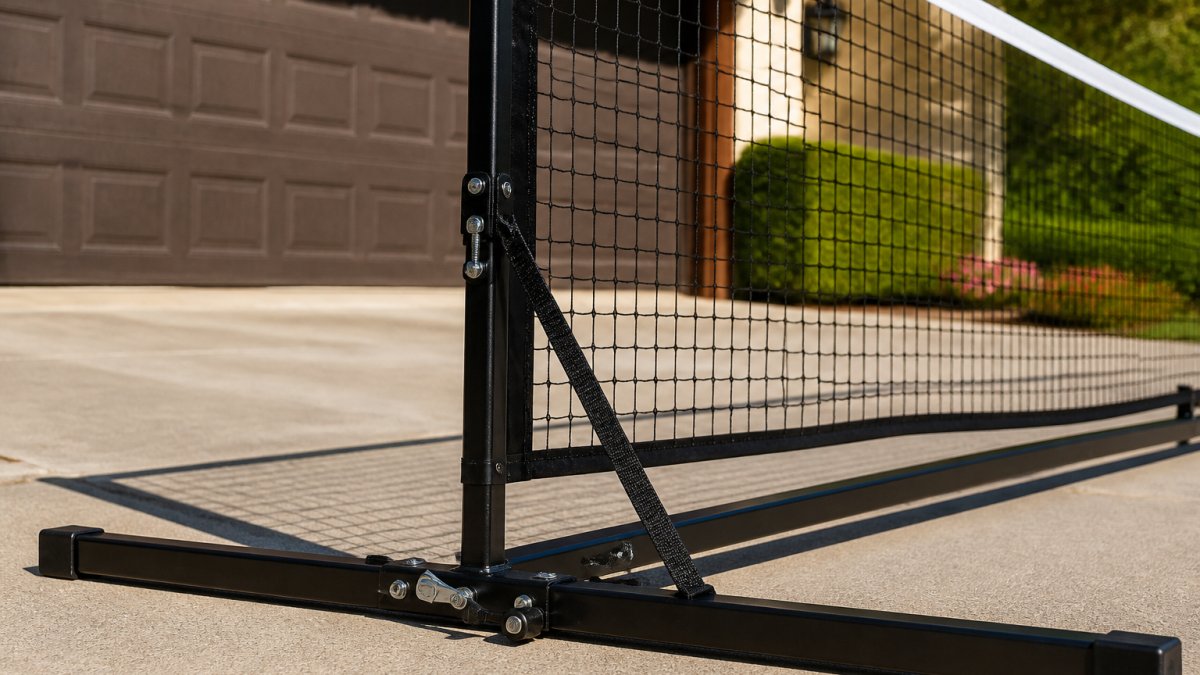
The frame is the backbone of your portable pickleball net system. Most quality systems use powder-coated steel, which resists rust and handles repeated setup cycles better than bare metal or aluminum. Steel is heavier than aluminum, but the added weight improves stability, a critical advantage in wind.

Look for frames with reinforced joints and locking mechanisms that won't loosen over time. Collapsible frames should snap or lock into place securely without wobbling. Cheap hinges and fasteners fail quickly, especially if you're setting up and taking down frequently.
Powder coating matters. It protects steel from moisture and UV damage, extending the frame's lifespan. If you're storing your net outdoors or in humid conditions, a quality powder coat finish prevents rust that can compromise structural integrity.
Net Tension and Center Support
A sagging net is unusable. The net must stay taut across its full 22-foot width to meet regulation standards and provide consistent play. This is where center support becomes critical.
A center strap or support post runs down the middle of the net, anchoring it to the frame at the 36-inch height. Without proper center support, the net sags in the middle, creating an uneven playing surface. Some systems use a single center strap; others have reinforced posts or multiple attachment points.
The net material itself matters too. Quality portable systems use 18-ply polyethylene (PE) netting, which resists fraying and maintains its shape. Thinner netting stretches and sags faster, especially in sun and wind.
Stability in Wind and on Different Surfaces
Portable systems rely on frame weight and base design for stability. Heavier frames (typically 20-30 pounds) resist tipping better than lightweight alternatives, especially in wind. The base, whether it's a wide footprint, weighted legs, or locking wheels, determines how well the system stays put on different surfaces.
Wind is a real concern in Carbondale and across Illinois. A portable net in an open park can catch wind like a sail. Systems with wider base footprints or weighted feet perform better in breezy conditions. Some premium systems include locking wheels or anchoring points for additional security.
Surface matters too. A driveway provides a stable, flat base. Grass, gravel, or uneven ground demands a system with adjustable feet or a design that accommodates slight slopes. Concrete and gym floors are ideal, but not every location offers that.
Consider where you'll use your net most often. If it's always on the same driveway, a lighter system with a modest base might work. If you're moving it between locations or setting up in parks, invest in a more stable design.
Portable vs Permanent Pickleball Net: Which Is Right for You
The choice between portable and permanent depends on your commitment level and space constraints. A portable pickleball net system is right if you want flexibility, don't have a dedicated court, or play casually. You set it up when you want to play and store it away afterward.

Permanent nets are installed on fixed posts, either surface-mounted or in-ground. They stay in place year-round, require no setup, and offer superior stability and durability. They're ideal for schools, recreation centers, or homeowners with a dedicated court space in Carbondale who play frequently.
Portable systems require no installation. Permanent systems demand more investment and commitment but eliminate setup hassle and offer better long-term durability. If you're unsure whether pickleball will stick as a hobby, portable is the safer bet. If you're confident you'll play regularly and have a permanent space available, permanent installation makes sense.
Think about storage too. Portable systems need a garage, shed, or storage area. Permanent nets don't require storage space but take up dedicated court real estate.
Srikel FlashCourt Pickleball Net 3.0 | Portable Regulation Net →
Setup, Assembly, and Ease of Use
The best portable pickleball net system is one you'll actually use. If setup takes 30 minutes and requires tools, you'll be less likely to play spontaneously. Quality portable systems are designed for speed.
Most modern portable systems feature collapsible frames that fold down and lock into place with a push-button or snap mechanism. No tools required. Setup should take 60 seconds or less once you're familiar with the process. Takedown is equally fast.
Check the manufacturer's specifications for setup time. If you're setting up frequently, multiple times per week, even small time differences add up.
Consider the carry bag too. A quality portable pickleball net system includes a sturdy carrying bag that makes transport practical. A flimsy bag means you'll be wrestling with loose parts, which discourages use.
If you have mobility limitations or limited upper-body strength, lighter systems are more practical. Most quality portable systems weigh between 17 and 30 pounds, which is manageable for most people but still requires effort to carry and position.
Portable Pickleball Net Storage Bag and Transport Options
How you store and transport your portable pickleball net system affects how often you actually use it. A net that's easy to store and carry gets used more.
Quality systems include a dedicated carry bag, typically made from durable polyester (600D or higher). The bag should protect the frame and net from damage during storage and transport. It should also be compact enough to fit in a car trunk or closet without taking up excessive space.
Packaged dimensions matter. Larger folded dimensions mean you'll need a truck or SUV, which limits when and where you can play.
Some portable systems include wheels or handles for easier transport. Locking wheels let you roll the system rather than carry it, which is useful if you're moving it frequently between locations or if you have strength limitations.
Store your net in a dry location. Moisture promotes rust on steel frames and mildew on netting. A garage or climate-controlled shed is ideal. Avoid leaving it outside year-round, even if the frame is powder-coated.
Select the Right System for Your Needs
Choosing the right portable pickleball net system comes down to matching features to your actual use case. Here's a practical framework:
| Use Case | Best Option | Key Reason |
|---|---|---|
| Casual driveway play, occasional use | Half-court or lightweight regulation net | Low cost, easy storage, minimal setup |
| Regular play, single location | Regulation-size portable system | Full court size, good stability, reasonable portability |
| Frequent moves between locations | Lightweight regulation net with wheels | Portability without sacrificing regulation dimensions |
| School or facility with multiple courts | Heavy-duty portable system | Durability, stability, supports frequent setup cycles |
| Competitive or match play | Regulation-size system with reinforced center support | Meets official standards, maintains net tension reliably |
Start by asking: How often will I play? Where will I set it up? Do I need regulation size, or is a half-court acceptable? Will I move it frequently?
Frequent players who move their net often need a lightweight system with solid stability, something like the Srikel FlashCourt Pickleball Net 3.0, which combines regulation dimensions (36 inches high by 22 feet wide) with fast setup and a portable weight of approximately 24.8 lbs. The powder-coated steel frame and reinforced center support maintain net tension reliably, and the included carry bag makes transport practical.
If you're playing casually in a confined space, the Srikel FlashCourt Mini 11' Portable Pickleball Net works well. It's lighter (approximately 17.8 lbs.) and more affordable, though it's only 11 feet wide, suitable for drills and casual play, not regulation matches.
For facilities and schools in Carbondale that need durability and stability for frequent use, the First Team Scorpion Portable Pickleball Set offers heavy-duty construction with weighted bases and non-marking wheels. It's built for institutional use and handles repeated setup cycles without degradation.
Sports Vista USA carries all these options, allowing you to compare regulation-size systems and half-court alternatives to find the right fit for your situation.
Conclusion
Choosing a portable pickleball net system doesn't require expensive trial and error. Focus on frame durability, net tension, and stability in wind. Match regulation dimensions (36 inches high by 22 feet wide) to your competitive needs. Prioritize setup speed and storage practicality based on how often you'll use it.
At Sports Vista USA, we help you compare portable pickleball net systems from trusted manufacturers. Whether you need a lightweight regulation net for frequent moves, a heavy-duty system for institutional use, or a half-court net for casual play, we carry options designed for serious play. Check out our selection of portable pickleball net systems and find the right equipment for your court in Carbondale and beyond.
Frequently Asked Questions
What are the official dimensions of a portable pickleball net?
Regulation portable pickleball nets are 36 inches high and 22 feet wide. Some compact options, like half-court systems, are 36 inches high and 11 feet wide, ideal for driveways or practice drills. Always verify dimensions match your playing space and whether you need full-width regulation play or a smaller setup for casual games.
How do I know if a portable pickleball net system will be stable enough for outdoor play?
Look for weighted bases, wide stance frames, and center support systems designed to reduce sagging. Powder-coated steel frames and reinforced center straps indicate durability.
What's the difference between a portable and permanent pickleball net?
Portable systems are lightweight, collapsible, and designed for quick setup and takedown without tools. They're ideal for driveways, parks, and shared spaces. Permanent nets are installed in fixed locations with concrete footings or anchors, offering maximum stability for dedicated courts. Choose portable if you need flexibility and easy storage; choose permanent for a dedicated court that stays in one location.
How long does it take to set up and store a portable pickleball net system?
Quality portable systems typically set up in 60 seconds or less with no tools required. Takedown is equally fast. The frame collapses and fits into a carry bag for storage and transport. Always review product setup guides to confirm timing matches your needs.


Leave a comment
This site is protected by hCaptcha and the hCaptcha Privacy Policy and Terms of Service apply.