


Table of Contents
- What Core Materials Actually Determine Paddle Longevity
- Polymer Honeycomb vs Foam Core: Which Lasts Longer
- Carbon Fiber vs Raw Carbon Fiber Face Materials
- Nomex vs Polymer Pickleball Paddle Construction
- How Long Do Pickleball Paddles Last in Regular Play
- Key Pickleball Paddle Durability Factors That Matter Most
- Repair vs Replace: When to Retire Your Paddle
- Choosing a Durable Paddle That Matches Your Play Style
- Frequently Asked Questions
Last Updated: October 6, 2026
What Core Materials Actually Determine Paddle Longevity
Your paddle's core, the internal structure sandwiched between the face and edge guard, determines how long it performs before degradation sets in. Understanding pickleball paddle core materials is the first step toward an investment that lasts multiple seasons instead of crumbling after a few months.

Core compression changes how your paddle responds to impact and how it wears. Manufacturing precision matters equally: paddles made with tight tolerances maintain their structure longer because the materials bond more effectively, while loose tolerances let the core separate or crack prematurely.
The paddles we carry at Sports Vista USA use materials designed for durability: polymer honeycomb cores, polypropylene honeycomb with EVA reinforcement, and composite faces that resist surface grit wear.
How Core Compression Affects Performance and Wear
Compression determines how densely packed the core is. Higher compression creates a stiffer, faster-responding paddle, but compressed cores fatigue faster under extreme impact because the material has less give.
Lower compression cores feel softer, absorb shock better, and reduce arm strain, but degrade more visibly because the material flexes repeatedly and loses its shape. Most players do best with balanced compression that offers both responsiveness and longevity.
Manufacturing Precision and Its Impact on Durability
Tight tolerances mean the core, face, and edge guard bond securely and move as one unit. Loose tolerances allow micro-gaps that become delamination, and once layers start separating, structural integrity fails quickly.
Thermoformed construction, used in paddles like the Warping Point Neon Gen 3, creates a unibody design where all components fuse together. This manufacturing method improves edge stability and reduces vibration because there are fewer weak points where layers can separate.
Polymer Honeycomb vs Foam Core: Which Lasts Longer
Polymer honeycomb cores dominate the market because they balance durability, performance, and cost, absorbing shock while staying stiff. Larger honeycomb cells mean a lighter but less durable paddle under sustained impact.
Foam cores, less common in modern paddles, degrade faster. Foam suffers compression set, meaning it doesn't fully bounce back after repeated compression, so it loses cushioning and responsiveness. Foam also absorbs moisture more readily, causing swelling and delamination in humid climates.
Honeycomb Cell Structure and Shock Absorption
Smaller, denser honeycomb cells absorb shock better because they distribute force across more material; larger cells reduce weight but sacrifice durability.
Polypropylene honeycomb is the most common core today: lightweight, affordable, and versatile. High-density EVA reinforcement around the perimeter, like in the Warping Point Neon Gen 3, adds edge stability, extends the sweet spot, and prevents edge guard failure.

Foam Core Degradation Patterns
Foam cores wear through compression set and surface softening, becoming less responsive with age. Foam also cracks or crumbles under temperature extremes or high humidity, failing faster than honeycomb in warm, humid climates.
Foam also wicks water more readily than honeycomb, leading to delamination when exposed to rain or humidity, which is why honeycomb has largely replaced it in quality paddles.
Carbon Fiber vs Raw Carbon Fiber Face Materials
The face material determines spin retention, durability, and feel at contact, and carbon fiber grades and finishes each have different longevity profiles.
Raw T700 carbon fiber, used in the Grasp Pickleball Paddle and Warping Point Neon Gen 3, provides excellent spin and durability.
Aramid fiber, like in the Niupipo SWORD&SHIELD J2K+, offers exceptional strength and stiffness and resists delamination better than pure carbon because it's more flexible. Hybrid aramid-carbon paddles combine aramid's strength with carbon's spin control.

Surface Grit Wear and Spin Retention Over Time
Surface grit is the texture of the paddle face.
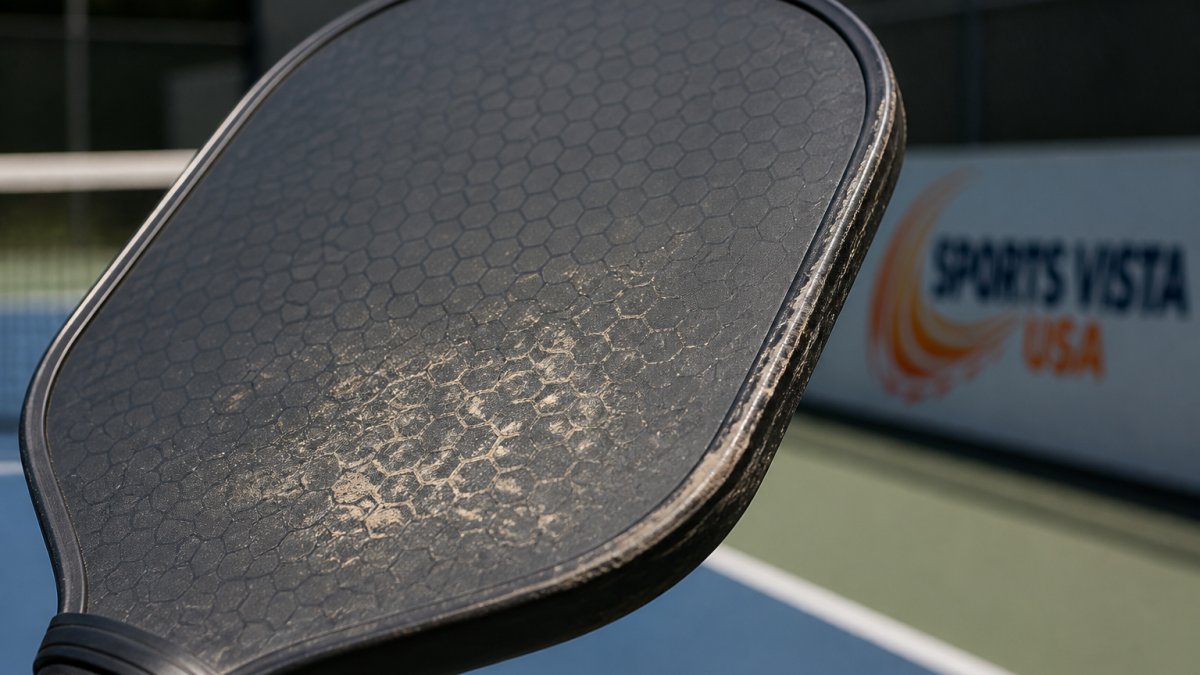
Textured carbon fiber faces wear faster than smooth ones because the peaks erode with each strike.
Raw carbon fiber maintains texture longer than coated finishes because the weave itself is the texture; once a coated finish's resin layer wears through, the underlying material is exposed.
Delamination and Edge Guard Failure
Delamination occurs when the face separates from the core because the adhesive bond fails, usually from manufacturing defects or repeated impact stress. Once it starts, the layers keep separating and the paddle loses structural integrity.
Edge guard failure is equally problematic: the guard protects the core from impact and moisture, so when it cracks or separates, moisture enters, the core swells or softens, and the paddle fails. Quality edge guards on thermoformed paddles resist this longer because they're bonded more securely.
Nomex vs Polymer Pickleball Paddle Construction
Nomex is a synthetic core material that's extremely durable and heat-resistant, but heavier than polymer honeycomb, which is why it's less common in recreational paddles.
Nomex appeals to players who prioritize durability over weight, but for most recreational players polymer honeycomb offers a better balance of durability and playability.
The longevity difference between Nomex and polymer honeycomb is often overstated; both can last years with proper care.
How Long Do Pickleball Paddles Last in Regular Play
A typical paddle lasts one to three years with regular play (2-4 times per week), depending on material quality; daily players see degradation faster.
Timelines vary by core material and construction: quality polymer honeycomb paddles often reach the higher end of that range, while foam cores degrade faster, sometimes losing performance within a year.
Niupipo SWORD&SHIELD J2K+ 16mm Aramid Fiber Pickleball Paddle →
Paddle Degradation Timelines by Material Type
Raw carbon fiber faces hold texture longer than coated finishes: a raw carbon paddle might keep good spin control for 18-24 months, while a coated finish may lose grip noticeably by month 12.
Aramid fiber paddles resist core degradation well because the material is more flexible than pure carbon, absorbing impact better and cracking less often.
When Core Cracking and Material Fatigue Appear
Core cracking usually follows significant impact stress or temperature extremes. A paddle repeatedly hit against a hard court edge cracks faster than one used on soft courts, and thermal expansion and contraction, like a paddle left in a hot car then taken into air conditioning, can trigger cracks.
Material fatigue in honeycomb cores shows up as permanent compression: cells don't spring back fully, reducing responsiveness and feel. It typically appears after 12-18 months of regular play, faster for aggressive power players.
Key Pickleball Paddle Durability Factors That Matter Most
Three factors dominate paddle longevity: material quality, manufacturing precision, and how you use the paddle. You can't control precision after purchase, but you can choose paddles made with proven materials and construction methods.
Thermal Expansion and Climate-Specific Degradation
Temperature swings cause materials to expand and contract. In climates with large seasonal differences, paddles experience more stress: one stored in a garage that reaches 100°F in summer and freezing in winter degrades faster than one kept at stable temperature.
Humidity matters too: it causes moisture absorption in foam cores and weakens adhesive bonds. In humid areas, choose polymer honeycomb over foam and store your paddle in a climate-controlled space.
Impact Resistance and Vibration Dampening
Paddles with better vibration dampening feel more comfortable and last longer, since vibration signals impact stress traveling through the paddle and accelerates material fatigue. Thermoformed construction and EVA reinforcement both reduce vibration.
Impact resistance depends on core material and thickness. A 16mm paddle has more material to absorb impact than a 13mm paddle, so it generally lasts longer. Thicker cores are heavier, but for players prioritizing durability, the trade-off is worth it.
Tensile Strength and Composite Material Quality
Tensile strength is a material's ability to resist pulling forces, so higher tensile strength means less tearing or separation under stress.
Composite quality varies by manufacturer: premium paddles use high-grade resin and precise fiber alignment, while budget paddles sometimes use lower-grade materials that degrade faster. A premium paddle might last twice as long as a budget model.
Repair vs Replace: When to Retire Your Paddle
Repairing a paddle is rarely worth it. Once the core delaminates or cracks, structural integrity is compromised, and epoxy repairs for edge guard failure are only temporary.
Prevention is the best approach: store your paddle in a climate-controlled space and avoid impacts with hard surfaces. When spin retention drops or responsiveness changes noticeably, it's time to replace it.
A new paddle costs significantly less than repeated repairs, so replacing every 1-3 years is more practical than attempting them.
Choosing a Durable Paddle That Matches Your Play Style
Your play style determines which durability features matter most: power players stress the core with hard impacts, while control players stress the surface with repeated spin shots. Knowing your style helps you pick a paddle built for your demands.
Power Players and Durability Trade-Offs
Power players need paddles that absorb impact without cracking: look for thicker cores (16mm rather than 13mm) and good shock absorption. Polypropylene honeycomb with EVA reinforcement, like in the Warping Point Neon Gen 3, handles those demands well.
Power-focused paddles sometimes trade surface texture for durability, since a smoother face wears slower than a highly textured one. The Warping Point Ascent Power model is built for players prioritizing power, with construction that supports aggressive impact stress.
Control-Focused Paddles and Long-Term Performance
Control players emphasize spin and placement over power, stressing surface texture more than the core.
The Warping Point Ascent Control model balances playability and durability for control-focused players, with 16mm construction that provides forgiveness without sacrificing finesse-shot responsiveness.
| Material Type | Typical Lifespan | Best For | Durability Notes |
|---|---|---|---|
| Polymer Honeycomb | 12-24 months | Most players | Good balance of durability and performance |
| Polypropylene + EVA | 18-24 months | Power players | EVA reinforcement extends edge durability |
| Aramid-Carbon Hybrid | 18-30 months | Control players | Aramid fiber adds flexibility and crack resistance |
| Raw Carbon Fiber | 12-18 months | Spin-focused players | Excellent texture retention but surface wear visible |
| Foam Core | 6-12 months | Casual players | Fastest degradation in humid climates |
Paddle durability comes down to material choice, manufacturing quality, and use.
At Sports Vista USA, we carry paddles built with these durable materials.
Frequently Asked Questions
What core material lasts longest in a pickleball paddle?
Polymer honeycomb cores generally outlast foam cores because their cell structure resists compression and maintains structural integrity through repeated impact. The honeycomb design distributes force across interconnected cells, slowing material fatigue. High-grade resin formulations and thermoformed construction further extend longevity. Paddles like the Warping Point Neon Gen 3 combine polypropylene honeycomb with EVA-reinforced edges for enhanced durability compared to basic foam alternatives.
How do pickleball paddle durability factors affect how long your paddle lasts?
Durability depends on core compression resistance, manufacturing tolerances, face material quality, and thermal stability. Paddles experiencing high core compression wear out faster because the material loses its shock-absorption properties. Manufacturing precision determines how well the face bonds to the core, poor tolerances lead to delamination. Climate extremes cause thermal expansion and contraction, accelerating degradation. Paddles with raw T700 carbon-fiber faces and textured surfaces retain spin longer but require consistent care.
Is foam core better than honeycomb for paddle longevity?
No. Honeycomb cores outlast foam cores. Foam compresses permanently under repeated impact, losing its pop and shock absorption within months of regular play. Honeycomb cells maintain their structure longer because force distributes across the interconnected network rather than crushing individual material layers. Paddles using polymer honeycomb construction, like the Grasp Paddle with its 16mm core, provide superior durability and more consistent performance over time compared to foam-core alternatives.
When should you replace a pickleball paddle instead of repairing it?
Replace when core cracking appears, delamination spreads beyond the edge guard, or the sweet spot shrinks noticeably. Minor surface grit wear can sometimes be managed, but once structural damage reaches the core, performance degrades irreversibly. If your paddle loses responsiveness or generates inconsistent spin despite regular play, the core has likely fatigued. Most paddles lose playability within 1-3 years of heavy use, depending on material quality and play intensity.

Leave a comment
This site is protected by hCaptcha and the hCaptcha Privacy Policy and Terms of Service apply.