

Table of Contents
- Understanding Glare on Outdoor Pickleball Courts
- Step 1: Assess Your Current Lighting Setup
- Step 2: Install Full-Cutoff and Shielded Lighting Fixtures
- Step 3: Choose the Right Pickleball Court Surface Coatings
- Step 4: Optimize Court Orientation North to South
- Step 5: Add Shade Management and Strategic Light Shields
- Step 6: Use Polarized Lenses and UV Protection Eyewear
- Common Mistakes to Avoid When Fixing Glare
Last Updated: August 25, 2026
Understanding Glare on Outdoor Pickleball Courts
Glare on outdoor pickleball courts degrades visual acuity and makes tracking the ball nearly impossible during peak play times. Light trespass (illumination spreading beyond the playing area) and light spill (scattered light in unintended directions) are the technical culprits. Both reduce contrast sensitivity, the ability to distinguish the ball against the background, and cause visual fatigue during extended play.
Light trespass bounces off surrounding surfaces like fences, buildings, or parked cars and reflects back onto the court at unpredictable angles. The solution requires controlling light direction at the source. Full-cutoff fixtures, designed to direct all light downward onto the playing surface, eliminate most light spill before it starts.
Why court surface reflectivity matters
Not all court surfaces handle light the same way. A glossy finish reflects 30-40% of incident light, creating mirror-like glare that bounces directly into players' eyes (peer-reviewed research). A matte finish absorbs more light and reflects only 10-20%, lowering overall glare intensity significantly. This difference is substantial: a matte court with the same lighting setup will feel noticeably less glaring than a glossy court.
Lighter colored courts (blues, grays) tend to have higher reflectivity than darker surfaces. If your court has a glossy light-colored finish, you're dealing with maximum glare potential and will need multiple glare-reduction strategies working together.
Step 1: Assess Your Current Lighting Setup
Before making changes, understand what you're working with. A proper assessment identifies which times of day cause the most problems and whether the issue stems from natural sunlight, artificial lighting, or both.
Measuring foot-candles and light distribution
Foot-candles measure the intensity of light falling on a surface. For outdoor pickleball courts, the recommended standard is 30-50 foot-candles during play, with even distribution across the playing area. Uneven distribution creates glare hot spots and shadows that confuse depth perception.
Observe your court at different times:
- Early morning (6-8 AM): Note if sunlight creates long shadows or glare from the east
- Midday (11 AM-1 PM): Check if the sun is directly overhead and whether shadows are minimal
- Late afternoon (4-6 PM): Identify if western sunlight creates intense glare
- Evening (after sunset): Evaluate artificial lighting quality and uniformity
Take photos from the player's perspective (standing at the baseline looking toward the net) at each time period. These photos document your baseline conditions and help you track improvements after implementation.
Identifying problem times and angles
The angle of light matters more than its intensity. Light from directly behind a player creates backlit conditions that make the ball harder to see. Light from the side creates shadows that interfere with depth perception. Light from above, when properly directed, minimizes these problems.
Create a simple chart documenting when glare is worst:
| Time of Day | Light Source | Severity (1-10) | Direction |
|---|---|---|---|
| 6-8 AM | Natural sunlight | 7 | East |
| 11 AM-1 PM | Natural sunlight | 4 | Overhead |
| 4-6 PM | Natural sunlight | 9 | West |
| 7-9 PM | Artificial | 6 | Variable |
This assessment guides your priorities. If afternoon western sun is your worst problem, orienting your court north-to-south becomes critical. If evening artificial lighting is the issue, fixture upgrades become the priority.
Step 2: Install Full-Cutoff and Shielded Lighting Fixtures
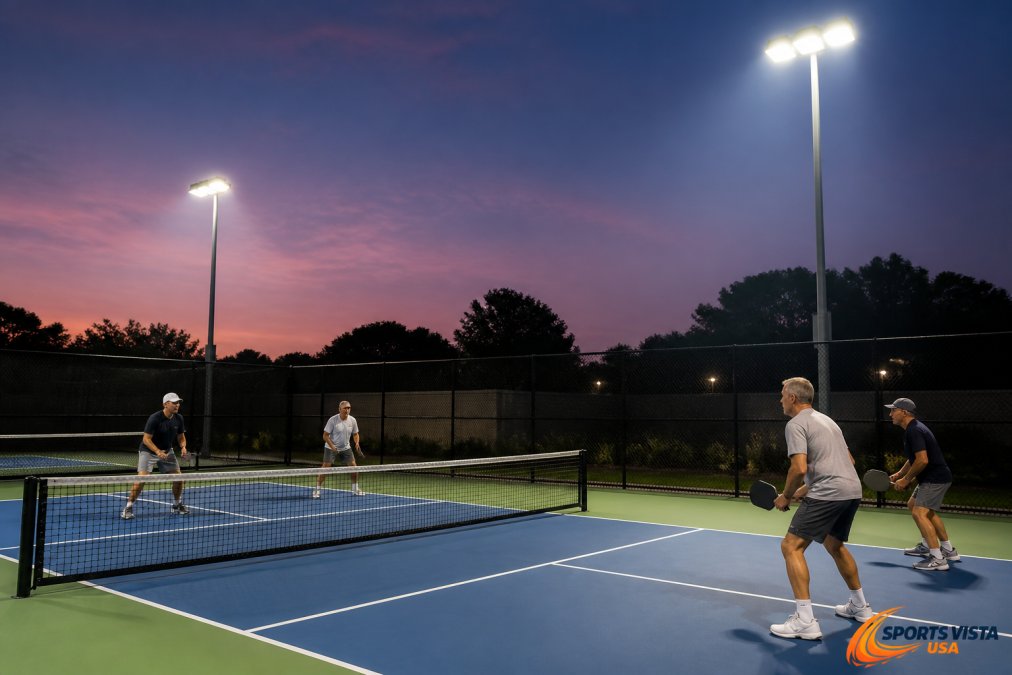
Full-cutoff fixtures are the single most effective tool for eliminating unwanted light scatter. Unlike traditional fixtures that emit light in all directions, full-cutoff designs use internal shields to direct all light downward onto the playing surface.
Fixture mounting height and beam angle
The height at which you mount fixtures directly affects the beam angle, the spread of light as it reaches the court. For outdoor pickleball courts, mounting heights typically range from 20 to 35 feet. At 25 feet, a properly designed full-cutoff fixture with a 60-degree beam angle covers approximately 60-70% of a standard court width, with overlap from adjacent fixtures creating uniform coverage.
A 60-degree beam provides good uniformity for courts 30-40 feet wide. A 40-degree beam works better for narrower courts or closer positioning. An 80-degree beam spreads light wider but creates more spillage at the edges. Matching fixture specifications to your court dimensions ensures light falls primarily on the playing surface with minimal spillage beyond the court boundaries.
LED efficiency and light quality
Modern LED fixtures offer significant advantages over older halogen or metal halide systems. LEDs produce less heat, operate more efficiently, and allow for better directional control through precise optical design. They also enable dimming capabilities, allowing you to adjust light levels based on time of day or season.
Pickleball players perform best with neutral white light (4000-5000K color temperature), which provides good contrast for ball tracking. When selecting LED fixtures, prioritize those specifically designed for sports court lighting. These fixtures undergo photometric testing to verify beam distribution, uniformity, and glare reduction.
Step 3: Choose the Right Pickleball Court Surface Coatings
Your court surface is a critical component of glare management. The coating you select influences both reflectivity and visual comfort during play.
Matte versus glossy finishes and reflectivity
Matte finishes absorb more light and scatter what they do reflect in multiple directions, reducing the intensity of glare reaching players' eyes. They provide consistent visual conditions throughout the day and are generally preferred for outdoor courts where you're managing both natural and artificial light.
Glossy finishes create mirror-like reflections that bounce light directly back toward the source and toward players' eyes. While glossy surfaces can look more professional and are easier to clean, they significantly amplify glare problems, especially when combined with bright artificial lighting or during afternoon sun exposure.
Acrylic-based matte coatings are the standard for outdoor pickleball courts. They provide good durability, UV protection, and consistent light-scattering properties. When selecting a coating, specify matte finish explicitly, some contractors default to glossy unless you request otherwise.
Step 4: Optimize Court Orientation North to South
Court orientation is one of the most overlooked glare solutions, yet it's one of the most effective. A north-to-south orientation positions the court so that sunlight approaches from the east (morning) and west (afternoon), rather than directly across the court. This minimizes the times when players are looking directly into the sun or dealing with harsh shadows across the court surface.
When a court is oriented east-to-west, players face into the sun during either morning or afternoon play. A north-to-south court keeps the sun to the sides, where it's less disruptive to play. If your court is already oriented east-to-west, the other glare-reduction strategies become even more important to compensate.
Step 5: Add Shade Management and Strategic Light Shields
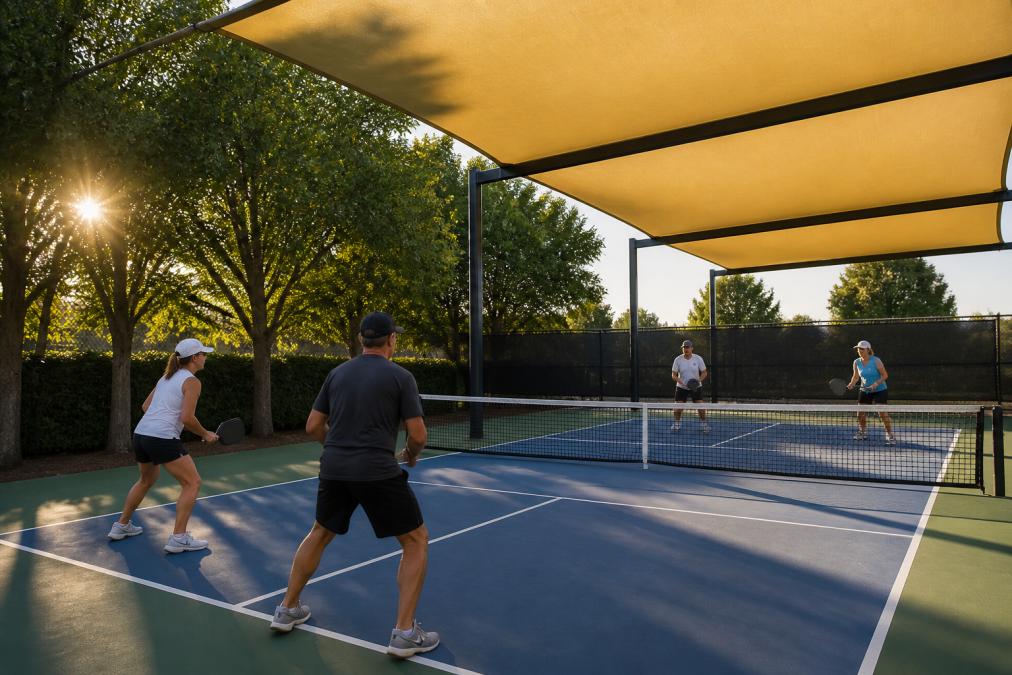
Shade structures and light shields provide targeted glare reduction by blocking direct sunlight or controlling artificial light direction.
DIY versus professional installation
DIY shade solutions include planting trees on the western side of your court (for afternoon sun blocking), installing shade cloth structures, or adding pergolas. These approaches are accessible for homeowners and require minimal technical expertise. Trees take years to mature, but shade cloth and pergolas can be deployed quickly.
Professional installation of permanent shade structures or sophisticated light-shielding systems offers better durability and engineering precision. Professional installers can design shade structures that block problem sun angles while maintaining adequate ventilation.
For residential courts, a hybrid approach often works best: plant trees or install permanent pergolas for natural shade, and use professional-grade light shields for artificial lighting fixtures. This combination provides year-round glare reduction without over-relying on any single solution.
Step 6: Use Polarized Lenses and UV Protection Eyewear
While you're managing the court environment, protecting your eyes during play is equally important. Eyewear designed for outdoor sports reduces visual fatigue and improves performance.
How polarized versus non-polarized lenses reduce visual fatigue
Polarized lenses contain a special filter that blocks reflected light waves, which is exactly what causes glare. When sunlight reflects off water, sand, or shiny court surfaces, it becomes horizontally polarized. Polarized lenses have a vertical filter that blocks these horizontal waves, dramatically reducing glare intensity.
Non-polarized lenses simply darken all light equally. They reduce overall brightness but don't specifically target the reflected light that causes glare. Players wearing polarized lenses report better ball tracking, reduced eye strain, and improved depth perception compared to non-polarized alternatives.
UV protection is equally important. Outdoor play exposes your eyes to ultraviolet radiation, which causes cumulative damage over time. Quality eyewear blocks 100% of UVA and UVB rays, protecting against cataracts and other long-term eye health issues (nei.nih.gov).
When selecting eyewear for pickleball, look for frames designed for court sports, which typically have better peripheral vision coverage and secure fitting. Amber or brown lenses enhance contrast and are preferred for outdoor court sports.
Common Mistakes to Avoid When Fixing Glare
Understanding what doesn't work helps you avoid wasting time and resources on ineffective solutions.
Assuming more light solves glare problems. Brightness without proper direction makes glare worse. A 100-foot-candle fixture with poor shielding creates more glare than a 50-foot-candle fixture with full-cutoff design. Focus on fixture quality and direction, not raw brightness.
Installing fixtures without considering beam angle. Fixtures with the wrong beam angle for your court dimensions create hot spots and dark areas. Uneven lighting is often more problematic than insufficient lighting. Always match fixture specifications to your court size before installation.
Ignoring surface reflectivity when upgrading lighting. You can install perfect fixtures on a glossy court and still deal with significant glare. The surface and lighting system must work together.
Neglecting seasonal sun angle changes. A solution that works perfectly in summer might be inadequate in winter when the sun is lower on the horizon. Design your glare solutions to handle year-round conditions.
Overlooking neighbor impact. Light trespass affects adjacent properties and can create legal issues or community tension. Full-cutoff fixtures and proper positioning are about being a responsible neighbor in residential areas.
Skipping the assessment phase. Jumping directly to solutions without understanding your specific glare problems often results in addressing the wrong issues. Spend time documenting when and where glare is worst before implementing fixes.
Fixing glare on outdoor pickleball courts requires a systematic approach that addresses lighting design, surface properties, court orientation, and player protection together. The most effective solutions combine full-cutoff fixtures that direct light precisely onto the playing surface, matte court coatings that minimize reflectivity, strategic shade management, and north-to-south court orientation when possible.
Sports Vista USA provides the lighting fixtures, court equipment, and accessories needed to create high-quality playing environments. Proper glare management improves both performance and safety while respecting neighboring properties. Check out Sports Vista USA's court lighting and equipment collection to find solutions matched to your court size and specific glare challenges.
Frequently Asked Questions
What type of paint reduces glare on outdoor pickleball courts?
Matte or satin-finish court surface coatings significantly reduce glare compared to glossy options. These finishes lower surface reflectivity, which minimizes harsh light bouncing off the court. Many facilities choose acrylic or polyurethane coatings with built-in UV protection and anti-slip properties. The specific product choice depends on your climate, budget, and maintenance preferences.
How does court orientation affect glare for outdoor pickleball?
A north-to-south court orientation minimizes direct sun exposure during peak playing hours. When courts run east-west, players face the sun's path across the sky, creating significant glare in morning and evening sessions. North-to-south alignment reduces this problem substantially. If you cannot reorient an existing court, shade structures, strategic lighting, and polarized eyewear become more critical to managing glare effectively.
What are the best anti-glare solutions for outdoor pickleball courts?
The most effective approach combines multiple solutions: install full-cutoff LED fixtures with proper mounting height and beam angles, apply matte surface coatings to reduce reflectivity, position shade structures to block direct sunlight, and encourage players to wear polarized UV-protective eyewear. Lighting standards for pickleball courts typically call for 30-50 foot-candles of illumination; proper fixture placement ensures even distribution without creating hot spots or spill onto adjacent areas.
Can landscaping help reduce glare on residential pickleball courts?
Yes. Strategic landscaping, such as trees, shrubs, or shade structures positioned on the western or southwestern side of the court, blocks late-afternoon and early-evening sun effectively. This approach works best when combined with matte court surface coatings and full-cutoff lighting fixtures. For residential courts, natural shade management often costs less than extensive lighting upgrades and improves overall aesthetics while reducing visual fatigue for players.
This article was written using GrandRanker


Leave a comment
This site is protected by hCaptcha and the hCaptcha Privacy Policy and Terms of Service apply.