


Table of Contents
- What Makes In-Ground Basketball Backboards Different
- Tempered Glass vs. Polycarbonate Backboard: Which Performs Better
- Basketball Backboard Sizes for Home Use: Finding Your Fit
- In-Ground Basketball Hoop Installation Guide: From Anchor to Court
- Key Features That Affect Backboard Performance
- Adjustable vs. Fixed-Height Systems
- Maintenance and Weather Resistance for Long-Term Durability
- Choosing the Right In-Ground Basketball Backboard for Your Needs
- Frequently Asked Questions
Last Updated: September 29, 2026
What Makes In-Ground Basketball Backboards Different
An in-ground basketball backboard is the stationary, anchored component of a residential or commercial basketball system that provides the rebound surface for shots. Unlike portable hoops that sit on stands or wheels, an in-ground system is permanently installed into concrete, offering superior stability, consistent ball response, and the authentic feel of a regulation court.
The key difference comes down to foundation. Portable hoops shift slightly under aggressive play, dunks, hard passes against the glass, or contact during games cause movement that affects shooting accuracy and player confidence. An in-ground basketball backboard remains rigid, anchored deep into the earth through either bolt-down or direct-bury installation methods. This stability translates directly to better rebound performance and a more professional playing experience.
For homeowners choosing an in-ground system means committing to a permanent court space, a trade-off that yields years of consistent, high-performance play without worrying about your hoop shifting or degrading under weather and use.
Tempered Glass vs. Polycarbonate Backboard: Which Performs Better
Tempered glass delivers superior rebound consistency and visual clarity, making it the preferred choice for serious players and regulation-style courts. Polycarbonate is lighter, more affordable, and more impact-resistant, but it yellows over time, absorbs more energy from shots, and doesn't provide the same authentic ball response.
Tempered glass returns shots with predictable speed and angle because the rigid surface doesn't flex. Polycarbonate flexes on impact, dampening rebound and making ball response feel softer and less consistent, a significant drawback for players developing their shot or competing on a surface that doesn't behave like a regulation court.
Tempered glass stays clear and maintains optical properties for decades, while polycarbonate scratches easily and yellows under UV exposure. Tempered glass is heavier and can crack if struck with extreme force, though this is rare in normal play.
The Ironclad Triple Threat 72" Pro and Ironclad Elite 72" models at Sports Vista USA both feature 72" x 42" tempered glass backboards, delivering the authentic rebound and durability that serious players expect. For residential courts where performance matters, tempered glass is the standard.

Basketball Backboard Sizes for Home Use: Finding Your Fit
The size of your basketball backboard determines how much playing surface you have and how regulation-style your shots will feel. Standard sizes for residential systems range from 54 inches to 72 inches wide, with 42 inches being the universal depth for regulation play.
54-Inch Backboards: Compact Driveways
A 54-inch backboard works well for driveways with limited space or younger players still developing their game, with less overhang and a tighter footprint for residential settings.
A 54-inch backboard doesn't feel as regulation-like as a full 72-inch court, and bank shots require more precision. For casual family play it's fine; for competitive players, the smaller size can feel limiting.
The Ironclad GameChanger GC55-MD offers a 32" x 54" tempered glass backboard, making it an excellent choice for families or developing athletes who need durability without the full regulation footprint.

72-Inch Backboards: Regulation Performance
A 72-inch backboard is the regulation width used in high school, college, and professional basketball, providing the full playing surface that serious players expect.
The 72-inch size requires more space and a larger concrete foundation but transforms your driveway into a legitimate court ideal for homeowners planning long-term use.
Both the Ironclad Triple Threat 72" Pro and Ironclad Elite 72" deliver the full regulation experience with 72" x 42" tempered glass backboards, heavy-duty steel poles, and professional-grade breakaway rims.
| Backboard Size | Width | Best For | Typical Pole Height | Space Requirements |
|---|---|---|---|---|
| 54-inch | 32" x 54" | Compact driveways, developing players | Adjustable 7.5'-10' | Smaller yards |
| 72-inch | 42" x 72" | Regulation play, serious athletes | Adjustable 5.5'-10' or fixed | Larger driveways, courts |
In-Ground Basketball Hoop Installation Guide: From Anchor to Court
Installing an in-ground basketball system requires proper site preparation, concrete work, and secure anchoring. The two primary installation methods, bolt-down and direct-bury, each have distinct advantages depending on your long-term plans and yard conditions.
Bolt-Down vs. Direct-Bury: Stability and Relocation
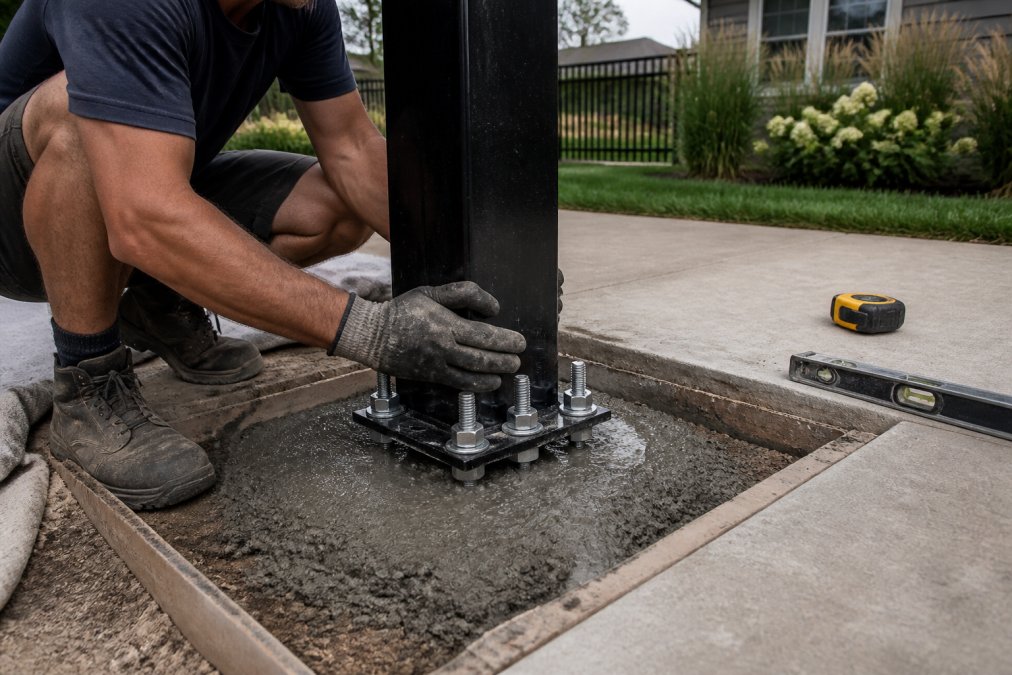
A bolt-down system uses anchor bolts embedded in concrete to secure the pole base, allowing the hoop to be unbolted and relocated if needed. Direct-bury systems insert the pole directly into the ground or a ground sleeve, creating a more permanent installation that can't be easily moved.
Bolt-down installation offers flexibility, if you relocate, you can unbolt and reinstall the system elsewhere. The installation process is also simpler with less extensive concrete work.
Direct-bury creates maximum stability by anchoring the pole deep into the earth, eliminating potential movement during extreme weather or aggressive play.
For homeowners planning to stay long-term, direct-bury is more stable. For those who might relocate, bolt-down offers flexibility.
The Ironclad Triple Threat 72" Pro and Ironclad GameChanger GC55-MD both use bolt-down systems, providing excellent stability while preserving relocation options. The First Team Legend Arena 42" x 72" Glass Basketball Hoop uses direct-bury installation, ideal for schools, parks, and permanent residential installations.

Concrete Foundation Requirements
Proper concrete work is non-negotiable. Your pad needs at least 4 inches thick (6 inches for heavy use), extending 24-36 inches beyond the pole base to distribute weight and prevent tipping.
Ironclad Triple Threat 72" Pro →
Ensure the ground is level and compacted before pouring. Uneven soil causes settling and instability; proper grading prevents water pooling that weakens concrete.
Anchor bolts must be set at correct depth and angle for bolt-down systems; ground sleeves ensure proper alignment for direct-bury. Precision during installation affects performance for years.
Allow concrete to cure for at least 7 days before installing the hoop, and consider a concrete sealer to protect against moisture and weather damage.
Key Features That Affect Backboard Performance
Beyond size and material, several design features determine how well your in-ground basketball backboard performs during play.
Backboard rigidity is critical, thicker, rigid backboards resist flexing and provide consistent rebound, while thinner ones absorb energy and make shots feel unpredictable.
Vibration reduction matters during dunks and aggressive rim-hanging. Pole diameter and material (typically 6" x 8" or 6" x 6" one-piece steel) directly affect vibration control.
Pole offset (distance the pole extends from the backboard) determines playing room. A 48-inch offset is typical for residential systems; smaller offsets create tighter areas, larger ones require more space.
Breakaway rim design reduces stress on the backboard during dunks. Quality rims flex downward on impact and return to horizontal, absorbing energy rather than transferring it to the glass.
Powder-coated steel protection prevents rust and extends the life of your pole and hardware. A black powder-coat finish is both aesthetic and functional, it resists corrosion from weather and UV rays.
All of these features are present in the premium Ironclad systems available through Sports Vista USA, which is why they deliver consistent, high-performance play year after year.
Adjustable vs. Fixed-Height Systems
Adjustable-height systems let you lower the rim for younger players or raise it to regulation 10 feet for competitive play. Fixed-height systems stay at one height, typically regulation (10 feet), and can't be changed.
Adjustable systems use either a crank mechanism (manual, reliable, no power) or spring-assisted lift (faster, easier adjustment).
For families with children of different ages, adjustability is valuable, young kids can shoot at 8 or 9 feet, then raise the rim as they grow.
Fixed-height systems are simpler, more affordable, and slightly more stable.
Maintenance and Weather Resistance for Long-Term Durability
An in-ground basketball backboard will face sun, rain, ice, and temperature swings throughout the year. Proper maintenance extends the life of your system significantly.
Choosing the Right In-Ground Basketball Backboard for Your Needs
For compact driveways with developing players, the Ironclad GameChanger GC55-MD delivers a 54-inch tempered glass backboard with adjustable height, bolt-down stability, and durable construction. It fits smaller yards while providing authentic rebound and years of reliable play.
Frequently Asked Questions
What's the difference between tempered glass and polycarbonate backboards?
Tempered glass delivers superior rebound consistency and clarity, making it the choice for serious players and regulation-style courts. It's stronger than standard glass but requires professional installation. Polycarbonate is lighter, more impact-resistant, and costs less, but rebound feel differs and clarity degrades over time. For in-ground systems where durability matters, tempered glass outperforms polycarbonate in both performance and longevity.
What backboard size should I choose for my driveway?
A 54-inch backboard fits compact driveways and works well for casual play and younger players. A 72-inch backboard delivers regulation-size rebound and is ideal for serious athletes and home courts where space allows. Measure your available space, consider player skill level, and think about future use. The Ironclad GameChanger GC55-MD offers a 54-inch option, while the Ironclad Triple Threat and Elite models provide full 72-inch regulation size.
How much does an in-ground basketball hoop cost?
In-ground basketball hoops range from $1,699 to $4,339+ depending on backboard size, materials, and installation type. The Ironclad GameChanger GC55-MD starts at $1,699 for a 54-inch adjustable system. The Ironclad Triple Threat 72" Pro is $2,599, and the Ironclad Elite 72" is $2,699. For premium fixed-height systems like the First Team Legend Arena 72" Glass, expect to invest $4,339. Prices reflect backboard quality, steel construction, warranty, and long-term durability.
Are in-ground basketball hoops worth the investment?
Yes, if you plan years of use and want professional-grade performance. In-ground systems offer superior stability, consistent rebound, and durability compared to portable hoops. They're anchored with concrete or bolt-down systems that reduce vibration and movement during aggressive play. The tempered glass backboards and heavy-duty steel poles hold up to dunking, hanging, and weather. With proper maintenance and a lifetime warranty on many models, an in-ground hoop becomes a permanent court asset that enhances home value and supports serious athletic development.


Leave a comment
This site is protected by hCaptcha and the hCaptcha Privacy Policy and Terms of Service apply.