


Table of Contents
- Why Cleaning Your Paddle Matters
- The Importance of Preserving Surface Grit
- Best Pickleball Paddle Cleaning Tools
- Step-by-Step Cleaning Process
- What to Avoid When Cleaning
- Pickleball Paddle Maintenance Tips
- Protecting Your Paddle Investment
- Frequently Asked Questions
Last Updated: September 30, 2026
Why Cleaning Your Paddle Matters
Your clean pickleball paddle is your most important piece of equipment. It controls spin, power, and touch on every shot. But here's what most players miss: a dirty paddle loses performance fast.
Court debris, ball fibers, and dust settle into the surface texture, reducing friction between ball and paddle face. You lose spin and control.
Keeping a clean pickleball paddle maintains spin, consistency, and touch, so your equipment performs like new.
The Importance of Preserving Surface Grit
The grit on your paddle face is not cosmetic. It's functional.
That textured surface creates friction. Friction creates spin. Remove the grit through aggressive scrubbing, and you remove the paddle's ability to generate topspin and sidespin. You're left with a slower, flatter paddle.
Preserving surface grit means cleaning gently. You want to remove debris without damaging the texture underneath. The goal is restoration, not refinishing.
Your paddle's raw carbon fiber and honeycomb core depend on that grit layer staying intact.
Many players don't realize that harsh chemicals and abrasive scrubbing can cause chemical degradation of the polymer composite face. The surface grit bonds to that base material. Aggressive cleaning breaks that bond.
Best Pickleball Paddle Cleaning Tools
The right tools are simple and inexpensive. Understanding why certain tools work and others damage your paddle is crucial to long-term performance.
Microfiber Cloth and Paddle Erasers
A microfiber cloth is your primary cleaning tool. It lifts dust and light debris without scratching the surface.
Microfiber fibers are finer than human hair and trap particles instead of pushing them around. Use one dry to remove loose debris, or damp to clean without water damage.
Paddle erasers are soft rubber tools designed for pickleball paddles. They work like pencil erasers but won't harm the composite face. Rub gently in circular motions to lift stubborn ball fiber residue. They're effective because they're designed specifically for this material.
Both tools cost very little and last for years. Keep a microfiber cloth in your paddle bag.
Mild Cleaning Solutions and the Chemistry Behind Them
Water alone removes most debris. For stubborn residue, mild dish soap works well.
Mix a small amount of mild dish soap with water. The solution should be barely soapy. Dip your cloth, wring it out completely, and wipe the paddle face. Never soak a paddle. Water can seep into the honeycomb core and cause structural damage.
Water penetration matters because it causes the resin binders in the honeycomb core to swell, weakening the bond between core and grit layer. The grit separates from the base material, reducing spin performance.
Isopropyl alcohol is safe in small amounts for sticky residue, but don't use it frequently. Repeated exposure weakens the resin bond between grit and composite face.
Why Harsh Chemicals Destroy Paddles
Bleach, acetone, and commercial degreasers will damage the paddle's composite materials. Here's the specific mechanism:
Bleach breaks down the polymer binders that hold the grit to the surface. Within hours, the grit begins to separate and the surface is permanently weakened.
Acetone dissolves the epoxy resin bonding the face to the core, causing irreversible delamination.
Strong degreasers alter the chemical structure of the binders, making the paddle feel softer or less responsive within days.
Vinegar is acidic and can etch the surface grit and weaken polymer binders over weeks of use.
Step-by-Step Cleaning Process
Here's how to clean your paddle the right way, and how to assess whether cleaning will actually restore performance.
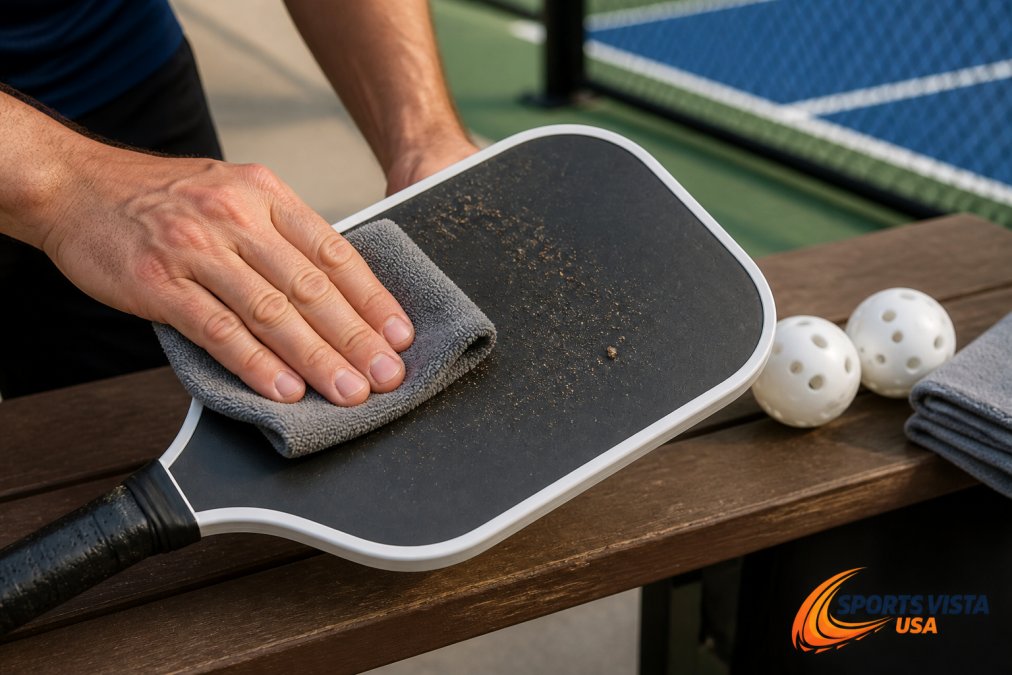
Step 1: Visual Inspection Before Cleaning
Before you wet anything, look closely at the paddle face under good light.
Grit that is covered in debris appears dull but feels raised and bumpy to the touch. This grit will respond to cleaning.
Grit that is permanently worn smooth feels flat or slick. No amount of cleaning will restore this; the paddle is experiencing normal wear.
This distinction sets realistic expectations. If your paddle's center is worn smooth but edges have texture, cleaning helps the edges but won't restore the center.
If the entire paddle face feels smooth and slick, the paddle is nearing the end of its useful life.
Step 2: Remove Loose Court Debris
Start dry. Use a microfiber cloth or soft brush to remove loose dust, dirt, and court debris. Wipe in one direction to prevent grinding debris into the surface and to reveal the actual grit texture underneath.
Step 3: Inspect for Damage or Wear
Look closely at the paddle face. Check for:
- Cracks in the composite face
- Soft spots in the honeycomb core (press gently; the paddle should feel firm)
- Areas where grit is missing entirely (not just worn smooth, but actually absent)
- Discoloration that might indicate chemical damage or moisture penetration
- Separation or peeling at the edges where the surface layer meets the core
If you see cracks or soft spots, stop cleaning. The paddle needs repair or replacement. Cleaning won't help a structurally damaged paddle.
If the grit is worn smooth in certain spots, that's normal wear. Gentle cleaning won't restore it, but it will keep the paddle playing consistently.
Step 4: Dampen Your Cloth
Fill a small bowl with room-temperature water. Add one drop of mild dish soap.
Dip your microfiber cloth into the solution. Wring it out completely. The cloth should be barely damp, not wet.
Excess water is the enemy. It seeps into the paddle's core and causes damage. A barely damp cloth cleans effectively without the risk.
Step 5: Clean in Circular Motions
Starting at the center of the paddle face, use light circular motions.
Work outward toward the edges. Keep the pressure light. You're wiping away residue, not scrubbing it off.
Pay attention to the areas where the paddle contacts the ball most. These spots accumulate more ball fibers and court dust.
Circular motions help distribute pressure evenly. They prevent you from wearing away grit in one spot while leaving debris in another.
Take about 30 seconds on each side. This is enough time to remove most debris without overdoing it.
Step 6: Address Edge Grime
The edges of the paddle collect grime where the paddle meets the court and net.
Use a slightly damp cloth to wipe around the edge. You can use a bit more pressure here since the edge doesn't contact the ball.
Don't forget the handle. Sweat and court dust build up there too. A quick wipe keeps it clean and prevents slipping.
Step 7: Assess the Results
After cleaning, look at the paddle face again under good light.
If the texture is now clearly bumpy and raised, cleaning worked.
What to Avoid When Cleaning
Several cleaning methods sound reasonable but damage paddles.
Never use hot water. Heat can warp the honeycomb core and weaken the adhesive that bonds the surface grit. Room temperature water only.
Pickleball Paddle Maintenance Tips
Cleaning is part of a broader maintenance routine. These practices extend paddle life and keep performance consistent.
How Often to Clean Your Paddle
Clean after every session if you play on outdoor courts. Outdoor surfaces are dustier. Debris accumulates faster.
Drying and Storage Best Practices
After cleaning, let the paddle air dry completely. Never use heat or direct sunlight. Both can warp the composite materials.
Recognizing Signs of Paddle Wear and Tear
Even with good maintenance, paddles wear out. Recognize these signs:
- Grit is noticeably smooth in the center
- The paddle feels slower or less responsive
- Cracks appear in the composite face
- The paddle feels softer when you hit the ball
- Spin performance drops significantly
Protecting Your Paddle Investment
Your paddle is a tool that directly affects your game. Protecting it makes sense financially and competitively.
Frequently Asked Questions
How often should you clean your pickleball paddle?
Clean your paddle after every few playing sessions, or whenever you notice ball fibers and court debris buildup on the surface. Regular cleaning prevents residue from hardening and protects the grit texture that gives you spin performance. If you play multiple times weekly, aim for a quick wipe-down after each session and a thorough clean once a week to maintain optimal playing conditions.
Can you use magic erasers on pickleball paddles?
No. Magic erasers are abrasive and can strip away the surface grit that creates friction and spin. They may also damage the composite face or honeycomb core material. Instead, use a soft microfiber cloth with mild dish soap and water, or a dedicated paddle eraser designed for pickleball paddles. These methods clean effectively without degrading your paddle's performance surface.
Will soap and water damage carbon fiber pickleball paddles?
Mild dish soap and water are safe for carbon fiber paddles when used correctly. Use a damp cloth (not soaking wet) and avoid prolonged soaking or submerging the paddle. Dry immediately after cleaning to prevent water from entering the honeycomb core. Avoid harsh chemicals or isopropyl alcohol, which can cause chemical degradation of the polymer and composite materials. Gentle pressure and quick drying keep your carbon fiber paddle safe.
Does cleaning a pickleball paddle restore spin?
Cleaning removes ball fibers and court debris that reduce friction and spin performance, so it can restore some lost spin. However, cleaning alone cannot reverse permanent grit wear. If your paddle's surface grit is genuinely worn down from extended play, the texture cannot be fully restored through cleaning. Regular maintenance slows spin decay and keeps your paddle playing closer to its original performance for longer.
Your pickleball paddle deserves the same care you give your game. Clean it gently, store it properly, and it will reward you with consistent performance. When you're ready to protect your equipment during travel or storage, Sports Vista USA offers pickleball paddle covers designed to keep your gear safe. Check Out our paddle protection options and keep your equipment in peak condition.


Leave a comment
This site is protected by hCaptcha and the hCaptcha Privacy Policy and Terms of Service apply.