


Table of Contents
- What Are Modular Sport Court Tiles and Why Homeowners Choose Them
- Durability and Weather Resistance in Cold Climates
- Installation and Sub-Surface Preparation for Existing Driveways
- DIY Outdoor Basketball Court Installation with Modular Tiles
- How to Install Outdoor Pickleball Court Surfaces
- Comparing Modular Tiles vs. Concrete and Asphalt
- Maintenance, Customization, and Long-Term Value
- Conclusion
Last Updated: August 19, 2026
What Are Modular Sport Court Tiles and Why Homeowners Choose Them
Modular sport court tiles are interlocking floor tiles made from polypropylene, rubber, or other durable synthetic materials designed to create athletic playing surfaces on existing driveways and outdoor spaces. These tiles snap together without adhesive, forming a complete court system that can support basketball, pickleball, volleyball, or multi-sport play. Homeowners in Carbondale and across the Midwest choose modular tiles because they transform an ordinary driveway into a functional athletic court in days rather than months, without the permanent commitment of pouring concrete or laying asphalt.
The appeal is straightforward: modular sport court tiles deliver professional-grade surface performance at a fraction of the cost and installation time of traditional court construction. Unlike concrete overlays that require excavation and curing, these interlocking systems sit directly on your existing surface. The UV-stabilized materials resist fading and weather damage, the interlocking mechanism prevents shifting, and the tiles are designed with impact absorption to reduce stress on joints during play.
What makes this approach particularly attractive for Carbondale homeowners is the flexibility. If you move, you can disassemble the court and take it with you. If you want to change the court markings or expand the playing area, you simply add or reconfigure tiles. The drainage system built into most modular tiles means water flows through rather than pooling, which is critical in cold climates where freeze-thaw cycles can damage traditional court surfaces.
Durability and Weather Resistance in Cold Climates
Cold climates present unique challenges for outdoor court surfaces. Freeze-thaw cycles, salt spray, and temperature swings exceeding 40 degrees between seasons can crack concrete, heave asphalt, and degrade materials not engineered for these conditions. Modular sport court tiles built with UV-stabilized polypropylene and specialized rubber compounds are designed to handle this punishment.
Quality modular tiles use polypropylene or TPE (thermoplastic elastomer) cores with rubber components that maintain flexibility even in sub-zero temperatures. Cheaper tiles become brittle in cold, crack under stress, and lose traction properties. The UV stabilization prevents color fading and material degradation from sun exposure, critical for tiles exposed year-round in Illinois winters.
Weather resistance also depends on drainage design. Standing water on a court surface freezes solid and creates hazardous playing conditions. The best modular tiles have perforated undersides that allow water to drain through to the driveway below. In Carbondale, where winter precipitation is common, this drainage capability directly extends the life of both the tiles and the concrete beneath them.
Freeze-thaw damage happens to the foundation, not the tiles themselves. If water gets trapped under the tiles and freezes, it expands and can heave the entire court. Proper sub-surface preparation prevents this by ensuring water doesn't accumulate underneath. The tiles themselves remain stable because they're designed to flex slightly with temperature changes rather than crack.
Installation and Sub-Surface Preparation for Existing Driveways
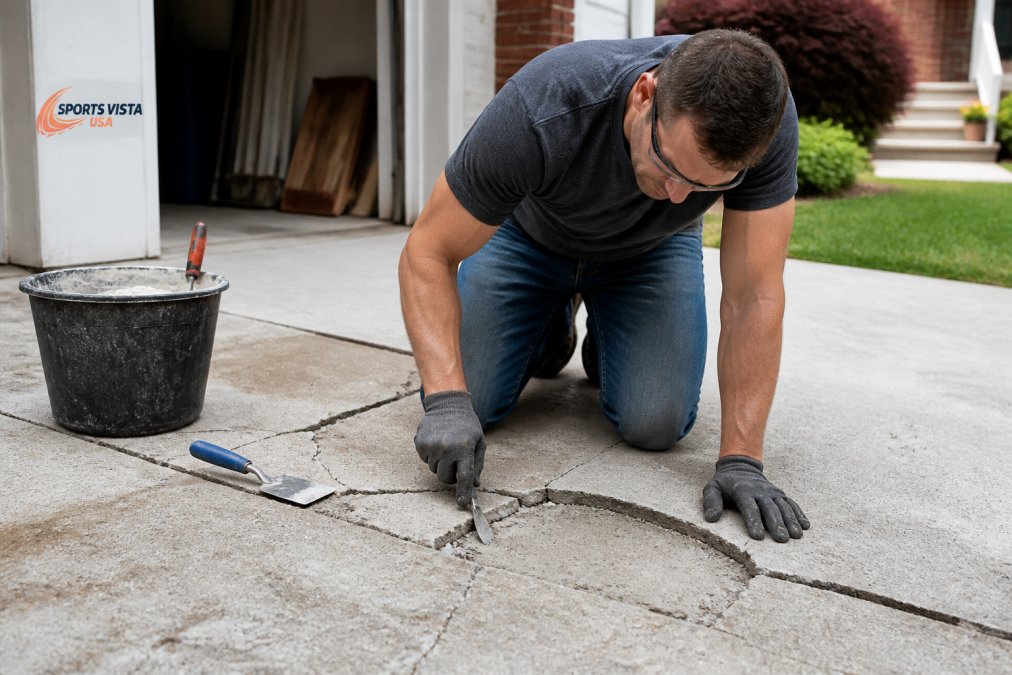
Most homeowners assume they can drop modular tiles onto their existing driveway and start playing. Proper sub-surface preparation determines whether your court lasts five years or fifteen.
Start by assessing your driveway's current condition. Identify cracks wider than a quarter-inch, areas where concrete has heaved or settled unevenly, and spots where water pools after rain. Small cracks (hairline to a quarter-inch) are acceptable; the tiles will bridge them. Larger cracks, spalling concrete, or significant unevenness need repair before installation.
For cracks, use a concrete patching compound rated for outdoor use. Clean the crack thoroughly, remove loose debris, and fill it flush with the surrounding surface. For heaved or uneven sections, grind down the high spots or fill the low spots with a self-leveling concrete overlay designed for driveways.
The surface must be clean and dry before tiles go down. Power wash the entire area to remove dirt, algae, and loose material. Let it dry completely (at least 24 hours in dry conditions). Any moisture trapped under the tiles will create problems, especially in cold climates where it can freeze and shift the entire court.
Once the surface is prepped, installation becomes straightforward. Lay out the tiles in rows, starting from one corner and working systematically across the court. The interlocking mechanism works like puzzle pieces; edges snap together with firm pressure. No adhesive is needed. As you work across the driveway, check that each tile sits flush with its neighbors. If you encounter a high spot that prevents a tile from sitting flat, stop and address it with grinding or additional patching.
DIY Outdoor Basketball Court Installation with Modular Tiles
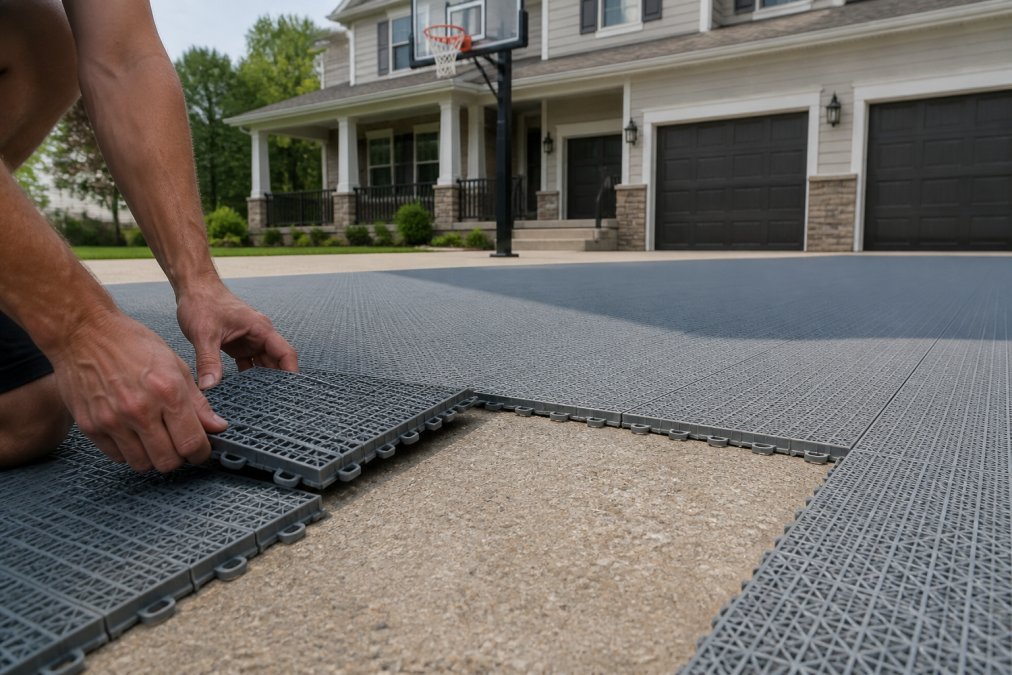
Building a basketball court with modular sport court tiles is a genuine DIY project for most homeowners. You don't need special equipment, heavy machinery, or professional contractors. What you do need is patience, careful measurement, and attention to the interlocking process.
A standard half-court for casual play measures 47 feet by 50 feet. A full court is 94 feet by 50 feet, but most residential driveways accommodate a 3-on-3 court (25 feet by 25 feet) or a shooting court (roughly 30 feet by 40 feet). Measure your driveway and decide what fits.
The Enlio SES Elite 3X3 Basketball Court systems available through Sports Vista USA come in pre-sized kits, including the 25' x 25' court and the larger 25' x 54' option. These kits include all tiles needed for the court area plus edge ramps that transition from the tiles to the surrounding driveway, preventing tripping hazards and protecting tile edges from impact damage.

Start at one corner and work in rows toward the opposite corner. As you place each tile, press down firmly on the interlocking edges to ensure they seat completely. The interlocking mechanism should click or snap together with noticeable resistance; if a tile slides into place too easily, it hasn't locked properly.
For a 25' x 25' court, expect installation to take 6-8 hours for two people working steadily. The physical demands are minimal, mostly bending, pressing, and walking.
Once tiles are down, add court markings. The Basketball Court Stencil Kit from Sports Vista USA lets you paint regulation court lines directly onto the tiles. Use exterior-grade paint rated for athletic surfaces. The stencil approach ensures lines are straight and properly spaced.
How to Install Outdoor Pickleball Court Surfaces
Pickleball courts have different dimensions than basketball courts but use the same modular tile installation principles. A regulation pickleball court measures 20 feet by 44 feet, making it roughly half the size of a tennis court. This smaller footprint means many residential driveways can accommodate a full pickleball court plus space for movement around the perimeter.
The installation process mirrors basketball court setup: prepare the sub-surface, lay tiles in systematic rows, and ensure interlocking edges seat completely. The main difference is the court markings. Pickleball requires specific line dimensions and spacing that differ from basketball.

For pickleball, select tiles designed for that sport specifically. The surface friction and ball response differ slightly from basketball surfaces. Some modular tile systems perform acceptably for both basketball and pickleball; others are sport-specific. Check the manufacturer's specifications for ball response and traction characteristics.
The drainage consideration remains critical. Pickleball courts sit lower to the ground than basketball courts, so water drainage is even more important. Standing water on a pickleball court creates slippery conditions and damages the playing surface faster.
One advantage of modular tiles for pickleball is easy net installation. Most systems include mounting points or allow you to install portable net posts that set into the tile surface, letting you set up and take down your court quickly.
Comparing Modular Tiles vs. Concrete and Asphalt
Three primary options exist for residential court surfaces: modular interlocking tiles, concrete, and asphalt. Each has distinct advantages and limitations that change depending on your climate, budget, and long-term plans.
Concrete is permanent and durable, lasting 20+ years with minimal maintenance. However, installation is expensive, time-consuming, and requires professional contractors. Concrete cracks in freeze-thaw cycles, especially in Carbondale's climate. Repairs are difficult and often visible. You cannot relocate a concrete court.
Asphalt is cheaper than concrete and faster to install, providing decent ball response and traction. The downside: asphalt degrades quickly in cold climates. UV exposure breaks down the binder, creating a crumbly surface. Cracks develop within 3-5 years in freeze-thaw environments. Seal coating extends life but adds ongoing maintenance costs.
Modular tiles occupy the middle ground. They cost less than concrete but more than basic asphalt. Installation is fast, days instead of weeks. The surface is removable, so you can take it with you if you move. Repairs are simple: replace individual tiles without affecting the rest of the court. In cold climates, modular tiles outperform both concrete and asphalt because they flex with temperature changes and drain water away from the foundation.
| Feature | Modular Tiles | Concrete | Asphalt |
|---|---|---|---|
| Installation Time | 1-3 days | 2-4 weeks | 3-7 days |
| Maintenance | Minimal (annual cleaning) | Occasional (crack repair, sealing) | Regular (seal coating every 2-3 years) |
| Cold Climate Performance | Excellent | Good (but cracks in freeze-thaw) | Poor (degrades quickly) |
| Removability | Yes | No | No |
| Repair Difficulty | Easy (replace tiles) | Difficult (patch visible) | Moderate (overlay needed) |
| Typical Lifespan | 10-15 years | 20+ years | 5-10 years |
For Carbondale homeowners specifically, modular tiles win on practical grounds. The freeze-thaw resistance matters more than the slight cost premium. The removability appeals to people who may relocate. The low maintenance fits busy schedules.
Maintenance, Customization, and Long-Term Value
Modular sport court tiles require minimal maintenance. The primary task is cleaning. Sweep or power wash the surface 2-3 times per year, or more frequently if you live under trees where leaves and debris accumulate. Power wash to remove algae that can grow on tiles in shaded areas.
The interlocking mechanism itself is maintenance-free. Unlike concrete joints that need resealing, modular tile edges don't degrade. If a tile becomes damaged, cracked, warped, or worn, you simply remove it and snap in a replacement.
Customization is one of the strongest advantages of modular systems. You can choose tile colors that match your home or aesthetic preferences. Court markings are painted on, so you can change them without replacing tiles. You can expand the court by adding tiles, or shrink it by removing them.
The long-term value proposition depends on your plans. If you're building a permanent home court and staying in your house for 10+ years, modular tiles deliver excellent value. The low maintenance cost and durability mean you'll spend far less over time than you would on concrete repairs or asphalt seal coating. If you might move within 5 years, the removability makes tiles the only sensible choice.
For schools, parks, and recreation departments in the Carbondale area, modular tiles offer flexibility for multi-sport use. A court can be configured for basketball one season and reconfigured for pickleball or volleyball the next.
Conclusion
Modular sport court tiles for residential driveways solve a real problem for Carbondale homeowners: how to build a quality athletic court without the cost, time, and permanence of concrete or the maintenance burden of asphalt. The interlocking system, UV-stabilized materials, and integrated drainage design are engineered specifically for cold climates where freeze-thaw cycles destroy traditional court surfaces.
The installation process is straightforward enough for DIY work, the maintenance is minimal, and the flexibility to repair, reconfigure, or relocate the court addresses concerns that concrete and asphalt can't. Whether you're building a basketball court, pickleball court, or multi-sport facility, modular tiles deliver professional performance without professional-grade complexity.
Sports Vista USA offers complete modular court systems designed for residential installation. The Enlio SES Elite Basketball Court kits come in multiple sizes to fit different driveway dimensions, and the Basketball Court Stencil Kit makes painting regulation court markings simple. Whether you're starting a new court or upgrading an existing surface, these systems combine durability, ease of installation, and long-term value in one solution.
Frequently Asked Questions
Can you install modular sport court tiles directly over an existing concrete driveway?
Yes, but proper sub-surface preparation is critical. The concrete must be clean, level, and free of significant cracks or debris. Fill small cracks, grind down high spots, and ensure water drainage. If the concrete is severely damaged or slopes poorly, you may need a concrete overlay or sub-base layer. Most interlocking floor tile systems work best on a stable, flat foundation, so inspect your driveway carefully before installation.
How do modular sport court tiles handle freeze-thaw cycles and winter weather?
Quality UV-stabilized polypropylene and TPE tiles resist freeze-thaw damage when properly installed with adequate drainage. However, performance varies by product and climate. Look for tiles rated for your region's temperature extremes and moisture conditions. Ensure your drainage system directs water away from the court. In areas with harsh winters, tiles with superior freeze-thaw resistance and proper sub-surface preparation will extend the lifespan significantly compared to standard options.
How long do modular sport court tiles typically last on a residential driveway?
High-quality modular sport court tiles typically last 8-15 years with proper maintenance and installation. Lifespan depends on UV stability, material thickness, drainage quality, climate exposure, and usage intensity. UV-stabilized tiles resist color fading and surface degradation better than standard alternatives. Proper drainage prevents water pooling and freeze-thaw damage. Regular cleaning and maintenance extend durability. Cheaper tiles may degrade faster, while premium systems with superior impact absorption and weather resistance perform longer.
What factors affect the cost of modular sport court tiles for a residential driveway?
Cost depends on tile quality (material composition, UV stabilization, thickness), court size and square footage, sub-surface preparation needs, drainage system requirements, customization options (colors, court markings), and whether you hire professional installers. Premium interlocking systems with superior impact absorption and freeze-thaw resistance cost more upfront but last longer and perform better athletically. DIY installation reduces labor costs. Stencil kits for court markings are an affordable add-on. Sports Vista USA offers modular systems starting at competitive price points for various court sizes and sport applications.
Building a court that performs well for years requires the right foundation and materials. Get started with Sports Vista USA's modular court systems and transform your driveway into a dedicated athletic space that your family will use for decades.
This article was written using GrandRanker


Leave a comment
This site is protected by hCaptcha and the hCaptcha Privacy Policy and Terms of Service apply.