

Table of Contents
- What Makes a Pickleball Paddle Truly Durable
- Carbon Fiber vs Fiberglass Pickleball Paddles: Which Lasts Longer
-
Best Pickleball Paddles for Durability: Top Picks Compared
- Six Zero Double Black Diamond, Best Raw Carbon Grit Longevity
- Selkirk Boomstik, Best for Grit That Outlasts Standard Carbon
- JOOLA Ben Johns Hyperion CFS 16, Best Thermoformed Construction
- Honolulu J2CR Crystal Endurance Grit, Best for Sustained Spin Retention
- 11SIX24 Power 2 Series, Best HexGrit Technology for Heavy Use
- Engage Encore Pro V3.0, Best Durable Carbon Fiber at a Lower Price
- Selkirk AMPED Invikta, Best Fiberglass Option for All-Court Durability
- How Long Do Pickleball Paddles Last: Signs of Wear to Watch For
- Environmental Impact on Paddle Durability
- Pickleball Paddle Maintenance Tips to Extend Paddle Life
- Which Durable Paddle Should You Choose
- Conclusion
Last Updated: August 16, 2026
Most players complaining about grit wearing out too fast are buying the wrong surface technology, not the wrong paddle. At Sports Vista USA, we've evaluated paddle construction across material types, core designs, and surface treatments to identify which paddles genuinely hold up over months of hard play. This guide cuts through marketing noise and focuses on what matters: materials science, surface longevity, and structural integrity.
Quick Picks:
- Best Raw Carbon Grit Longevity: Six Zero Double Black Diamond
- Best Grit That Outlasts Standard Carbon: Selkirk Boomstik
- Best Thermoformed Construction: JOOLA Ben Johns Hyperion CFS 16
- Best Sustained Spin Retention: Honolulu J2CR Crystal Endurance Grit
- Best for Heavy Use: 11SIX24 Power 2 Series
- Best Budget Carbon Fiber: Engage Encore Pro V3.0
- Best Fiberglass Option: Selkirk AMPED Invikta
What Makes a Pickleball Paddle Truly Durable
Durability means maintaining structural integrity, surface grit, and playability over extended use. Three construction elements determine longevity: core technology, paddle face material and surface grit, and edge guard system.
Core Technology: Polymer, Foam-Injected, and Honeycomb Cores
Most performance paddles use a polymer honeycomb core, which balances stiffness with vibration dampening and resists compression fatigue. Foam-injected cores eliminate hollow core deformation where repeated impacts deform cell walls. The JOOLA Hyperion CFS 16 uses a Reactive Polymer Core with Hyperfoam Edge Wall technology to extend sweet spot life under impact fatigue. The 11SIX24 Power 2 Series uses full-foam construction, which maintains feel significantly longer than standard hollow core designs.
Thermoformed construction bonds the face directly to the core under heat and pressure, eliminating the adhesive layer that can fail over time and making delamination far less likely.
Surface Grit, Abrasion Resistance, and Spin Retention Over Time
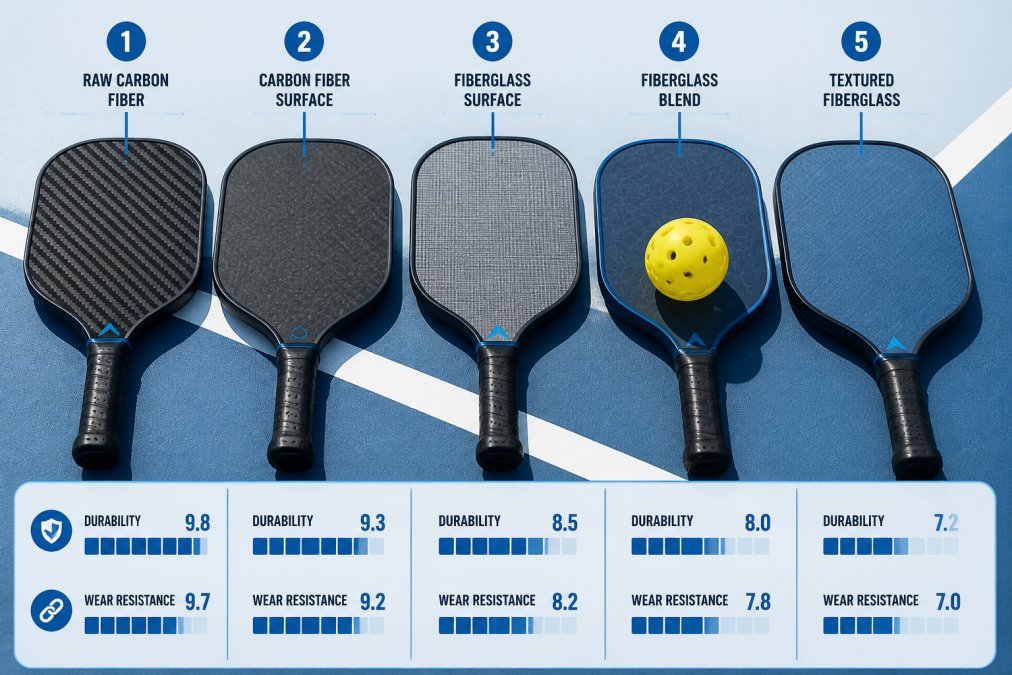
Raw carbon fiber offers excellent initial spin but the microscopic texture degrades with abrasion against court surfaces and ball seams. Proprietary surface treatments outlast standard raw carbon fiber. Selkirk's Infinigrit surface lasts at least twice as long as traditional raw carbon fiber. The Honolulu J2CR uses Crystal Endurance Grit treatment on Toray T700 carbon fiber, engineered to resist surface wear. The 11SIX24 HexGrit technology applies a structured texture pattern that distributes abrasion load more evenly than relying purely on carbon weave.
Fiberglass weave surfaces like Selkirk's FiberFlex wear differently than carbon, with inherently more forgiving abrasion resistance, though they generate less initial spin.
Edge Guards and Structural Integrity
Edge guards absorb court contact impact and prevent delamination from spreading inward. Selkirk's EdgeSentry system on the AMPED Invikta is purpose-built edge protection that adds meaningful structural longevity. JOOLA's Hyperfoam Edge Wall reinforces the most impact-prone area while extending the sweet spot. Paddles without quality edge guards are more fragile; one hard court contact can start delamination that spreads within weeks.
Carbon Fiber vs Fiberglass Pickleball Paddles: Which Lasts Longer
Carbon fiber offers higher tensile strength and stiffness, translating to better power output. Raw carbon surfaces provide exceptional initial grit but degrade faster under heavy abrasion than treated alternatives. Structural longevity is excellent; surface longevity depends on the treatment applied.
Fiberglass is more flexible, absorbing impact differently and reducing peak stress that causes core delamination. The FiberFlex surface on the Selkirk AMPED Invikta maintains consistent touch over time, though it won't generate the same spin ceiling as premium carbon.
A thermoformed carbon fiber paddle with proprietary grit treatment outlasts a standard raw carbon paddle significantly. A quality fiberglass paddle outlasts a budget carbon paddle almost every time. Material type matters less than construction quality.
According to USA Pickleball's equipment standards and approved paddle list, approved paddles must meet specific surface roughness and material standards, providing a baseline for evaluating construction quality claims.
Best Pickleball Paddles for Durability: Top Picks Compared
Seven paddles stand out when durability is the primary criterion. Each represents a different approach to maintaining playability over time.
| Paddle | Core Type | Surface Technology | Best For |
|---|---|---|---|
| Six Zero Double Black Diamond | Polypropylene honeycomb | Diamond Tough raw carbon | Raw carbon grit longevity |
| Selkirk Boomstik | Proprietary | Infinigrit treated surface | Maximum grit lifespan |
| JOOLA Hyperion CFS 16 | Reactive Polymer + Hyperfoam | Carbon Friction Surface | Thermoformed construction |
| Honolulu J2CR Crystal Endurance | Foam core | Crystal Endurance Grit on T700 carbon | Sustained spin retention |
| 11SIX24 Power 2 Series | Full-foam | HexGrit technology | Heavy use and tour play |
| Engage Encore Pro V3.0 | ControlPro Polymer | Amplified Carbon Face | Budget carbon durability |
| Selkirk AMPED Invikta | Polymer honeycomb | FiberFlex fiberglass | Fiberglass all-court use |
Six Zero Double Black Diamond, Best Raw Carbon Grit Longevity
The Double Black Diamond maintains grit longer than most untreated carbon faces through its Diamond Tough raw carbon fiber surface. Thermoformed construction bonds the face to the polypropylene honeycomb core under heat and pressure, eliminating the adhesive failure point that causes delamination in cold-pressed paddles. This process increases face stiffness, raising ball exit velocity while reducing micro-flexing that accelerates surface grit degradation.
Selkirk Boomstik, Best for Grit That Outlasts Standard Carbon
Selkirk's Infinigrit surface directly addresses grit degradation, lasting at least twice as long as traditional raw carbon fiber. The Boomstik pairs this with a large sweet spot and Pro-Spin+ NextGen Texture for consistent spin generation throughout the paddle's lifespan. For competitive players who play four or more days per week, the higher upfront cost often works in favor of a paddle that maintains performance longer.
JOOLA Ben Johns Hyperion CFS 16, Best Thermoformed Construction
The Hyperion CFS 16 represents the most technically complete durability approach. The Carbon Friction Surface generates maximum spin, while the Hyperfoam Edge Wall extends the functional sweet spot and reinforces the paddle perimeter against impact damage. Thermoformed construction creates a mechanically superior face-to-core bond compared to adhesive bonding.
Honolulu J2CR Crystal Endurance Grit, Best for Sustained Spin Retention
The J2CR focuses specifically on spin retention over time. Crystal Endurance Grit treatment on Toray T700 carbon fiber resists the surface abrasion that strips grit from standard paddles. The foam core provides dwell time and a plush feel many players prefer over stiffer hollow core designs.
11SIX24 Power 2 Series, Best HexGrit Technology for Heavy Use
HexGrit technology distributes abrasion load more evenly through a hexagonal texture pattern, slowing grit degradation compared to surfaces relying on carbon weave texture alone. Full-foam construction eliminates hollow cell deformation that causes dead spots under heavy use. PPA Tour pros use this paddle in match conditions, providing real-world validation of performance longevity.
Engage Encore Pro V3.0, Best Durable Carbon Fiber at a Lower Price
The Encore Pro V3.0 is the entry point for players wanting genuine carbon fiber construction without premium pricing. The Amplified Carbon Face provides real carbon fiber surface performance, and one-piece cold-pressed construction delivers stability that budget paddles with multi-piece assembly often lack. It's USA Pickleball approved and made in the USA.
Selkirk AMPED Invikta, Best Fiberglass Option for All-Court Durability
The AMPED Invikta makes the case for fiberglass in a carbon-dominated market. The FiberFlex surface generates consistent power and spin, wearing gradually rather than in a noticeable step-change. The polymer honeycomb core provides a large sweet spot, while EdgeSentry edge guard adds meaningful structural protection.
How Long Do Pickleball Paddles Last: Signs of Wear to Watch For
Quality paddles last between one and three years for recreational players, while competitive players who play four or more times per week may see meaningful performance degradation in six to twelve months.
Grit Degradation and Loss of Spin
The first sign of a paddle past its useful life is reduced spin on serves and dinks. Run your thumb across the paddle face: a fresh carbon surface feels rough like fine sandpaper. A worn surface feels smooth or glassy.
Delamination, Dead Spots, and Weight Distribution Shifts
Delamination occurs when the paddle face separates from the core, creating a bubble or soft spot with a noticeably different sound and feel. Tap across the paddle face with a knuckle: consistent tone indicates intact bonding, while hollow or dull sound in a localized area indicates delamination has begun. Dead spots are areas where the core has compressed or the face-to-core bond has failed, resulting in reduced power output and inconsistent ball exit velocity.
Environmental Impact on Paddle Durability
Temperature extremes are the most underestimated durability factor. Leaving a paddle in a hot car accelerates adhesive breakdown in cold-pressed paddles and can soften foam cores. Repeated freeze-thaw cycles stress composite materials at the molecular level, particularly at face-to-core bond points. A paddle stored properly in a climate-controlled environment will outlast an identical paddle stored in a garage or car trunk by a meaningful margin.
Pickleball Paddle Maintenance Tips to Extend Paddle Life
Proper maintenance is the simplest way to extend paddle life.
Cleaning the Paddle Face Without Damaging Grit
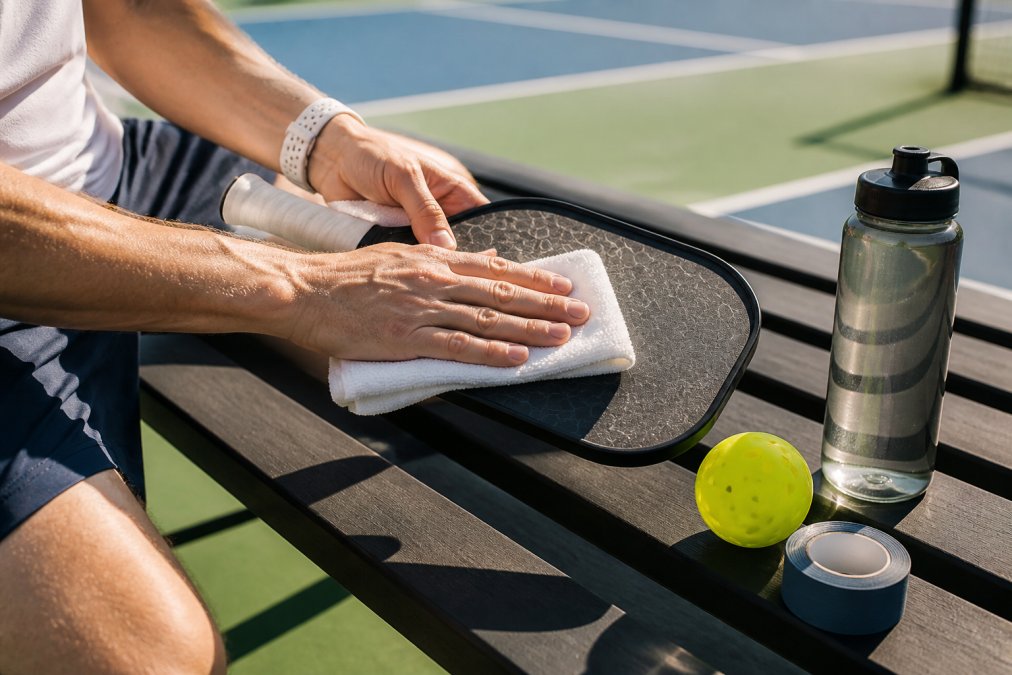
Clean the paddle face after every session. Ball residue, court dust, and skin oils fill the microscopic texture that creates spin. A soft, slightly damp microfiber cloth is sufficient for routine cleaning. Avoid abrasive materials, household cleaners, and solvents, which can strip surface treatments and accelerate grit degradation.
- Wipe paddle face with a dry microfiber cloth after each session
- Use a slightly damp cloth for ball residue and court dust
- Avoid paper towels, which can scratch carbon fiber surfaces
- Never use household cleaners, acetone, or alcohol-based products on treated surfaces
- Inspect edge guards monthly for cracks or separation
Storage, Temperature, and Repair Basics
Store paddles in a protective case, not loose in a bag. Avoid storage in vehicles, uninsulated garages, or anywhere experiencing significant temperature swings. Edge guard separation is the most common repairable damage. Address edge guard separation immediately to prevent the delamination that follows when the core is exposed to impact and moisture.
As noted in USA Pickleball's official equipment care guidelines, maintaining equipment properly preserves compliance with approved equipment standards for sanctioned play.
Which Durable Paddle Should You Choose
The right choice depends on how you play and how long you need the paddle to last.
Play four or more times per week at a competitive level: The Selkirk Boomstik's Infinigrit surface or the 11SIX24 Power 2 Series HexGrit technology are engineered specifically for the surface wear patterns that high-frequency play produces.
Prioritize thermoformed structural durability: The JOOLA Ben Johns Hyperion CFS 16 offers the most technically complete construction with Hyperfoam Edge Wall reinforcement and reactive polymer core that resists impact fatigue.
Want sustained spin retention at a mid-tier price: The Honolulu J2CR Crystal Endurance Grit delivers T700 carbon fiber construction with purpose-built surface treatment below the Boomstik's price.
New to pickleball or playing recreationally: The Engage Encore Pro V3.0 provides genuine carbon fiber construction and cold-pressed durability at an accessible price.
Prefer fiberglass construction: The Selkirk AMPED Invikta remains the strongest fiberglass option for all-court play, with EdgeSentry protection and FiberFlex surface consistency.
For players building or upgrading a full pickleball setup, Sports Vista USA carries paddles, nets, portable court systems, and accessories designed for both recreational and competitive use.
The best pickleball paddles for durability share three characteristics: a core that resists compression fatigue, a surface treatment that outlasts standard raw carbon fiber, and edge protection that prevents delamination from the perimeter. Any paddle delivering all three will hold its playability significantly longer than paddles compromising on one or more factors.
For additional context on composite material performance in sports equipment, the American Sports Medicine Institute's research on equipment and injury prevention provides useful background on how material stiffness and vibration dampening interact with player mechanics over time.
Frequently Asked Questions
Which pickleball paddle lasts the longest?
Paddles with proprietary grit technologies tend to outlast standard raw carbon fiber surfaces. The Selkirk Boomstik's Infinigrit surface is claimed to last at least twice as long as traditional raw carbon fiber, while the Honolulu J2CR Crystal Endurance Grit and Six Zero Double Black Diamond also earn strong marks for sustained surface texture. Thermoformed construction and foam-injected cores add structural longevity beyond just the paddle face.
How long should a good pickleball paddle last?
A quality pickleball paddle typically lasts one to three years for regular recreational players, though competitive players who play several times per week may notice grit degradation and reduced spin retention in under a year. Core delamination, dead spots, and noticeable weight distribution shifts are the clearest signs it's time to replace a paddle. Proper storage and cleaning can meaningfully extend playability.
Does paddle grit affect durability?
Grit affects how long a paddle stays playable, not just how long it holds together physically. Raw carbon fiber surfaces lose surface texture faster under heavy use, reducing spin retention and ball control even when the paddle's structural integrity remains intact. Paddles using advanced grit systems like HexGrit, Infinigrit, or Crystal Endurance Grit are specifically engineered to slow that degradation and maintain consistent performance over more hours of play.
Are carbon fiber pickleball paddles more durable than fiberglass?
Carbon fiber paddles generally offer higher tensile strength, better abrasion resistance, and stiffer paddle faces that hold up well under impact fatigue. Fiberglass paddles flex more, which can reduce surface cracking over time but typically degrades grit faster. For players focused on long-term spin retention and structural durability, carbon fiber is the stronger choice. Fiberglass remains a solid option for players who prioritize a softer touch and vibration dampening.
What are the best pickleball paddles for heavy use?
For heavy use, prioritize paddles with thermoformed construction, reinforced edge guards, and advanced grit surfaces. The Six Zero Double Black Diamond, JOOLA Ben Johns Hyperion CFS 16, and Selkirk Boomstik are all built for high-volume play. Facilities and clubs that go through paddles quickly should also factor in warranty coverage and whether the manufacturer offers replacement programs for commercial or institutional buyers.
Grit wear and structural degradation are the two reasons most players replace paddles before they should have to. Sports Vista USA's pickleball selection focuses on paddles built with thermoformed construction, proprietary surface treatments, and reinforced edge systems that address both problems directly. Check out the current paddle selection at Sports Vista USA to find the right durability-focused option for your playing frequency and budget.
This article was written using GrandRanker


Leave a comment
This site is protected by hCaptcha and the hCaptcha Privacy Policy and Terms of Service apply.