

Table of Contents
- What Professional Volleyball Net Tensioning Systems Do
- How Volleyball Net Tensioner Mechanisms Work
- Volleyball Net Setup and Adjustment for Consistent Tension
- Volleyball Pole and Net Compatibility Essentials
- Professional Volleyball Net Tensioning Systems Comparison
- Troubleshooting Common Tensioning Issues
- Choosing the Right System for Your Facility
- Frequently Asked Questions
Last Updated: October 20, 2026
What Professional Volleyball Net Tensioning Systems Do
A professional volleyball net tensioning system maintains consistent net height and tension across the entire court during play. These systems are engineered to keep nets stable, prevent sagging, and meet competition standards without manual readjustment between games.
The core function is straightforward: anchor the net to upright poles and apply controlled tension through mechanical hardware. What separates professional systems from basic setups is precision. A poorly tensioned net sags in the middle, creating uneven playing conditions. Players can't trust the net's behavior, and referees spend time making adjustments instead of managing the game.
Professional volleyball net tensioning systems solve this by using durable steel tubing, heavy-duty hardware, and mechanisms designed to hold tension consistently. Whether you're setting up a court in Carbondale for a school league or a recreation center serving multiple programs, the right tensioning system means you set it once and trust it.
For facilities managing multiple courts or frequent games, consistency matters. Teams need predictable playing conditions. The net height should be exactly 7 feet 11 5/8 inches for men's play, 7 feet 4 1/8 inches for women's play. Tension should be even from sideline to sideline. A quality tensioning system delivers that reliability.
How Volleyball Net Tensioner Mechanisms Work
The heart of any professional volleyball net tensioning system is its tensioning mechanism. Understanding how these work helps you choose the right system and troubleshoot problems when they arise.
Wormgear Crank Design
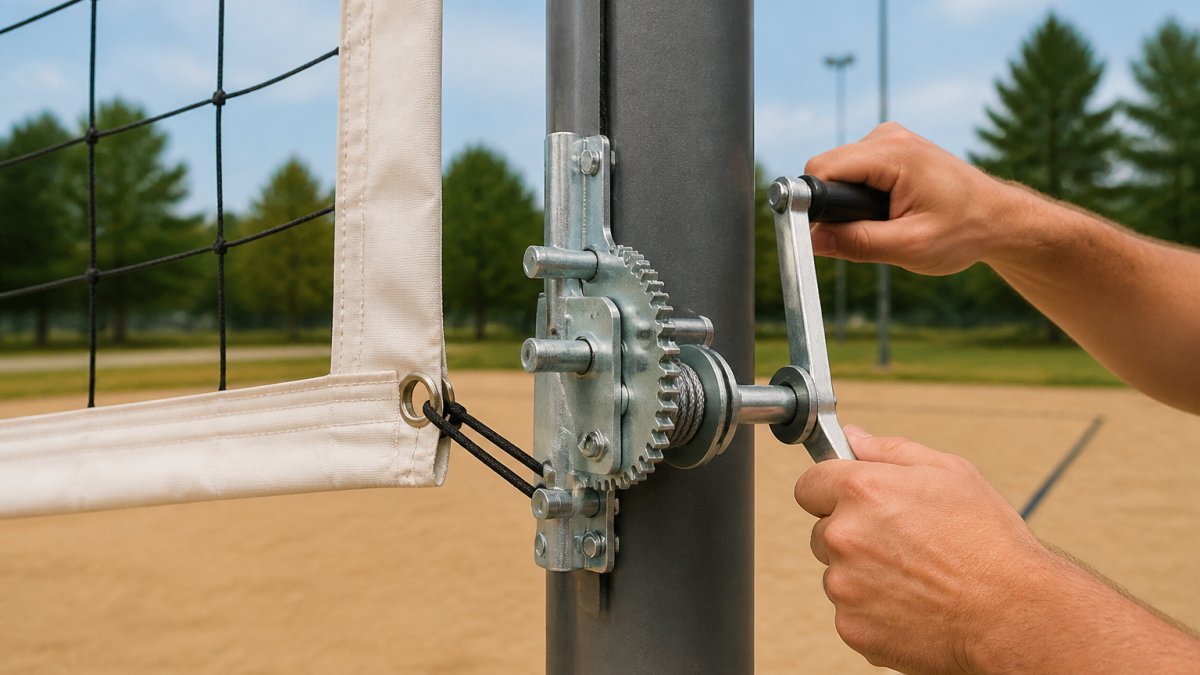
A wormgear crank system uses a hand-cranked mechanism to gradually tighten the net. You turn the crank handle, which drives a worm gear that pulls the net tighter through a cable or strap system. This design offers fine control, you can adjust tension gradually without over-tightening.
The mechanical advantage of wormgear systems means less physical effort is required to achieve high tension. A single person can tension a full court net without assistance. The ratchet design prevents the mechanism from slipping backward once you stop turning, so tension holds steady during play.
Wormgear cranks are commonly found on semi-permanent outdoor volleyball systems. They're durable, weather-resistant, and require minimal maintenance. If the crank feels stiff or won't turn smoothly, inspect the mechanism for dirt or corrosion and clean as needed.
Ratchet and Hook-and-Loop Systems
Ratchet-based tensioning uses a push-button release mechanism. You pull the strap tight, then engage the ratchet to lock it in place. The ratchet teeth prevent the strap from slipping backward. To release tension, you press the button and the strap retracts.
Hook-and-loop straps (often called side tape tensioners) wrap around the net and attach to anchor points. These straps provide distributed tension across multiple contact points rather than pulling from a single location. This design reduces stress on individual components and keeps the net more evenly tensioned.
Many portable systems combine both approaches. The side tape tensioners handle the primary tension load, while a bottom rope tensioner keeps the net from sagging at the center. This redundancy improves stability and makes the system more forgiving if one component loosens slightly.
Ratchet systems are easier to adjust quickly between games. Wormgear systems take longer to adjust but hold tension more reliably over extended play periods. For facilities in Carbondale that host back-to-back games, the choice between these mechanisms affects your workflow.
Volleyball Net Setup and Adjustment for Consistent Tension
Setting up a professional volleyball net tensioning system correctly ensures consistent performance throughout the season. The initial setup takes time, but proper installation prevents recurring problems.
Start by positioning the upright poles at the correct distance. For a standard net, poles should be 32 feet apart. Verify this measurement twice before anchoring anything.
Once poles are positioned, attach the net to the poles using the system's hardware. Most systems use hook-and-loop straps that wrap around the pole and the net's top edge. Ensure these straps are evenly spaced and snug.
Next, apply initial tension using your system's tensioning mechanism. Start with moderate tension, you should be able to press the net down slightly with your hand.
Check tension at multiple points: the center, the sidelines, and near each pole. The net should feel equally tight everywhere. If you notice sagging at the center or tight spots near the poles, loosen everything and reposition the straps.
After initial setup, check tension before each day of play. Courts in Carbondale experience temperature changes that can affect net tension slightly. Cold temperatures may reduce tension; warm temperatures may increase it.
Volleyball Pole and Net Compatibility Essentials
Not all nets fit all poles. Compatibility depends on pole diameter, net attachment method, and system design. Mismatched components lead to poor tension, loose nets, or damaged equipment.
Standard Post Diameters and Spacing
Professional volleyball systems use poles with outer diameters of 2-3/8 inches or 3-1/2 inches. Larger diameter poles (3-1/2 inches) offer greater strength and stability, especially for high-traffic facilities or outdoor installations where wind loads are higher.
The net's top edge has a reinforced tape with loops or attachment points. These must align with the pole's diameter and the tensioning hardware's design. A net designed for 2-3/8-inch poles won't attach securely to 3-1/2-inch poles without adapters.
Pole spacing affects net geometry. Standard spacing is 32 feet between pole centers. Some systems use 28-foot spacing for smaller courts or recreational play. If you're replacing a net or upgrading a system, confirm your pole spacing before ordering. A mismatch means the net won't reach or will be too loose.
Indoor vs. Outdoor System Considerations
Indoor systems prioritize quick setup and takedown. Portable systems use lightweight poles and simple tensioning mechanisms. They're designed to be installed and removed frequently without permanent anchoring.
Outdoor systems must withstand weather. They use heavier-duty steel tubing, weather-resistant materials, and semi-permanent or permanent anchoring. Wind loads are much higher outdoors, so outdoor poles are typically larger diameter and more robustly braced.
Gared Sideout Outdoor Volleyball System - 2-3/8in OD Semi-Permanent Standards →
Net material differs too. Indoor nets are often lighter and use standard netting. Outdoor nets use weather-resistant materials that resist UV degradation and moisture. If you install an indoor net outdoors, it will deteriorate quickly and lose tension consistency.
For facilities in Carbondale managing both indoor and outdoor courts, using system-specific nets and poles prevents confusion and equipment failure. Don't mix components from different systems.
Professional Volleyball Net Tensioning Systems Comparison
Sports Vista USA offers several professional volleyball net tensioning systems, each designed for specific facility types and usage levels. Here's how they compare:
| System | Best For | Key Advantage | Ideal Installation |
|---|---|---|---|
| Gared Mongoose Lt | Backyards, recreational play, grass courts | Lightweight, affordable, portable | Temporary outdoor setups |
| Gared Mongoose Wireless | Parks, schools, multi-sport facilities | Tool-free setup, consistent tension, cable-free design | Grass, sand, or hard courts |
| Gared Sideout 2-3/8" OD | Recreation centers, schools, outdoor courts | Semi-permanent durability, flexible installation | Outdoor courts with moderate traffic |
| Gared Sideout 3-1/2" OD | High-traffic facilities, parks, schools | Heavy-duty poles, enhanced stability | Outdoor courts with frequent use |
The Mongoose Lt is the entry point. It's lightweight and easy to move, making it ideal for facilities that set up and take down courts seasonally. The tool-free design of the Mongoose Wireless eliminates the need for crank handles or ratchet tools, just position the poles and adjust tension with built-in mechanisms. For semi-permanent installations, the Sideout systems offer the professional-grade stability that schools and recreation departments need.

The choice between 2-3/8-inch and 3-1/2-inch pole diameter depends on usage frequency and wind exposure. The 3-1/2-inch system costs more but handles aggressive play and outdoor conditions better. For facilities in Carbondale hosting competitive play or managing high-traffic courts, the larger diameter is worth the investment.
Troubleshooting Common Tensioning Issues
Even well-maintained systems develop problems. Knowing how to diagnose and fix common issues keeps your court playable without calling for service.
Net sags at the center but feels tight at the poles. This usually means the side tape tensioners are pulling the net down at the poles while the center lacks support.
Tensioning mechanism won't turn or feels stuck. Dirt, rust, or corrosion in the wormgear or ratchet mechanism causes this. Clean the mechanism with a dry brush. If it's rusted, apply a light penetrating oil, wait 15 minutes, and try again.
Net keeps loosening during play. Ratchet systems may not be fully engaged. Verify the push-button release is fully seated and the ratchet teeth are locked.
Poles lean or feel unstable. Loose hardware at the base is usually the culprit. Inspect all bolts and fasteners at the pole base and anchoring points. Tighten any loose bolts with the appropriate wrench.
Straps tear or fray at attachment points. Worn straps reduce tension consistency and can fail suddenly. Replace damaged straps immediately. Most systems use standard hook-and-loop strap kits that are inexpensive and easy to install.
For persistent problems that don't respond to these steps, contact Sports Vista USA at 618-720-0192.
Choosing the Right System for Your Facility
The best professional volleyball net tensioning system depends on your facility's needs, budget, and usage patterns.
For backyards and casual play: The Gared Mongoose Lt offers affordability and portability. Set it up for weekend games, then store it away. Tension remains consistent for recreational play without requiring frequent adjustment.
For parks and recreation programs: The Gared Mongoose Wireless eliminates tool requirements and setup complexity. Multiple staff members can manage court setup without specialized training.
For schools and high-traffic facilities: The Gared Sideout systems provide the durability and consistency that competitive play demands. The 3-1/2-inch OD option handles frequent use and weather exposure.
For outdoor courts in Carbondale experiencing variable weather: Semi-permanent systems with heavy-duty poles resist wind and temperature fluctuations better than portable systems.
Consider your facility's climate, usage frequency, and staff expertise when deciding. A portable system is cheaper upfront but requires more frequent adjustment and maintenance. A semi-permanent system costs more but reduces labor and delivers better consistency.
Choosing the right professional volleyball net tensioning system means understanding what your facility actually needs, not just what's cheapest. At Sports Vista USA, we carry systems from entry-level portable options to heavy-duty semi-permanent installations.
Frequently Asked Questions
How do you tension a professional volleyball net?
Professional volleyball net tensioning typically uses a wormgear crank or ratchet system. Turn the crank slowly while monitoring net sag at the center. The net should be tight enough to prevent excessive bounce but not so tight it strains the posts. Most systems include side tape tensioners and bottom rope tensioners that work together to maintain even tension across the entire net. Proper tension prevents net sag and ensures consistent ball response during play.
What is the difference between a crank and a ratchet volleyball net tensioner?
A wormgear crank tensioner uses a turning handle to gradually increase tension through a mechanical screw system, offering fine control and smooth adjustment. A ratchet design uses a push-button or lever mechanism for faster tensioning with preset increments. Crank systems are common in semi-permanent installations where precise tension adjustment is needed. Ratchet systems work well for portable or frequently adjusted setups where speed matters more than micro-adjustments.
Are volleyball net tensioning systems compatible with different pole systems?
Compatibility depends on post diameter and attachment hardware. Standard volleyball systems use either 2-3/8-inch or 3-1/2-inch OD (outer diameter) steel tubing posts. The Gared Sideout systems come in both sizes, the 2-3/8-inch OD model suits smaller recreational courts, while the 3-1/2-inch OD model provides enhanced stability for high-traffic facilities. Always confirm your existing post diameter before purchasing a new tensioning system or replacement net to ensure proper fit and function.
How tight should a volleyball net be?
A properly tensioned volleyball net should have minimal sag at the center, typically no more than a few inches when tested. The net should be tight enough to provide consistent ball response and prevent excessive movement during play, but not so tight it overstresses the posts or hardware. Professional competition standards require specific tension levels, but recreational and school facilities should aim for even tension across the entire net width and consistent height at the center and sidelines.


Leave a comment
This site is protected by hCaptcha and the hCaptcha Privacy Policy and Terms of Service apply.