


Table of Contents
- Quick Comparison: Volleyball Equipment for Club Teams
- Volleyball Net Systems for Clubs: Portable vs Semi-Permanent
- Replacement Nets and Court Equipment That Keeps Play Moving
- Balls, Ball Carts, and Storage Solutions for Practice Efficiency
- Volleyball Court Maintenance Best Practices for Club Facilities
- Training Aids and Player Protective Gear: What Club Teams Actually Need
- Budget-Friendly Club Procurement Strategies and Local Sourcing in Carbondale
- Conclusion
- Frequently Asked Questions
Last Updated: September 12, 2026
Quick Comparison: Volleyball Equipment for Club Teams
Club directors face the same problem every season: replacing worn nets, mismatched posts, and balls that lose their feel after a few weeks of practice. This guide from Sports Vista USA breaks down the volleyball equipment for club teams that actually holds up, from net systems to storage racks, with the trade-offs spelled out.
Quick Picks:
- Best portable system: Gared Mongoose Wireless Volleyball System
- Best semi-permanent system: Gared Sideout Outdoor Volleyball System, 3-1/2in
- Best value net replacement: Gared Sideout Outdoor Volleyball Net, 28ft
- Best practice ball: SportsHeavenClub 2500 TecSoft Volleyball
| Item | Type | Price | Best For |
|---|---|---|---|
| Gared Mongoose Wireless Volleyball System | Portable system | $715.27 | Grass, sand, and hard courts |
| Gared Sideout System - 3-1/2in | Semi-permanent system | $1,418.06 | High-traffic outdoor facilities |
| Gared Sideout System - 2-3/8in | Semi-permanent system | $1,205.35 | Backyards, schools, and parks |
| Gared Sideout Net - 32ft | Replacement net | $206.51 | 36ft post systems |
| Gared Sideout Net - 28ft | Replacement net | $189.17 | 32ft post systems |
| SportsHeavenClub 2500 TecSoft | Practice ball | $31.77 | Indoor club practices |
| SportsHeavenClub Pro-Lite Premier NFHS | Match ball | $32.75 | High school competition |
| Gared 4-Tier Ball Rack | Storage | $201.74 | 16-ball capacity |
Volleyball Net Systems for Clubs: Portable vs Semi-Permanent
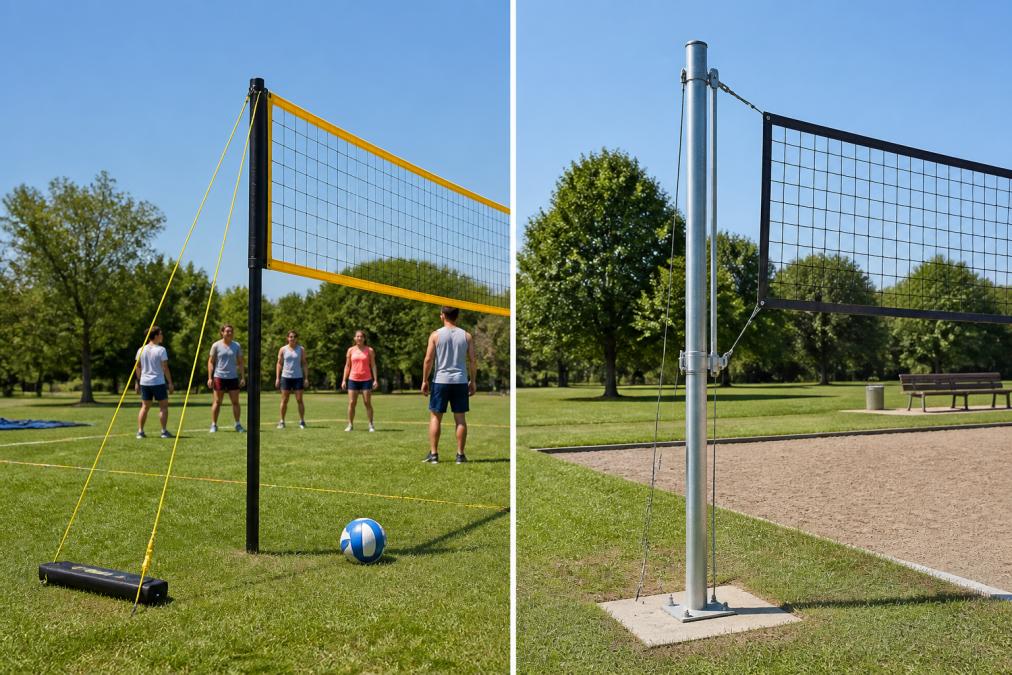
Volleyball net systems for clubs fall into two categories: portable systems that move between courts, and semi-permanent systems installed for the long haul. The right choice depends on how often your club plays and whether your court location is fixed.


Portable Systems for Grass, Sand, and Hard Courts
The Gared Mongoose Wireless Volleyball System is the pick for clubs that rotate between surfaces. It uses a cable-free design with tool-free setup, so coaches can raise a net on grass, sand, or hard court without tensioning hardware. That matters when your club runs clinics at multiple sites in one week.
Semi-Permanent Standards for High-Traffic Outdoor Courts
For a fixed court that sees daily use, the Gared Sideout Outdoor Volleyball System with 3-1/2in standards is built for schools, parks, and recreation centers. The larger post diameter adds stability under repeated play. Clubs with lighter traffic can step down to the 2-3/8in OD version, which keeps installation flexible while still delivering a stable setup.
Replacement Nets and Court Equipment That Keeps Play Moving
A net is often the first thing to fail on an outdoor court. Weather exposure and repeated tensioning can wear the cable and tape, so clubs may consider budgeting for replacement nets as a recurring line item.
Match the net to your post spacing. The Gared Sideout Outdoor Volleyball Net, 32ft fits 36ft post systems, including ODVB, ODVB35, and ODVB40SQ configurations. Clubs running 32ft post systems need the 28ft net instead. Both use weather-resistant construction to hold tension through changing conditions.
Balls, Ball Carts, and Storage Solutions for Practice Efficiency
Practice efficiency can be improved by keeping balls organized. Balls scattered across a gym floor can cost minutes every session, and those minutes can add up over a season.
Match and Practice Balls Built for Club Use
The SportsHeavenClub Pro-Lite Premier NFHS Volleyball is the match-day option. It carries a lightweight microfiber cover, a floating butyl bladder for air retention, and a supplier-listed NFHS approval for official high school play. For daily practice, the SportsHeavenClub 2500 TecSoft Volleyball uses a laminated microfiber PU cover and 2N1P winding to hold shape through heavy repetition.
Ball Racks, Cages, and Team Gear Bags
Storage keeps a gym usable. The Gared 4-Tier Volleyball Ball Rack holds up to 16 balls, while the 3-Tier model holds 12. Programs storing multiple sports in one room should look at the Gared All Sport Deluxe Ball Storage Cage, which suits gyms, schools, and recreation centers.
Volleyball Court Maintenance Best Practices for Club Facilities
Volleyball court maintenance best practices are usually written as a cleaning schedule. That misses the reason club directors actually care: equipment condition is a liability and insurance question, not just a performance one. A net that fails tension mid-match is a safety incident. A post base that has shifted is a hazard you documented or you did not.
The routine below is built around that reality, inspect, correct, and record.
The Weekly Walk-Through
Before the first practice of each week, walk every court and check four things in order:
- Net height and cable tension on each court
- Post bases and anchoring for movement or corrosion
- Net tape and cable ends for fraying
- Ball pressure, rotating older balls to practice-only use
Net tension can be a common failure point. A net that has gone slack can wear its own tape and cable faster, and it can also change the height of the contact point, which may lead to player complaints.
The Monthly Deep Check
Once a month, go past the walk-through:
- Re-check net height and cable tension on every court
- Inspect post bases and anchoring for movement or corrosion
- Look for fraying on net tape and cable ends
- Confirm ball pressure and rotate older balls to practice-only use
- Clear debris and standing water from outdoor courts
- Document any damage with photos before it worsens
Outdoor courts can benefit from clearing debris and standing water every month, as both can accelerate wear on net tape and post finishes. Indoor courts may not require this step as frequently, but the anchoring check remains important, as a loose post base indoors can be easy to miss.
Documentation Is the Part Most Clubs Skip
Photograph damage when you find it, note the date, and keep the record with your facility files. Documenting equipment condition can be helpful for facility management. If a player is injured on a court, questions may arise regarding the equipment's condition and the club's awareness. A dated photo log can provide a record.
NFHS volleyball rules and equipment standards set the competition requirements your facility should verify before sanctioned play. Those standards are also the reference point a facility manager or insurer is most likely to use when reviewing your setup.
When to Repair vs. Replace
A frayed cable end or a net tape that has started to separate may indicate a need for net replacement. Net replacement can be a recurring line item, and budgeting for it ahead of time may be more cost-effective than replacing under pressure mid-season. Minor corrosion or a slightly loose post base is usually a maintenance item, but any movement in the post itself should be addressed promptly.
Building the Maintenance Calendar
Integrating maintenance into your procurement calendar can be beneficial. Inspecting weekly, deep-checking monthly, and reviewing a photo log at the end of each season can help inform replacement decisions. Clubs that follow this process may find that replacement decisions become easier, as the log can indicate which items are failing.
Training Aids and Player Protective Gear: What Club Teams Actually Need
Training aids and protective gear are important categories for club teams. Sometimes, gear is purchased and may not align with how the team trains. Aligning purchases with your drill schedule can be beneficial.
Protective Gear: Buy for Contact Roles, Not for Everyone
Knee pads are a common piece of protective gear for club players, as diving and floor play can involve contact with the floor. Elbow pads can be important for players who frequently make floor contact on defense, and ankle support braces are often used by players returning from a sprain or working back from a rolled ankle.
Outfitting the whole roster identically may not be necessary. A setter who rarely leaves her feet may not need the same padding as a libero. Consider sizing the order to the roles on your roster, and keeping a small stock of spare knee pads in the gear bag, as a pad that blows out mid-tournament may not be replaceable at the venue.
Training Aids That Earn Their Storage Space
A training aid can be a valuable investment if it aligns with your regular drill schedule. Four categories to consider for most clubs include:
| Aid | What it trains | Best fit |
|---|---|---|
| Serving target nets | Serve accuracy and zone placement | Every level; easy to set up on any court |
| Hitting boxes | Approach timing and attack height | Clubs running pin-hitter and middle attack work |
| Setting targets | Setter hand position and location consistency | Programs with dedicated setter training blocks |
| Vertical jump testers | Objective jump measurement across a season | Clubs tracking athlete development |
Serving targets can be an effective aid for improving serve accuracy and zone placement. Hitting boxes can be beneficial as attackers develop, allowing coaches to replicate game-height contacts in practice. Setting targets can be valuable for programs with dedicated setter training blocks.
The Storage Test
Before you buy any aid, ask where it lives when it is not in use. A hitting box is bulky and needs a corner of the gym or a storage room. Target nets fold flat and hang on a hook. Jump testers are small but easy to lose.
A Practical Order of Operations
For a club building this category from scratch, a practical sequence might involve prioritizing knee pads for contact-role players first, then serving targets, followed by a hitting box if your gym has the space, and then measurement tools like a jump tester once a coach is available to record the numbers. Protective gear can protect players, and training aids can offer benefits over a season. Consider funding them in that order.
Budget-Friendly Club Procurement Strategies and Local Sourcing in Carbondale
Club budgets can be optimized when procurement is planned ahead. Grouping purchases of balls, nets, and storage into a single order may reduce freight handling, and prioritizing items that experience wear can be beneficial.
Sourcing from a single supplier can simplify procurement. Consolidating a court equipment order into one delivery may avoid repeated appointment scheduling. Programs searching for volleyball equipment can compare complete systems, replacement nets, and storage on one storefront instead of piecing together orders from multiple vendors.
USA Volleyball club program resources outlines how club programs structure equipment needs across a season, which helps when building a procurement calendar.
Budget priority order for most clubs:
- Replacement nets and cables
- Practice balls in sufficient quantity for drills
- Ball storage that keeps the gym floor clear
- Protective gear for players in contact roles
- Training aids and measurement tools
Conclusion
Building a club equipment roster can benefit from planning. Sports Vista USA carries net systems, replacement nets, balls, storage racks, and court equipment that club programs need, along with basketball, pickleball, and multi-sport facility gear for organizations building out a complete playing environment. Check current availability at Sports Vista USA.
Frequently Asked Questions
What equipment do I need to start a volleyball club?
At minimum, a club needs a net system with posts, a supply of match-quality balls, and storage for both. For outdoor programs, a portable system such as the Gared Mongoose Wireless Volleyball System handles grass, sand, and hard courts with tool-free setup. Add ball racks, protective padding, and replacement nets as your roster grows. Programs running sanctioned high school play should stock NFHS-approved balls like the SportsHeavenClub Pro-Lite Premier.
What are the five key equipment items used in volleyball?
The five core items are the net system (posts, standards, and net), volleyballs, protective knee pads, ball storage such as carts or racks, and court padding or safety gear. Club teams also add training aids like setting targets and hitting boxes. Getting the net system and ball supply right matters most because those two items affect every practice and match your team plays.
How do I choose the right volleyball net system for a commercial facility?
Start with how permanent the court needs to be. High-traffic outdoor facilities benefit from semi-permanent standards, like the 3-1/2 inch Gared Sideout system, because larger-diameter posts add stability. Programs that move between sites or play on multiple surfaces should choose a portable, cable-free option instead. Always confirm post spacing and net size match before ordering, since a 32ft net fits 36ft post systems while a 28ft net fits 32ft systems.
How often should club volleyball equipment be inspected?
Inspect net systems, posts, and padding before every match and at least monthly in depth. Check net tension, look for frayed cables or worn netting, and confirm post anchors are secure. Replace worn nets rather than patching them, since tension problems create safety risks. Balls should be checked for shape and air retention regularly, and any ball that no longer holds pressure should be retired from match play.
What are the benefits of professional-grade volleyball court accessories?
Professional-grade accessories last longer under daily club use and reduce mid-practice failures. Heavy-duty ball racks hold 12 to 16 balls and keep practice flowing, while commercial storage cages organize multi-sport facilities. Durable nets maintain consistent tension, which supports fair play and safer landings. Buying equipment rated for commercial use typically means fewer replacements per season and less disruption to your practice schedule.
Club programs lose practice time to equipment that fails mid-season, and replacing it piece by piece costs more than planning ahead. Sports Vista USA offers semi-permanent and portable volleyball systems, replacement nets sized to your posts, NFHS-approved match balls, and ball storage built for gyms and recreation centers. Check Out the full volleyball lineup and get your court ready before the first practice.


Leave a comment
This site is protected by hCaptcha and the hCaptcha Privacy Policy and Terms of Service apply.