


Table of Contents
- Why Durability Matters in Pickleball Paddles for Seniors
- Quick Comparison: Durable Pickleball Paddles for Seniors
- Warping Point Grasp 16mm: Best for Shock Absorption and Joint Comfort
- Warping Point NightBlade 16mm: Best for Quick Hands at the Kitchen Line
- Warping Point Phoenix 16mm: Best for Competitive All-Court Players
- Budget and Recreational Picks: Ascent Series and Simply Southern Reef
- How to Choose a Pickleball Paddle for Joint Comfort
- Pickleball Paddle Maintenance Tips That Extend Paddle Life
- Frequently Asked Questions
Last Updated: September 10, 2026
Why Durability Matters in Pickleball Paddles for Seniors
Durable pickleball paddles for seniors solve a specific problem: the honeycomb core and face material have to survive years of play while still protecting aging joints from repeated impact. The common failure pattern is predictable, a paddle feels great for six months, then the core softens, the surface slickens, and the player swings harder to compensate. That extra effort lands directly on the elbow and shoulder.
Durability and comfort are the same feature measured in two ways.
How Core Thickness and Face Material Affect Longevity
Thicker cores resist crushing better. A 16mm polypropylene honeycomb core spreads impact across more material per hit, so it deforms less over thousands of strikes. Thinner 13mm profiles feel livelier but compress faster under heavy use.
Face material decides how long the surface stays playable. Raw carbon fiber holds texture far longer than painted or sprayed surfaces, which is why USA Pickleball's equipment standards matter when you're evaluating tournament-legal options.
Quick Comparison: Durable Pickleball Paddles for Seniors
| Paddle | Price | Core | Face | Best For |
|---|---|---|---|---|
| Grasp 16mm | $59.99 | 16mm honeycomb | Raw T700 carbon | Shock absorption |
| NightBlade 16mm | $149.99 | 16mm Flexwave foam | Multi-layer carbon | Quick hands |
| Phoenix 16mm | $219.99 | 16mm PowerDrive | Raw T700 carbon | All-court control |
| Ascent Control/Power | $59.99 | 16mm | Carbon | Budget recreational |
| Simply Southern Reef | $32.99 | 13mm | Printed composite | Casual play |
Warping Point Grasp 16mm: Best for Shock Absorption and Joint Comfort
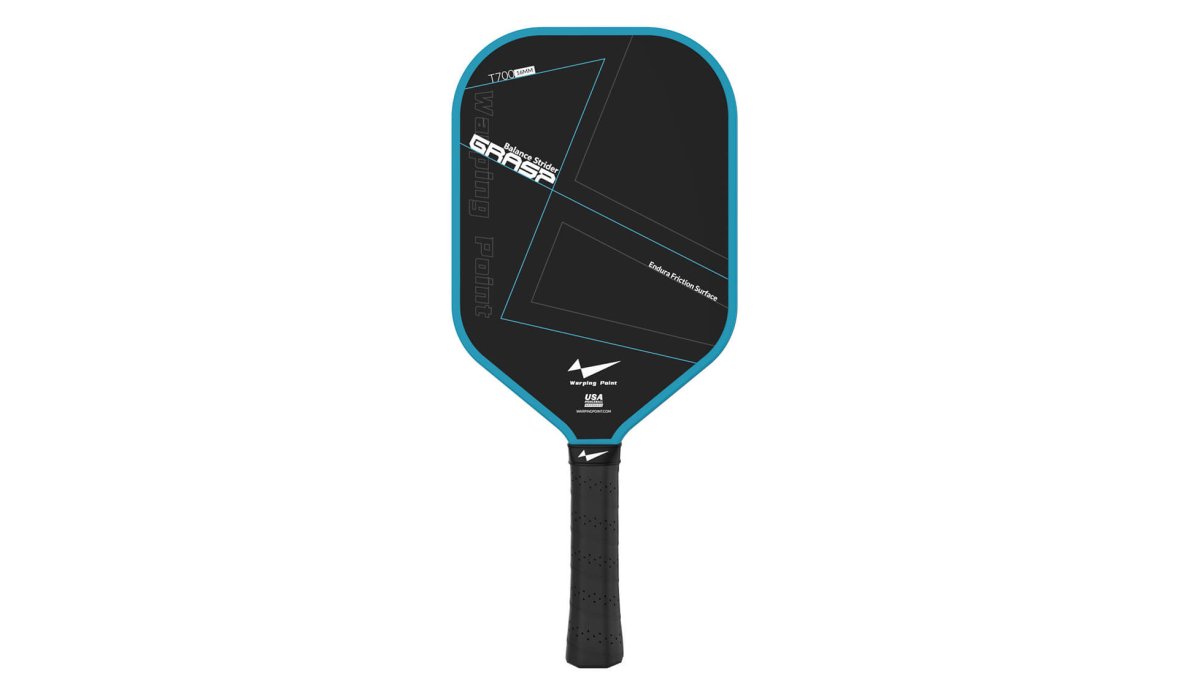
The Grasp Pickleball Paddle - 16mm is our top pick for seniors dealing with arm discomfort. Its 16mm honeycomb core is built for forgiveness and shock absorption, and the thermoformed unibody construction reduces vibration transfer into the handle.

Specs, Price, and Who It Fits
The Grasp measures 16.45 x 7.5 inches with a 5.78-inch handle and a 4.125-inch grip circumference, reach without a bulky feel. At $59.99, it is the strongest value here for anyone whose primary concern is arm comfort.
Warping Point NightBlade 16mm: Best for Quick Hands at the Kitchen Line
Quick hands at the net demand stability during fast exchanges, and the NightBlade Pickleball Paddle - 16mm delivers it. Its foam-filled Flexwave core balances pop with control, and the textured multi-layer face supports spin on dinks and resets.
At $149.99, the NightBlade sits mid-range. The 5.5-inch handle gives two-handed backhand players extra room, and it carries supplier-listed approvals from both USA Pickleball and UPA-A.
Where it falls short: the foam core feels firmer than a pure honeycomb design, so players with acute joint sensitivity may prefer the softer Grasp response.
Warping Point Phoenix 16mm: Best for Competitive All-Court Players
Competitive seniors who still want to attack should look at the Phoenix Pickleball Paddle - 16MM. The elongated shape adds reach for drives and passing shots, while 16mm PowerDrive construction keeps the feel controlled rather than harsh.
At $219.99, it features TPE foam, a dense honeycomb core, and an EFC edge wall for stability and energy transfer. The 5.6-inch octagonal handle accommodates one- or two-handed grips.
The tradeoff is weight distribution. Elongated paddles generate more use, which can stress the elbow on off-center hits. Pair it with a relaxed grip and let the paddle do the work.
Budget and Recreational Picks: Ascent Series and Simply Southern Reef
Not every senior needs a $200 paddle. The Ascent Pickleball Paddle - Control and its Power counterpart both come in at $59.99 with 16mm profiles, giving budget shoppers the same core thickness as premium models.


For pure casual play, the Simply Southern Reef Pickleball Paddle is a 13mm, 8 oz option at $32.99. It's lighter and easier to maneuver, but the thinner core offers less vibration dampening, so it suits social games more than daily drilling.
How to Choose a Pickleball Paddle for Joint Comfort
Choosing a pickleball paddle for joint comfort comes down to four measurable factors: core thickness, total weight, grip circumference, and handle length. Get them right and you reduce the shock your arm absorbs on every shot; get them wrong and you compensate with a tighter grip and harder swing, exactly how elbow and shoulder pain starts.
- Core thickness: A 16mm polypropylene honeycomb core spreads impact across more material per hit, so less vibration reaches the handle. A 13mm core feels livelier but transmits more energy into your hand and forearm. For daily play, 16mm is the comfort default.
- Total weight: Heavier paddles add stability and plow-through but raise swing effort. Lighter paddles reduce shoulder strain but feel twitchy on off-center hits. Most senior players land in the 7.5 to 8.5 oz range.
- Grip circumference: A grip that is too small forces a tighter squeeze, and that tension travels up the forearm to the lateral elbow. The Grasp 16mm uses a 4.125-inch circumference, smaller than most 16mm paddles, so larger hands should plan on an overgrip.
- Handle length: Longer handles (5.5 inches and up) let you relax the grip and still control the paddle, and give two-handed backhand players room. The NightBlade 16mm and Phoenix 16mm both use 5.5-inch-plus handles.
Matching the Paddle to the Condition You Are Managing
Most buying guides treat 'joint comfort' as one problem. It is not, the paddle that helps arthritis is not always the paddle that helps tennis elbow or a recovering rotator cuff.
- Arthritis in the hands and wrists: Prioritize a larger grip circumference and a softer core. A grip that fills the hand reduces the force needed to hold the paddle, and a 16mm honeycomb core like the one in the Grasp Pickleball Paddle - 16mm softens the sting on mishits. An overgrip adds cushioning without changing balance.
- Tennis elbow (lateral epicondylitis): The enemy is vibration and grip pressure. A thermoformed unibody build like the Grasp's reduces vibration transfer into the handle because there are fewer joints for energy to rattle through. Pair it with a relaxed grip and let the paddle's mass do the work.
- Rotator cuff issues: The enemy is swing effort, especially on serves and overheads. A lighter, head-light paddle reduces how much your shoulder has to lift and decelerate. Avoid adding head weight, which raises swing weight and loads the cuff.
- General age-related stiffness: The enemy is repetition without recovery. Rotating between two paddles gives each core time to rebound and gives your arm a slightly different impact profile on alternating days.
A common pattern is buying the lightest paddle available, then discovering it lacks stability and forces harder swings. Weight is a trade-off, not a score, the right answer is the heaviest paddle you can swing comfortably for a full session.
Tuning Balance Without Buying a New Paddle
If you are unsure about weight, the Pickleball Effect Tungsten Weighted Tape at $28.00 lets you experiment with balance using lead-free tungsten in 0.5g, 1g, or 1.5g per inch increments. Start near the handle to add stability without raising swing weight, then work outward for more plow-through.
A Simple Selection Order
Work through the factors in this order:
- Pick core thickness first (16mm for comfort, 13mm only if speed matters more than shock absorption).
- Pick a weight you can swing for a full session without fading late.
- Check grip circumference against your hand size, and plan on an overgrip if it runs small.
- Confirm handle length supports your grip style, one-handed or two.
- Adjust balance with tape only after you have played the stock setup.
For most seniors managing a joint issue, that sequence lands on a 16mm paddle with a raw carbon face and a grip you can hold loosely. To compare models side by side, the pickleball paddle collection lays out core thickness, face material, and handle specs for each option.
Pickleball Paddle Maintenance Tips That Extend Paddle Life
Most paddle guides stop at what to buy. Almost none explain how to keep a paddle playing like day one, the part that determines whether a 'durable' paddle stays durable. A raw carbon face and 16mm honeycomb core outlast a painted composite face by a wide margin, but only if you protect the two things that fail first: face texture and core shape.
What Actually Wears Out First
- Face texture. Spin comes from face roughness. Painted or sprayed surfaces lose it quickly; raw carbon fiber holds it far longer. Abrasive cleaners and gritty court dust accelerate the loss on any face.
- The core. Polypropylene honeycomb deforms gradually under repeated impact. Heat accelerates it, and moisture is worse: once water reaches the core through a lifted edge guard, the honeycomb can soften and pop drops permanently.
- The edge guard. The paddle's first line of defense. A guard that lifts or cracks lets moisture and grit into the core, the most common cause of premature failure.
- The grip. A worn grip forces you to squeeze harder to control the paddle, and that grip pressure aggravates tennis elbow.
A Maintenance Schedule You Can Actually Follow
- After every session: Wipe the face with a damp microfiber cloth. Skip abrasive cleaners, which strip spin-generating texture. Air-dry before it goes back in the bag.
- Weekly: Inspect the edge guard along its full perimeter. Press it back down if lifted, and stop playing if it has cracked, that is an open door to the core.
- Monthly: Check the grip for glazing and flat spots. Replace it every 40 to 60 hours of play, or sooner if you grip tighter than usual.
- Seasonally: Reassess face texture by feel. When a raw carbon face feels glassy rather than gritty, it has given you most of what it had.
- Storage, always: Keep the paddle flat and out of a hot car. Heat warps cores and loosens edge guards faster than play.
Rotating Two Paddles Is the Cheapest Durability Upgrade
If you play daily, rotating between two paddles gives each core time to recover its shape between sessions and spreads impact load across two faces instead of one. A player who drills five days a week puts the same number of hits on a single paddle in half the calendar time. Two mid-priced 16mm paddles often outlast one premium paddle used daily, and you get a backup for the day a grip or edge guard gives out.
Playing Outdoors in Southern Illinois
Seniors in Carbondale who play outdoors through humid Illinois summers should pay particular attention to storage. Moisture is the quiet killer of honeycomb cores, and a paddle left in a hot car between sessions combines the two worst conditions: heat and humidity. Bring the paddle inside between sessions, store it flat rather than on its edge, and dry the face before it goes in the bag. Indoor play at a climate-controlled facility removes most of this risk.
When to Retire a Paddle
A paddle is done when the face feels glassy, the edge guard is cracked or missing, the core feels soft or dead on center hits, or you notice a rattle when you shake it. Any one of those means it is no longer protecting your arm the way it did when new, and continuing to play usually shows up as elbow or shoulder soreness before it shows up as lost points.
If you are searching for durable pickleball paddles for seniors near me, match core thickness to your comfort needs first, then let price follow. For most players, that means a 16mm paddle with a raw carbon face, a grip you can hold loosely, and a maintenance routine that keeps both alive for years instead of months.
Frequently Asked Questions
What is the best pickleball paddle for seniors?
The best fit depends on how you play. For joint comfort, a 16mm core paddle like the Warping Point Grasp absorbs shock and widens the sweet spot, which helps on off-center hits. Players who want more reach can try an elongated model such as the Phoenix 16mm. Lighter recreational options like the Simply Southern Reef (8 oz) suit casual social play. Match thickness, weight, and grip size to your swing speed and hand size before buying.
Which pickleball paddle is the most durable?
Paddles built with a polypropylene honeycomb core, a carbon fiber face, and thermoformed unibody construction hold up best against repeated play. The Warping Point Neon Gen 3 and Phoenix combine a raw T700 carbon fiber face with a thermoformed build. The Grasp adds an edgeless unibody design that reduces vibration and protects the edge. Face texture and edge guards wear first on any paddle, so inspect those areas monthly.
How often should senior pickleball players replace their paddles?
Replace a paddle when the face texture smooths out, the edge guard cracks, or the core feels dead on center hits. Casual players who play once or twice a week often get a year or more from a well-built paddle. Frequent players, three or more sessions weekly, may notice reduced spin and pop within six to nine months. Rotating two paddles and storing them out of a hot car extends usable life.
Are lightweight paddles less durable than heavier ones?
Not necessarily. Durability comes from core material, face construction, and edge protection, not overall weight. A lightweight paddle with a polypropylene honeycomb core and carbon fiber face can outlast a heavier paddle with a thin composite face. The Simply Southern Reef weighs 8 oz and uses a 13mm profile, while the Grasp and NightBlade use 16mm cores with carbon faces for more structural stability. Weight affects swing speed and joint stress more than lifespan.
Do carbon fiber faces last longer than composite faces?
Carbon fiber faces generally resist wear better than basic composite or fiberglass faces, and raw carbon textures hold spin longer. The Grasp, Phoenix, Neon Gen 3, and NightBlade all use raw T700 carbon fiber surfaces. The Osaka Pro Tour uses T700 SC Toray carbon with a textured friction face. Any textured surface eventually smooths with play, so clean it after sessions and avoid abrasive cleaners to protect spin potential.
Finding a paddle that survives years of play without punishing your arm is harder than it should be, especially when most product pages lead with marketing instead of specifications. Sports Vista USA stocks a focused range of 16mm options with raw carbon faces, supplier-listed approvals, and a 30-day paddle trial on eligible models, so you can test before you commit. Browse the pickleball collection, compare core thickness side by side, and check out with confidence.


Leave a comment
This site is protected by hCaptcha and the hCaptcha Privacy Policy and Terms of Service apply.