


Table of Contents
- How to Buy a Volleyball Net That Fits Your Court
- Outdoor Volleyball Net Options Built for Weather and Wear
- Complete Volleyball Net System vs. Net Only
- Volleyball Net Dimensions: Length, Height, and Post Compatibility
- Volleyball Net Installation: What to Plan Before You Order
- Which Volleyball Net Should You Buy? Matching Setup to Buyer
- Conclusion: Buy Once, Play for Seasons
- Frequently Asked Questions
Last Updated: October 5, 2026
How to Buy a Volleyball Net That Fits Your Court
When you buy a volleyball net, three things decide the outcome: your playing surface, whether you need a net only or a full volleyball net system, and how the net attaches to your posts. Get them wrong and you end up with a net that sags, frays, or never fits.

At Sports Vista USA, we help homeowners, schools, parks, and recreation departments match equipment to the court they actually have, including buyers around Carbondale, Illinois. This guide covers outdoor net options, complete systems, dimensions, and installation planning.
A volleyball net is the mesh barrier suspended between two posts that divides the court and defines legal play height. It is measured by length and top-tape height, and it must match your post spacing to hold tension. Run this checklist before you order:
- Measure the distance between your posts, center to center
- Confirm the playing surface: grass, sand, hard court, or indoor
- Decide whether you need a net only or a complete system
- Check whether your posts are permanent, semi-permanent, or portable
- Confirm the net height you need for your level of play
Outdoor Volleyball Net Options Built for Weather and Wear
Outdoor nets face UV exposure, rain, wind load, and constant re-tensioning, so the material and construction of the tape and mesh matter more than almost any other spec. The Gared Sideout line is built for this: both the 28ft and 32ft versions use weather-resistant construction designed to hold consistent tension.
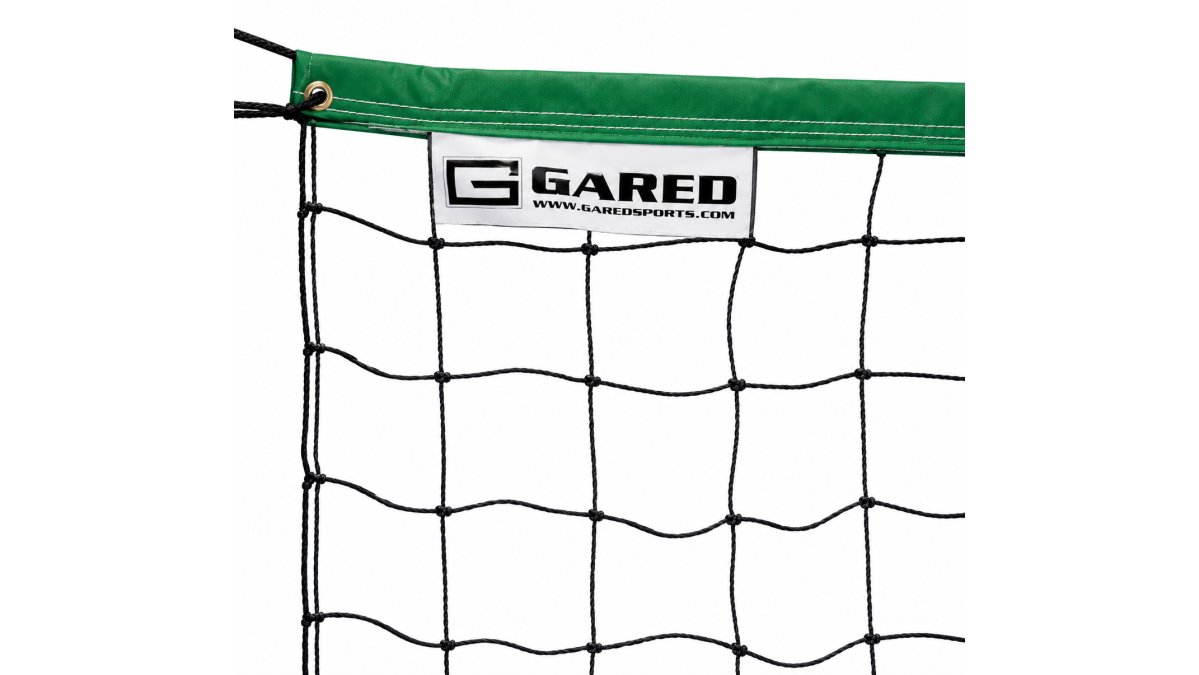
Replacement Nets: The Sideout 28ft and 32ft
The Gared Sideout Outdoor Volleyball Net - 28ft is built for 32ft post systems, including ODVB, ODVB35, and ODVB40SQ configurations. The Gared Sideout Outdoor Volleyball Net - 32ft pairs with 36ft post systems in those same configurations.
Both are net-only products. Posts and hardware are sold separately, which makes them a strong fit if your existing standards are still in good shape and you just need to replace a worn net.
What Weather Resistance Actually Means for Net Life
Weather resistance describes how a net handles UV fading, moisture, and repeated tension cycles without stretching out of shape.
Complete Volleyball Net System vs. Net Only
The core question is whether you already own compatible posts. If you do, a replacement net is the budget-friendly route; if not, a complete system saves you from hunting down matching hardware. A volleyball net system includes the net plus posts, standards, and tensioning hardware; a net-only purchase includes just the mesh and tape.
| Setup Type | What's Included | Best For | Example |
|---|---|---|---|
| Net only | Net and tape | Existing compatible posts | Sideout 28ft or 32ft net |
| Portable system | Net, posts, tensioning | Grass, sand, multi-sport use | Mongoose Wireless System |
| Semi-permanent | Net, standards, hardware | Schools, parks, frequent play | Sideout 2-3/8in OD System |
| Heavy-duty semi-permanent | Net, larger standards, hardware | High-traffic facilities | Sideout 3-1/2in OD System |
Portable, Semi-Permanent, and Permanent Setups Compared
Portable systems move with you. The Gared Mongoose Wireless Volleyball System uses a cable-free, tool-free design for grass, sand, and hard courts, so setup is quick and there is no tensioning hardware to fight with.
Semi-permanent systems stay put for the season but can be removed. The Gared Sideout Outdoor Volleyball System - 2-3/8in OD Semi-Permanent Standards suits backyards, schools, parks, and recreation centers that want more stability than a portable setup.

For high-traffic facilities, the Gared Outdoor Volleyball System - 3-1/2in uses larger diameter standards for added strength.
Volleyball Net Dimensions: Length, Height, and Post Compatibility
Net dimensions are the spec buyers get wrong most often, because length and post spacing are not the same number.
Volleyball net dimensions describe the net's length along the top tape and the height of that tape above the court. Men's and women's competition heights differ, and recreational play often uses a lower setting. The specs below are the ones that actually determine how a net plays.
Reading a Net Spec Sheet Like a Buyer
- Net length. The Sideout line comes in 28ft and 32ft. Length is measured along the top tape, not between the posts.
- Compatible post spacing. 32ft posts for the 28ft net, 36ft posts for the 32ft net. Post system families in the Sideout line include ODVB, ODVB35, and ODVB40SQ.
- Mesh.
- Top tape and bottom tape. The top tape carries the legal height and takes the tension; the bottom tape holds the lower edge and keeps the mesh from riding up. Both should be stitched, not stapled, and wide enough to resist curling.
- Tensioning method. Nets are tensioned by cable, rope, or a built-in strap. Cable tensioning holds a flatter top line and suits permanent and semi-permanent systems; rope tensioning is lighter and easier to adjust by hand, which suits portable setups.
- Height adjustment. Adjustable systems let you move the top tape between men's, women's, and recreational heights. Fixed-height systems lock in one setting. If your court hosts mixed groups, adjustment range is the spec to check first.
Why Post Spacing and Net Length Are Not the Same Number
A net sized for the wrong post system will not tension correctly. Posts too close together leave slack in the middle; posts too far apart mean you cannot reach full tension. That is why the 28ft net pairs with 32ft posts and the 32ft net with 36ft posts: the gap between net length and post spacing is the take-up the tensioning system needs.
Gared Sideout Outdoor Volleyball Net - 28ft →
Height Settings by Level of Play
Height is measured at the top tape, at the center of the net.
The single most useful thing you can do is confirm your post spacing before you buy.
Volleyball Net Installation: What to Plan Before You Order
Installation planning starts before checkout. Three things decide whether your setup works: the surface you play on, how the posts are anchored, and how the shipment reaches you. Here is what changes between a portable, semi-permanent, and permanent court.
Surface Compatibility: Grass, Sand, Hard Court, and Indoor
- Grass. The most common backyard surface. Grass holds a semi-permanent standard well when the soil is stable. Portable bases work for occasional play.
- Sand. Sand needs a base that spreads load rather than a single stake. Portable systems with wide-footprint bases are the usual fit for beach-style play.
- Hard court. Asphalt and concrete need sleeves or anchored plates set into the surface, which makes permanent installation the most sensible choice because the posts do not move once set.
- Indoor. Gym floors use floor sleeves or portable standards with weighted bases. Indoor nets are typically a separate product because the mesh and tape do not need UV or weather resistance.
Anchoring: How Each System Stays Up
- Portable systems rely on weighted or wide bases and a cable-free or strap-based tensioning design. The Gared Mongoose Wireless Volleyball System uses a cable-free, tool-free design for grass, sand, and hard courts.
- Semi-permanent systems use ground sleeves or stakes that hold the standards for the season and allow removal at the end of it. The Gared Sideout Outdoor Volleyball System - 2-3/8in OD Semi-Permanent Standards suits backyards, schools, parks, and recreation centers that want more stability than a portable setup.
- Permanent systems set the standards in concrete or anchored plates. For high-traffic facilities, the Gared Outdoor Volleyball System - 3-1/2in uses larger diameter standards for added strength.
Portability and Setup Trade-Offs
Portability and stability pull in opposite directions. A system that moves easily is lighter and depends on its base or tensioning design for stability; a system that stays put is heavier and anchored, which is why it holds up to daily play. Match the system to how often the court gets used, not to how it looks on day one.
Delivery and Freight: What Buyers in Carbondale Should Expect
These products ship by common carrier because of the size of the posts, net systems, and installation components. Freight is prepaid by Gared and added to your invoice, and a delivery appointment may be required.
For buyers in Carbondale and across southern Illinois, that means planning for a freight delivery rather than a standard parcel drop. Make sure someone is available to receive the shipment, and inspect everything within 3 days of receipt. If anything is missing or damaged, notify support right away with photos of the shipment and packaging.
Which Volleyball Net Should You Buy? Matching Setup to Buyer
The right net depends on what you already own and how the court gets used. Here is how we would match each option to a buyer.
- You have compatible posts and just need a new net: the Sideout 28ft or 32ft replacement net.
- You need a court that moves: the Mongoose Wireless Volleyball System.
- You run a backyard, school, or park court that plays all season: the Sideout 2-3/8in OD Semi-Permanent System.
- You manage a high-traffic facility: the Sideout 3-1/2in OD System.
If you are searching for a volleyball net near me in Carbondale, measure your posts and confirm your surface first, then match the net to those numbers.
Conclusion: Buy Once, Play for Seasons
The wrong net can lead to sagging mesh and re-tensioning. The right one allows for consistent play.
Sports Vista USA stocks outdoor nets, complete systems, and replacement components built for serious play, with weather-resistant construction, post-system compatibility across the Sideout line, and portable options for programs that move. Check Out our volleyball selection and confirm your fit before you order.
Frequently Asked Questions
What should I look for when buying a volleyball net?
Start with three things: net length, post compatibility, and where you'll play. A 28ft net fits 32ft post systems, while a 32ft net fits 36ft post systems, so measure your existing standards first. Then decide between a replacement net and a complete system. If you already own posts and hardware, a net-only purchase like the Gared Sideout Outdoor Volleyball Net saves money. If you're starting from scratch, a full system with standards and net gets you playing sooner.
What is the difference between indoor and outdoor volleyball nets?
Outdoor nets are built with weather-resistant materials that hold consistent tension through wind, sun, and rain. Indoor nets prioritize a different setup, typically anchored to floor sleeves or ceiling systems in a gym. If your court is outside, buy an outdoor volleyball net. The Gared Sideout nets are designed for outdoor durability and are compatible with outdoor post systems such as ODVB, ODVB35, and ODVB40SQ configurations.
Do I need a complete volleyball net system or just a net?
It depends on what you already own. If your posts, standards, and hardware are in good shape, a replacement net is the budget-friendly route. The Gared Sideout Outdoor Volleyball Net comes in 28ft ($189.17) and 32ft ($206.51) sizes. If you need posts and net together, a complete volleyball net system makes more sense. The Mongoose Wireless Volleyball System ($715.27) offers tool-free portable setup, while the Sideout semi-permanent systems with 2-3/8in ($1,205.35) or 3-1/2in ($1,418.06) OD standards suit schools and parks.
How do I set up a volleyball net system for a school or park?
For frequent-use facilities, plan for volleyball net installation before ordering. Confirm your court area, post placement, and delivery access, because semi-permanent systems ship by common carrier and may require a delivery appointment. The 3-1/2in OD Sideout system is built for high-traffic facilities like schools and recreation centers, while the 2-3/8in OD version suits backyard and lighter-use courts. For programs that move between locations, the Mongoose wireless system sets up without tools on grass, sand, or hard courts.


Leave a comment
This site is protected by hCaptcha and the hCaptcha Privacy Policy and Terms of Service apply.