
Table of Contents
- How We Evaluated Basketball Court Accessories for Schools
- Quick Comparison: Top Accessories for School Courts
- Durable Basketball Hoop Padding for Schools: What to Look For
- Maximizing Safety with Basketball Backboard Safety Padding
- Investing in Commercial Grade Basketball Court Equipment
- Training Aids and Storage for Year-Round Programs
- Budgeting and Procurement for Public Schools
- Final Verdict: Choosing the Right Accessories for Your Court
- Frequently Asked Questions
Last Updated: September 9, 2026
Equipping a school gymnasium goes far beyond selecting the right goal. This review of basketball court accessories for schools from Sports Vista USA focuses on the institutional-grade upgrades that protect students, withstand heavy traffic, and simplify maintenance for facility managers.
Basketball court accessories for schools review requires a different lens than consumer shopping. A school system faces continuous play, varying skill levels, and strict safety oversight. Below, we break down the specific products worth the investment and the procurement strategies that help public schools stretch tight budgets.
How We Evaluated Basketball Court Accessories for Schools
Accessories are typically assessed against criteria such as safety compliance, durability under repeated use, ease of maintenance, and total cost of ownership. Safety standards often reference impact absorption and proper anchoring, making padding and mounting hardware important considerations.
Durability often depends on construction materials. Powder-coated steel frames and weather-resistant finishes are indicators of products built for institutional settings. The ability of an item to support multiple sports can also deliver better value for schools.
Accessories that require frequent adjustment, repainting, or replacement parts can create hidden labor costs. Products with straightforward installation and minimal upkeep generally offer better long-term value.
Quick Comparison: Top Accessories for School Courts
| Accessory | Primary Purpose | Best For | Key Consideration |
|---|---|---|---|
| Court Stencil Kit | Accurate line marking | Schools refreshing outdoor courts | Reusable for multiple seasons |
| Solar Court Light | Extended play hours | Facilities without trenching budget | No electrician required |
| Ball Storage Cage | Secure equipment organization | Gyms with multiple sports programs | Lockable, mobile storage |
| Toss Back Training Aid | Skill development | PE classes and team practices | Adjustable for age groups |
| Modular Court Flooring | Resilient playing surface | Outdoor 3x3 or training areas | Drainage-focused design |
Durable Basketball Hoop Padding for Schools: What to Look For
Durable basketball hoop padding for schools must absorb impact while resisting tears, moisture, and UV damage. Impact absorption is the single most important specification.

Look for closed-cell foam wrapped in heavy-duty vinyl or similar puncture-resistant material. The outer cover should feature reinforced seams and secure attachment points that keep padding firmly in place.
Wall-mounted padding behind the backboard deserves equal attention. Continuous padding across this surface reduces injury risk during fast-break plays and aggressive rebounding.
Material Specifications That Matter for Institutional Use
Thickness and density are the primary differentiators between consumer-grade and institutional-grade products. Padding with a minimum thickness of 2 inches is often sought for high-impact zones directly beneath the basket and along the baseline.
The outer vinyl covering should be at least 18-ounce coated fabric with UV inhibitors built into the material rather than applied as a topical spray. Reinforced stitching at all seams prevents the cover from splitting when a player's shoe catches the padding.
Look for continuous anchor channels or heavy-duty straps that secure padding at multiple points. Padding held by a single strap at the top and bottom will rotate over time, creating gaps.
ADA Compliance: A Frequently Overlooked Requirement for School Courts
One aspect of court padding that most general guides miss is compliance with the Americans with Disabilities Act (ADA) for educational facilities. ADA standards affect how court accessories are installed in schools that receive federal funding.
For basketball court accessories in schools, the key ADA consideration is protrusion limits. Wall-mounted padding that extends more than 4 inches from the wall must have its leading edge at or below 27 inches from the floor, or be detectable by a person using a cane.
Padding, ball return systems, and storage cages must not encroach on the clear width required for wheelchair access. Wall padding that runs continuously from the floor to a height of at least 6 feet can serve both impact protection and ADA compliance.
For outdoor courts in Carbondale and across ILLINOIS, any padding or accessory must not create trip hazards or obstruct accessible paths of travel. Verify that post protectors sit flush with the court surface or have beveled edges.
Climate-Specific Durability for Illinois Schools
Schools in Carbondale face a unique combination of climate stressors. Hot, humid summers accelerate vinyl degradation and promote mildew growth. Freezing winters cause condensation inside padding covers, which can freeze and expand, stressing seams.
For outdoor court padding in Illinois, look for materials rated for continuous outdoor exposure with a UV stabilization package. Indoor padding that is used outdoors may show cracking and color fading.
Inspect padding regularly. The freeze-thaw cycle can loosen mounting hardware, so re-torquing all mounting bolts after winter is a recommended practice.
Maximizing Safety with Basketball Backboard Safety Padding
Basketball backboard safety padding extends protection to the most common impact zone on a school court. The area directly beneath and around the basket sees the highest concentration of player contact.
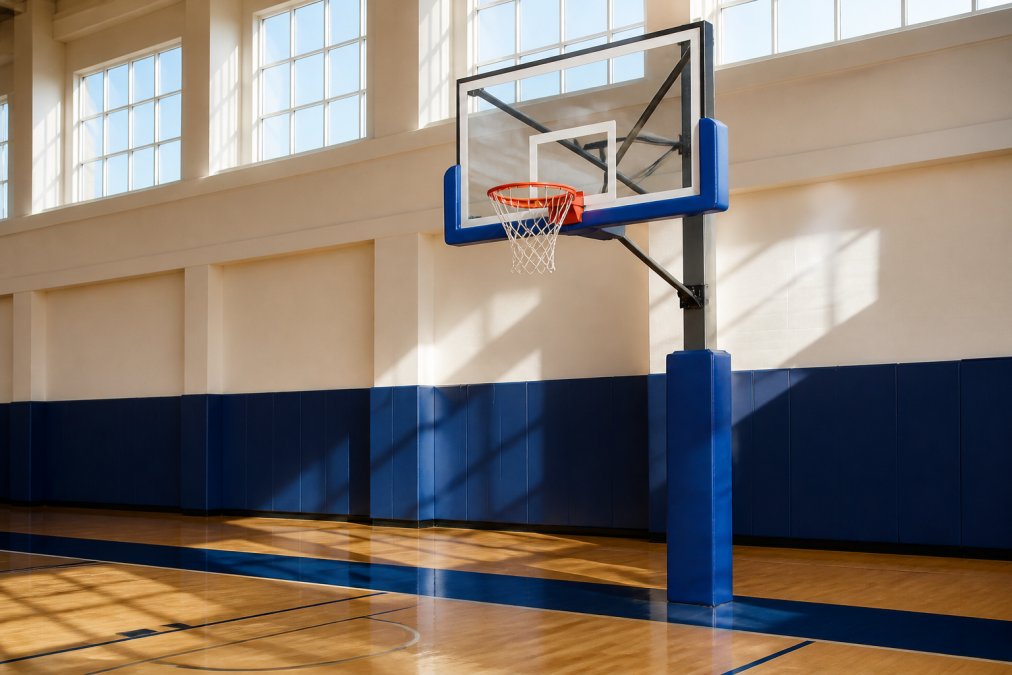
Consider the entire support structure. A post protector sleeve shields players from contact with the goal's vertical support. Many schools also install padding on exposed wall sections and sideline obstructions.
For schools in Carbondale and across ILLINOIS, verify that any padding installed on exterior courts carries a UV-resistant rating suitable for year-round conditions.
Investing in Commercial Grade Basketball Court Equipment
Commercial grade basketball court equipment differs from residential products in construction standards, warranty coverage, and expected service life. Heavy-duty construction using thicker steel and reinforced welds separates institutional equipment from consumer alternatives.
Breakaway rims represent a critical investment for school courts. These rims flex under aggressive dunks and heavy contact, reducing stress on the backboard and protecting players from hand and wrist injuries.
Ball containment netting and ball return systems minimize disruption during practice. Netting behind the backboard catches errant shots, while return systems funnel the ball back to players, maximizing repetition during shooting drills.
Training Aids and Storage for Year-Round Programs
Training aids transform a standard court into a year-round development facility. Rebounders and toss-back equipment let players practice passing, catching, and shooting mechanics without requiring a partner.
[The Gared - Master Toss Back Basketball Training Aid](https://sportsvistausa.com/products/master-toss-back-basketball-training-aid) offers an economical entry point for schools building a skill-development program. Its wide legs with suction cups provide a stable base, while the adjustable frame angle supports varied drills. The unit folds flat for efficient storage between classes.

Programs with larger budgets benefit from the Gared - Varsity Toss Back Basketball Training Aid. This advanced model features an adjustable rebound frame, variable rebound angles, and height adjustment from 4'5" to 7'4", accommodating athletes from elementary through high school. Its roll-around base with casters simplifies movement between stations.

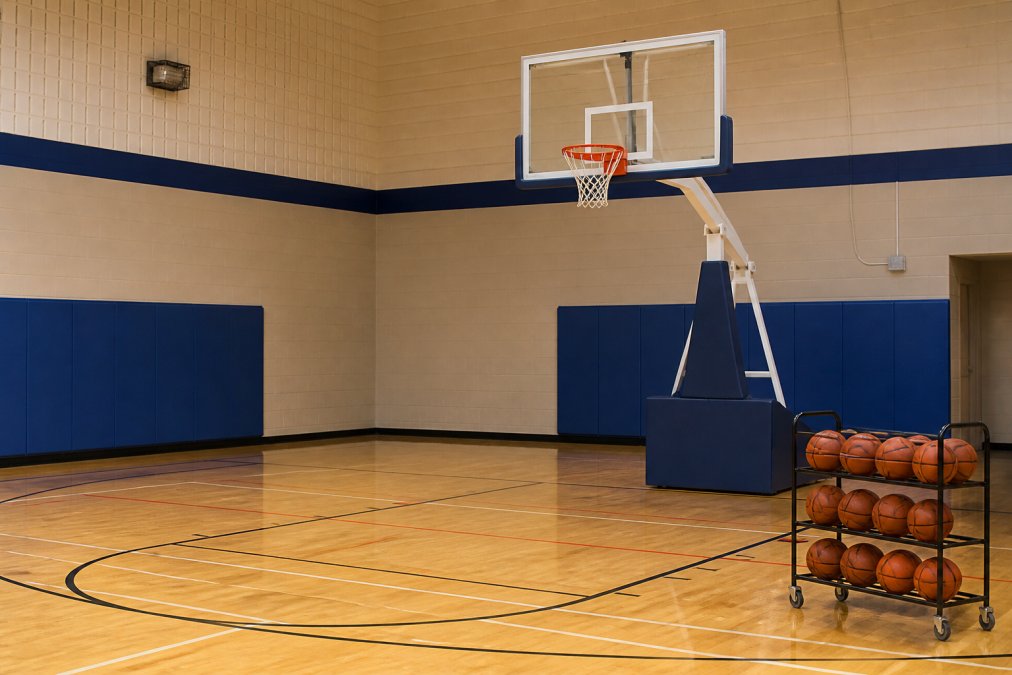
Proper storage protects equipment investment. The Gared All Sport Deluxe Ball Storage Cage secures balls in a lockable, powder-coated cage mounted on swivel casters. This heavy-duty welded wire locker keeps basketballs and volleyballs organized, accessible, and accounted for across multiple programs sharing one facility.
Budgeting and Procurement for Public Schools
Public school procurement follows a different path than private facility purchasing. Budget cycles, bid requirements, and vendor approval lists shape how schools acquire equipment.
Start by identifying the specific accessories needed and their priority order. Safety padding and breakaway rims should outrank cosmetic upgrades. Document the condition of current equipment with photos and maintenance records to strengthen funding requests.
Schools may combine purchases across departments or partner with other districts to secure better pricing. Some states offer cooperative purchasing contracts that can simplify the bid process. Checking with your state's procurement office before issuing a standalone request for proposals can be beneficial.
For outdoor courts, factor in local climate conditions. Schools in Carbondale experience hot summers and freezing winters, so choose weather-resistant finishes and materials rated for temperature swings.
Navigating School District Purchasing Requirements
Public school purchasing is governed by state and local regulations that vary across Illinois. Most districts require formal competitive bidding for purchases above a certain threshold. Below that threshold, districts may use informal quotes or cooperative contracts.
Some joint purchasing programs allow school districts to purchase equipment through contracts that have already been competitively bid, potentially eliminating the need for each district to run its own solicitation. Check whether your district participates in such a program or a regional cooperative.
When a purchase requires a formal bid, write specifications that focus on performance outcomes rather than brand names. Describe the required padding thickness, material composition, impact absorption rating, and warranty period. Avoid specifying a single manufacturer unless you can document that only one product meets your needs.
Grant-Funded Equipment Purchases for Athletic Programs
Many schools fund basketball court accessories through grants that support physical education, after-school programs, and community recreation. Grants, such as the Carol M. White Physical Education Program (PEP) grant, have historically funded equipment for school-based programs. State-level grants may also be available through state boards of education.
When applying for grants, link equipment purchases to measurable program outcomes. A proposal that connects new equipment to measurable program outcomes may score higher than a simple equipment request.
Some grants require matching funds. Identify potential matching sources early, local booster clubs, community foundations, and corporate sponsors in Carbondale and surrounding areas often contribute.
Cooperative Purchasing and Multi-District Collaboration
Beyond state programs, national cooperative purchasing organizations offer contracts that Illinois schools can use. Instead of drafting specifications, advertising a bid, and awarding a contract, a school can issue a purchase order against an existing cooperative contract.
Partnering with neighboring districts may achieve volume discounts. A group of districts that jointly purchase equipment may qualify for pricing typically reserved for larger buyers.
Building a Multi-Year Equipment Replacement Plan
A rotating replacement schedule spreads costs across budget years and prevents the crisis of multiple systems failing simultaneously. A typical plan for a school with two to four courts might allocate funds each year to replace padding on one court, upgrade rims on another, and add storage capacity.
Document the installation date and expected service life of every accessory. Institutional-grade padding and breakaway rims often come with warranties and have expected service lives. Track these timelines in a spreadsheet and review it annually.
Final Verdict: Choosing the Right Accessories for Your Court
Selecting basketball court accessories for schools review comes down to matching each product to your facility's specific demands. Evaluate the age groups using the court, the hours of weekly use, and whether the space hosts multiple sports.
Safety padding and breakaway rims should anchor every school court budget. These components directly protect students and reduce liability exposure. Storage solutions and training aids are strong secondary investments once core safety needs are met.
For facility managers seeking dependable, institutional-grade equipment, Sports Vista USA provides a complete range of basketball court accessories from trusted manufacturers. Our catalog covers safety padding, training equipment, storage solutions, court lighting, and modular flooring systems suited for schools and recreation departments.
Frequently Asked Questions
What are the most durable basketball court accessories for high-traffic school use?
For high-traffic school environments, prioritize accessories built with heavy-duty construction. This includes backboard padding with thick, impact-resistant foam and a weather-resistant vinyl cover, and ball storage cages made from welded wire with a powder-coated finish. These materials withstand daily use and resist vandalism better than consumer-grade alternatives.
How do you choose the right padding for school basketball backboards?
Choose basketball backboard safety padding that meets recognized safety standards for impact absorption. Look for padding that completely covers the backboard's bottom edge and corners, as well as any exposed hardware. A minimum thickness of 2 inches is common for school settings. The padding must have a durable, easy-to-clean cover and a secure mounting system to prevent it from shifting during play.
What safety standards should school basketball equipment meet in Illinois?
School basketball equipment should be installed and maintained to meet the safety expectations of organizations that govern school athletics. This often involves ensuring proper anchoring for portable hoops and using padding that meets impact-attenuation standards. Consulting with your school district's risk management department can help confirm specific compliance requirements for your facilities.
What are the essential maintenance accessories for outdoor school basketball courts?
For outdoor courts, a court marking kit is essential for refreshing faded lines to maintain regulation dimensions. Regularly inspect the court surface for cracks and keep it clear of debris. For the hoops themselves, check that anchoring systems remain secure and that any padding remains firmly attached. A maintenance schedule that includes these checks extends the life of the court and equipment.
Equipping a school court for long-term success requires balancing safety, durability, and budget constraints. Start with the accessories that protect players and extend equipment life, then build out your program's capabilities over time. Check out the full selection of basketball court accessories at Sports Vista USA and outfit your facility with commercial-grade equipment built for serious play.


Leave a comment
This site is protected by hCaptcha and the hCaptcha Privacy Policy and Terms of Service apply.