


Table of Contents
- Why Adjustable Height Pickleball Nets Matter
- Understanding Regulation Pickleball Net Height
- Multi-Sport Flexibility With Adjustable Nets
- Portable Pickleball Net Options for Your Space
- Quick Pickleball Net Setup for Driveways and Courts
- Installing a Pickleball Net for Driveway Play
- Choosing the Right Adjustable Net for Your Needs
- Frequently Asked Questions
Last Updated: October 12, 2026
Why Adjustable Height Pickleball Nets Matter
An adjustable height pickleball net solves a real problem for players and facility managers: one court space can serve multiple sports and skill levels without equipment swaps. This flexibility matters whether you're setting up a driveway court in Carbondale or managing a multi-sport facility.

The standard pickleball net height is 36 inches at the center. But if your court also hosts volleyball, badminton, or tennis, you need different heights. Fixed nets force you to choose one sport or buy multiple systems. Adjustable nets eliminate that choice.
For homeowners and recreation departments alike, this means better space efficiency and lower total equipment costs. Schools appreciate it. Parks use it. Serious players choose it because the ability to adjust height without removing the net saves time and frustration.
Understanding Regulation Pickleball Net Height
Regulation pickleball net height is 36 inches at the center and 34 inches at each sideline. Those two numbers matter together: the net is intentionally lower at the posts so the top edge dips toward the middle, which is why a center strap is required equipment, not an optional accessory.
Here is how the major net sports compare, so you can see why one adjustable frame can serve several games:
| Sport | Net height at center | Net height at posts | Notes |
|---|---|---|---|
| Pickleball | 36 in | 34 in | Center strap required; 22 ft wide |
| Badminton | 5 ft (60 in) at center | 5 ft 1 in at posts | 20 ft wide for doubles |
| Tennis | 36 in at center | 42 in at posts | 42 ft for doubles |
| Volleyball | 7 ft 11 5/8 in (men) / 7 ft 4 1/8 in (women) | Same | 32 ft wide; needs a much taller system |
Two things trip people up. First, the 34-inch post height is not a suggestion, a net strung flat at 36 inches across its full width is out of spec and plays differently on wide shots.
For casual driveway play, a couple of inches rarely changes the outcome of a rally. But if you play in a league, host a ladder, or want your practice to translate to tournament conditions, the 36/34 split is worth verifying every time you set up.
This is where an adjustable net earns its keep. Fixed-height portable nets are built to a single setting and rely on tension alone to hold it. Many portable systems, including the Srikel FlashCourt line, print height markers on the frame so you can confirm the setting without hunting for a tape.

If you also run volleyball or badminton on the same surface, note that volleyball's 7-foot-plus height is a different class of equipment. A pickleball-first adjustable net will not reach it; you need a true multi-sport system with a taller mast, like the Voyager Multi-Sport Net System, which is covered in the next section.
Multi-Sport Flexibility With Adjustable Nets
A single adjustable net can handle pickleball, volleyball, badminton, and tennis. This is the real advantage for shared court spaces.
Here's how the heights stack up:
| Sport | Net Height | Why It Matters |
|---|---|---|
| Pickleball | 36 inches | Center height for regulation play |
| Badminton | 20 inches | Lower net encourages speed and angle shots |
| Tennis | 39 inches | Higher net rewards power and spin |
| Volleyball | 96 inches (men's) / 84 inches (women's) | Much higher; requires different system |
The Voyager Multi-Sport Net System handles pickleball, tennis, badminton, and volleyball with a single crank-adjustable frame. You raise or lower the net without removing it. One person can change heights in seconds.

This matters for schools with shared courts. It matters for parks serving multiple programs. It matters for homeowners who want to host different games without buying separate equipment.
Portable Pickleball Net Options for Your Space
Portable nets come in three main categories: lightweight recreational, mid-range portable, and heavy-duty commercial.
Lightweight recreational nets are best for casual driveway play and practice. The Srikel FlashCourt Mini is an 11-foot half-court net that weighs about 17.8 lbs. It fits in a carry bag and sets up in roughly 60 seconds. This works for families, beginners, and players with limited space.
Full-court portable nets give you regulation width (22 feet) but stay portable. The Srikel FlashCourt Pickleball Net 3.0 is 36 inches high by 22 feet wide and weighs about 24.8 lbs. It sets up in seconds with no tools.
Heavy-duty commercial nets are built for frequent use in schools, parks, and clubs. The First Team Scorpion Portable Pickleball Net includes weighted bases for stability and non-marking transport wheels. It's heavier and more durable than recreational options, designed for daily setup and takedown.
Your choice depends on how often you play, where you play, and whether you move the net regularly. Driveway players often start with a lightweight option. Facilities that host multiple games daily choose commercial-grade systems.
Quick Pickleball Net Setup for Driveways and Courts
Setting up a portable pickleball net should take minutes, not hours. Most quality systems are designed for speed and simplicity.
The best nets use a collapsible frame with a push-button or snap-lock system. You unfold the frame, lock the legs in place, attach the net, and you're done. No tools. No complicated assembly.
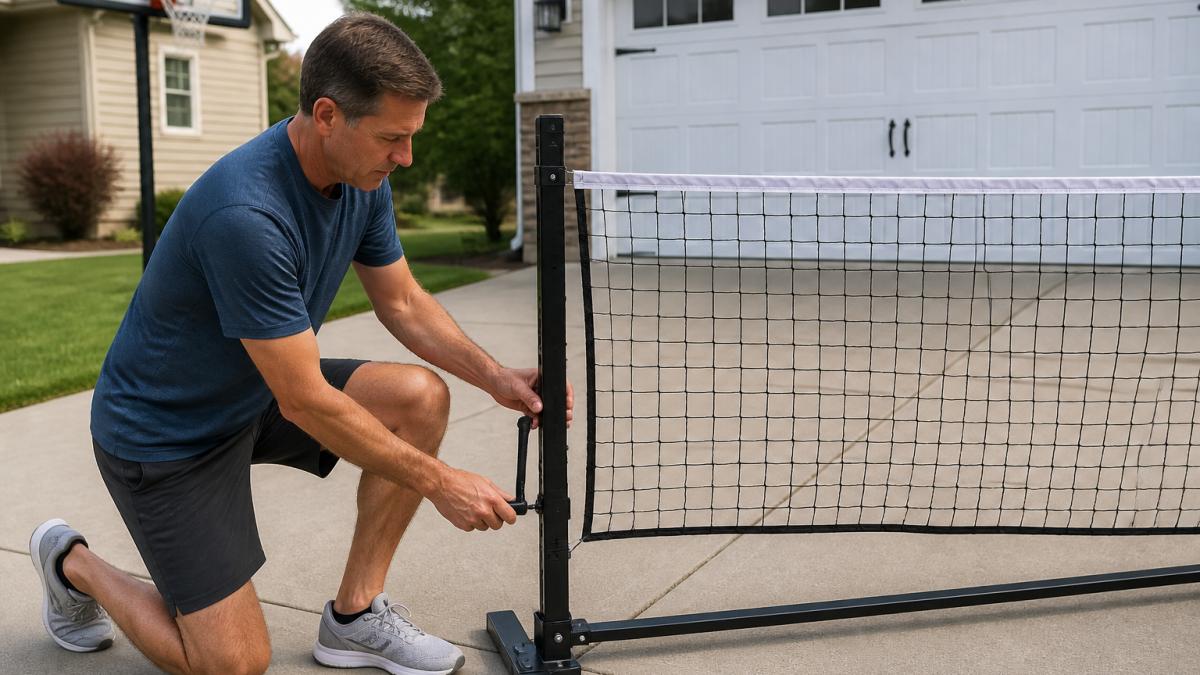
Here's what a typical setup looks like:
- Remove the net from its carry bag
- Unfold the frame fully
- Snap or lock the leg supports into place
- Attach the net to the frame
- Adjust height if needed using marked indicators
- Check that the net is level and tight
Most portable nets reach regulation height (36 inches) automatically when fully assembled. If your net is adjustable, verify the height with a measuring tape or use the printed height markers on the frame.
Srikel FlashCourt Pickleball Net 3.0 | Portable Regulation Net →
For driveway courts in Carbondale, consider your surface. Asphalt, concrete, and grass all work. Grass may shift slightly during play, so check net tension between games.
Installing a Pickleball Net for Driveway Play
Driveway installation is straightforward because portable nets do not require permanent mounting, but getting the layout right the first time saves you from re-measuring every session. Here is the measured procedure most guides skip.
Measure the court before you unfold the net
A regulation pickleball court is 20 feet wide by 44 feet long, with the net splitting it into two 22-foot halves. For casual play you can compress the length, but keep the width at 20 feet so the sidelines stay honest.
- Pick a reference edge, usually the garage face or a driveway seam, and mark your baseline with chalk.
- Measure 44 feet perpendicular to that baseline and mark the far baseline.
- From each baseline corner, measure 20 feet across and mark the sidelines.
- Square the rectangle with the diagonal check: both diagonals of a true 20 x 44 rectangle measure approximately 48 feet 4 inches. If your two diagonals match each other, the corners are square. If they do not, shift the short side until they do.
- Mark the net line at the 22-foot midpoint and set the net there.
A 20 x 44 footprint needs roughly 30 feet of clearance behind each baseline for safe play, so a standard two-car driveway often works for singles and casual doubles but will feel tight for full-court doubles.
Prep the surface
Sweep the driveway clean before setup. Small gravel and grit under the frame feet are the most common cause of a net that will not sit level. If your driveway has a noticeable crown or slope, place the net so the frame legs sit on the flattest section, then check height at both posts, a 1-inch slope across 20 feet will show up as a visible tilt.
Set up and verify
Unfold the frame, lock every leg, attach the net, and confirm 36 inches at center and 34 inches at the posts. Tighten the center strap last. Then walk the perimeter and check that no part of the net or frame sits over a trip hazard like a drain grate or expansion joint lip.
Carbondale weather and seasonal setup
Consider your local weather and seasonal conditions when setting up a driveway net:
- Wind: Portable nets are light by design, so anchoring the frame legs with sandbags or weights can prevent tipping during windy conditions.
- Freeze-thaw: In winter and early spring, driveway surfaces can heave and crack. Set the net on a section that is intact and level.
- UV and storage: Store the net indoors between sessions rather than leaving it assembled in the driveway to protect it from the elements.
- Snow and ice: Avoid setting up on packed snow or ice, as the frame feet may not grip, and the net could shift during play.
If you want a net that handles this routine without fuss, the Srikel FlashCourt Pickleball Net 3.0 sets up tool-free at regulation width, and the Srikel FlashCourt Mini is a lighter half-court option for tighter driveways. Both are built for the take-down-and-store pattern that helps preserve equipment.
Choosing the Right Adjustable Net for Your Needs
The right net depends on three factors: how often you play, where you play, and what sports you want to support.
For casual driveway play: A lightweight portable net like the Srikel FlashCourt Mini works well.
For regular driveway or park play: A full-court portable net like the Srikel FlashCourt Pickleball Net 3.0 gives you regulation dimensions and still stays portable.
For schools, churches, and parks: A multi-sport adjustable system like the Voyager Multi-Sport Net System handles pickleball, volleyball, badminton, and tennis with one crank-adjustable frame.
For facilities that need heavy-duty durability: The First Team Scorpion Portable Pickleball Net includes weighted bases, non-marking wheels, and a commercial-grade frame.
Consider storage space too. Lightweight nets pack into small bags. Commercial systems need more room.
Think about your court surface as well. Concrete and asphalt work with any portable net.
An adjustable height pickleball net transforms how you use your court space.
Sports Vista USA carries portable and adjustable pickleball net systems built for serious play. The Srikel FlashCourt options work for driveway and casual court play.
Frequently Asked Questions
What is the regulation height of a pickleball net?
A regulation pickleball net is 36 inches high at the sidelines and 34 inches high at the center. This lower center height distinguishes pickleball from tennis and volleyball. An adjustable height pickleball net lets you set it to these exact specifications, ensuring fair play whether you're practicing alone or competing with others. Many adjustable systems include height indicators to make finding the correct position quick and accurate.
Can an adjustable pickleball net be used for other sports?
Yes. Multi-sport adjustable nets can accommodate pickleball (36 inches), badminton, tennis, and volleyball at their respective heights. This flexibility makes them ideal for schools, recreation centers, and facilities serving multiple sports programs. A single adjustable system eliminates the need to purchase separate nets for each sport, saving space and money while keeping your court versatile.
How do you set up a portable pickleball net on a driveway?
Most portable pickleball nets use a collapsible frame with a push-button or crank system. Start by unfolding the frame, locking the feet into place, and attaching the net to the frame's clips or hooks. On a driveway, ensure the surface is clean and level to prevent tipping. Check that the net is centered and the height is correct before play. Many portable systems, like the Srikel FlashCourt, set up in about 60 seconds without tools.
How do you keep a portable pickleball net stable on different surfaces?
Stability depends on the net's design and your playing surface. Portable nets with weighted bases or foot locks perform better on smooth surfaces like driveways and indoor courts. For outdoor grass or uneven terrain, look for systems with wider base footprints or the option to add weight. Heavy-duty portable systems designed for facilities often include non-marking wheels and weighted bases to prevent shifting during play.


Leave a comment
This site is protected by hCaptcha and the hCaptcha Privacy Policy and Terms of Service apply.