


Table of Contents
- What Makes Multi-Sport Court Flooring Different
- Modular Sports Court Tiles: Fast Installation and Flexibility
- Concrete vs Asphalt Sports Court Bases
- Basketball and Pickleball Court Flooring: Performance Trade-Offs
- Outdoor Pickleball Court Surface Options
- Traction, Shock Absorption, and Player Comfort
- Maintenance, Durability, and Long-Term Value
- Choosing the Right Multi-Sport Court Flooring for Your Needs
- Frequently Asked Questions
Last Updated: October 17, 2026
What Makes Multi-Sport Court Flooring Different
Multi-sport court flooring isn't one-size-fits-all. It's engineered to balance traction, shock absorption, and ball response across basketball, pickleball, volleyball, and other activities.
A basketball court needs firm, predictable ball bounce and ankle support for lateral movement. Pickleball requires quick court coverage and precise ball control on a smaller surface. Volleyball demands shock absorption for jumping and landing. Traditional single-sport surfaces excel at one thing but compromise on others. Multi-sport flooring splits the difference, delivering acceptable performance across all three without being perfect for any single sport.

This balance matters because many Illinois facilities serve multiple programs. Schools host basketball in winter and volleyball in spring, community centers rotate sports, and homeowners want one court for family play across games. The right multi-sport court flooring adapts without a full surface replacement.
Modular Sports Court Tiles: Fast Installation and Flexibility
Modular sports court tiles are the fastest path to a playable court.
Tiles are typically made from TPE (thermoplastic elastomer), polypropylene, or rubber compounds, locking together through tongue-and-groove or snap-fit systems.
Installation speed is the primary advantage. Modular tiles are ideal for tight timelines or spaces where extended construction would disrupt operations.
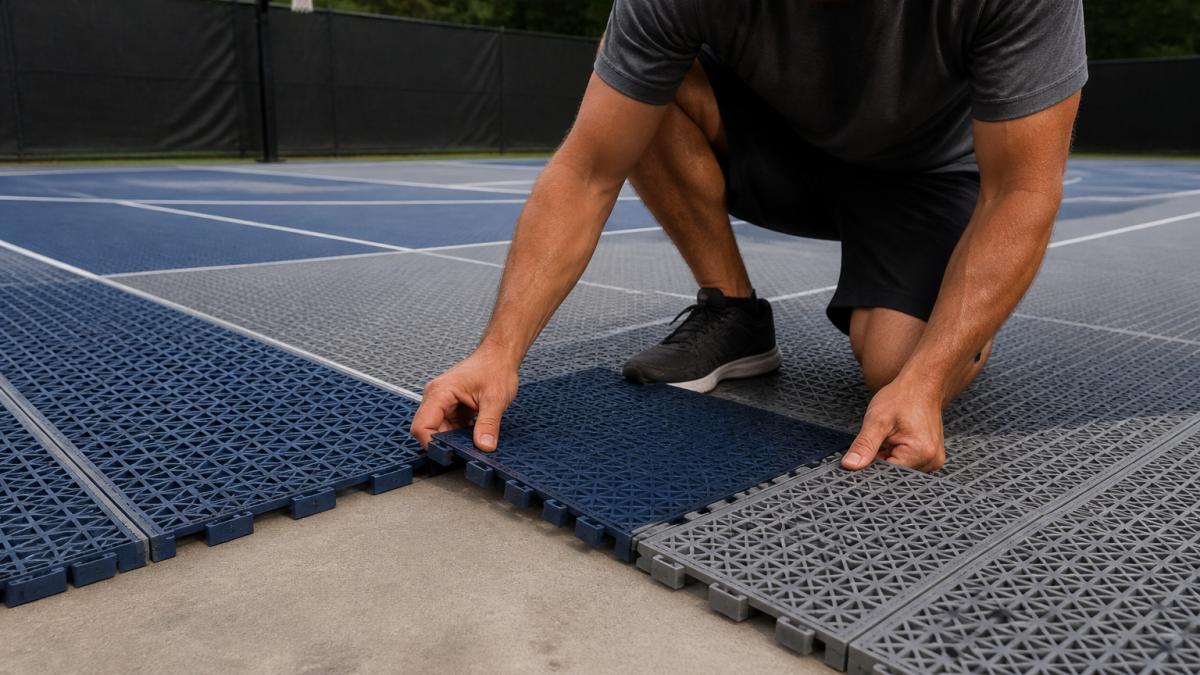
The Enlio 3X3 Basketball Court systems from Sports Vista USA exemplify this approach. The 25' x 54' option provides ample space for serious training or recreational play.

One trade-off: modular tiles don't match the ball response consistency of poured or laid surfaces. Seams create minor irregularities that affect ball roll, fine for casual play and training, though some competitive players notice.
Durability depends on material quality and base preparation. A poorly prepared base causes tiles to shift or settle unevenly. The Enlio systems specify a clean, flat, properly drained base, concrete or asphalt works when in good condition.
Concrete vs Asphalt Sports Court Bases
The base determines how well your court performs and how long it lasts. Concrete and asphalt each have distinct advantages for sports court applications.
Concrete bases are rigid and stable, holding their shape through freeze-thaw cycles that matter in Illinois winters. Concrete resists moisture penetration better than asphalt and lasts longer with minimal maintenance, though it costs more to install.
Concrete's main drawbacks are cost and curing time. It can also crack if soil shifts or freeze-thaw cycles stress it, and repairs are expensive and visible.
Asphalt bases are faster and cheaper to install, ready within days and more forgiving of minor drainage issues or uneven grading. For temporary installations or budget-conscious projects, asphalt makes sense.
Asphalt's limitations are significant in Illinois. It softens in summer heat and becomes brittle in winter cold, expanding and contracting with temperature swings and stressing flooring installed on top. It also oxidizes and degrades over 10-15 years, and water penetrates it more easily, deteriorating the base beneath your court.
For multi-sport court flooring in Carbondale, concrete is the better long-term choice despite higher upfront cost. It handles freeze-thaw cycles predictably and stays stable and level for years. Asphalt works for temporary installations or tight budgets.
| Base Type | Installation Time | Cost | Durability | Best For |
|---|---|---|---|---|
| Concrete | 28+ days (curing) | Higher | 20-30 years | Permanent courts, freeze-thaw climates |
| Asphalt | 3-7 days | Lower | 10-15 years | Temporary courts, budget projects |
Basketball and Pickleball Court Flooring: Performance Trade-Offs
Basketball and pickleball demand opposite things from a court surface. Understanding these trade-offs helps you choose a multi-sport option that actually works for your primary sport.
Basketball courts need firm surfaces with strong, consistent ball response, players make split-second decisions based on how the ball reacts, and a soft surface slows it and makes shooting less predictable.
Pickleball courts need lower bounce and slower ball speed on a smaller court with lighter paddles and a lower net. A soft surface that dampens ball response actually improves play, and extra shock absorption helps players moving laterally in a confined space.
Multi-sport surfaces compromise with mid-range firmness and bounce. Basketball play is slightly less responsive than a dedicated court, and pickleball slightly faster. Most recreational players don't notice; serious athletes sometimes do.
If your facility hosts both sports equally, this compromise is worth accepting. If basketball is dominant and pickleball is occasional, choose a surface optimized for basketball. If pickleball is your primary sport, optimize for that instead.
The Enlio 3X3 systems are designed with basketball as the primary sport. The TPE and SES rubber construction provides the firmness and ball response basketball players expect. Pickleball can be played on these surfaces, but the court performs better for basketball.
Outdoor Pickleball Court Surface Options
Outdoor pickleball courts have expanded rapidly, along with surface options. Pickleball surfaces tend toward softer, slower materials that dampen ball speed and reduce noise.
Acrylic surfaces are common for outdoor pickleball courts, affordable, durable, and consistent. They slow the ball compared to concrete, which pickleball players prefer.
Modular tiles designed specifically for pickleball use softer materials than basketball tiles. These tiles emphasize shock absorption and traction over ball response. They're ideal if pickleball is your primary sport.
Concrete with a specialized pickleball coating is another option. This combines concrete's durability with a softer, slower playing surface.
For multi-sport courts where pickleball is secondary to basketball, standard modular basketball court tiles work fine. Pickleball players will notice the surface is firmer and faster than a dedicated pickleball court, but casual play won't suffer.
The choice depends on your climate and play volume. In Carbondale's weather, acrylic surfaces need occasional resealing, modular tiles require minimal maintenance, and concrete-based systems need periodic recoating.
Enlio 3X3 Basketball Court 25' x 25' – SES Elite Sports Flooring →
Traction, Shock Absorption, and Player Comfort
Three factors determine whether a court feels right to play on: traction, shock absorption, and overall player comfort.
Traction is how much grip the surface provides. Players need enough to cut and stop without slipping, but too much risks ankle injuries when feet stick while the body keeps moving.
Most modern court surfaces provide adequate traction through textured tops or specialized coatings. The Enlio systems use grooved construction that enhances traction while managing water drainage. Traction is rarely a limiting factor in quality court flooring.
Shock absorption determines how much impact your joints experience. Bare concrete transmits shock directly through your feet and legs; soft surfaces absorb it but can feel unstable. The best multi-sport courts balance these extremes.
Basketball players need moderate shock absorption. Too little and repeated jumping causes joint stress. Volleyball and pickleball players benefit from more shock absorption because of constant jumping and lateral movement.
Player comfort combines these factors with surface temperature, sound, and feel. A court that feels good keeps players engaged longer and reduces injury risk, comfort is subjective, but players quickly identify surfaces that feel wrong.
For multi-sport courts in Carbondale, test the surface if possible before committing. What feels comfortable for one sport might feel wrong for another.
Maintenance, Durability, and Long-Term Value
The cheapest court initially often becomes expensive long-term if maintenance and repairs drain resources.
Modular tile systems require minimal maintenance, occasional sweeping or rinsing to remove debris. The Enlio systems are designed for outdoor use, handling rain and temperature swings without the periodic resealing or resurfacing asphalt needs. Damaged tiles are replaced individually.
Concrete and asphalt bases require more attention. Concrete develops cracks that need sealing to prevent water penetration, and asphalt needs resealing every 3-5 years plus replacement after 10-15 years.
Poured surfaces like traditional gymnasium floors need regular maintenance, with refinishing every 5-10 years taking the court out of service.
Modular systems excel at repairability. A damaged tile costs less to replace than repairing a section of poured surface. Expansion or reconfiguration is also straightforward with modular tiles.
Durability depends on material quality and climate. In Illinois, freeze-thaw cycles stress surfaces. Modular TPE and rubber tiles handle this better than asphalt. Concrete handles it well but requires quality installation and proper drainage.
For long-term value in Carbondale, modular tile systems over a concrete base offer the best balance: moderate initial cost, minimal maintenance, and affordable repairs.
| Surface Type | Maintenance | Repair Cost | Lifespan | Best Value For |
|---|---|---|---|---|
| Modular Tiles | Minimal (sweep/rinse) | Low (replace tile) | 15-20 years | Long-term value, flexibility |
| Concrete Base | Moderate (sealing) | Moderate (patching) | 20-30 years | Permanent installations |
| Asphalt Base | High (resealing) | High (resurfacing) | 10-15 years | Budget projects, temporary use |
| Poured Courts | High (refinishing) | High (resurfacing) | 15-25 years | Professional facilities |
Choosing the Right Multi-Sport Court Flooring for Your Needs
Start by identifying your primary sport and how much play the court will receive.
If basketball is primary, choose a surface optimized for basketball with acceptable performance for other sports. Modular basketball tiles like the Enlio systems deliver this balance.
If you're splitting time equally between sports, accept that no surface will be perfect for all of them. Choose the surface that handles your most demanding sport well. Casual players won't notice the compromises.
Consider your site conditions. Modular tiles work well over a stable, well-drained concrete base but aren't ideal over uncertain or settling ground. If you need to install quickly, modular tiles are faster than poured surfaces.
Think about maintenance and budget. Modular systems cost less initially and require minimal maintenance. Poured surfaces cost more but might last longer in a permanent facility.
Test surfaces if you can. Many manufacturers offer sample tiles or installed-court visits, an hour on a candidate surface beats discovering later that it doesn't feel right for your sport.
The Enlio 3X3 Basketball Court systems from Sports Vista USA provide a complete solution for multi-sport courts. The 25' x 25' option suits residential courts and smaller training facilities.
Frequently Asked Questions
Can one court surface work for basketball and pickleball?
Yes, multi-sport court flooring can accommodate both sports, but surface choice involves trade-offs. Basketball requires more shock absorption and consistent ball response, while pickleball needs high traction and a firmer surface for quick lateral movement. Modular rubber tiles and synthetic surfaces like polypropylene can support both, though each sport performs optimally on different materials. Your choice depends on which sport is primary and how often each is played on the same court.
What is the best surface for an outdoor pickleball court?
Outdoor pickleball court surfaces should prioritize traction, weather resistance, and drainage. Modular interlocking tiles with textured surfaces provide excellent grip and allow water to drain quickly. Rubber and synthetic materials resist moisture and UV damage. The Enlio SES Elite modular system, for example, features grooved construction designed to move water through the surface and operates across a wide temperature range, making it suitable for year-round outdoor play in varying climates.
How do concrete and asphalt compare for outdoor sports courts?
Concrete and asphalt serve as base layers rather than finished playing surfaces. Concrete is more durable and stable long-term but requires proper drainage and can crack in freeze-thaw cycles. Asphalt is easier to install and repair but degrades faster under UV exposure and temperature swings. Both require a top surface layer, such as modular tiles or rubber, to provide traction, shock absorption, and player comfort. Your choice depends on site drainage, climate, budget, and whether you plan to resurface later.
What should you consider when choosing flooring for a multi-sport court?
Prioritize: (1) which sports will be played most often, (2) indoor or outdoor location and local weather conditions, (3) traction and slip resistance for safety, (4) shock absorption for player comfort and injury prevention, (5) drainage if outdoors, (6) installation timeline and base preparation, (7) maintenance requirements and lifecycle cost. Multi-sport surfaces require compromise, no single material excels at every sport. Match the flooring to your primary use case and accept that secondary sports may not perform at peak level.
Choosing the right multi-sport court flooring means balancing performance, budget, and long-term maintenance. The best option for your facility depends on your primary sport, site conditions, and how you plan to use the court. Sports Vista USA helps customers find solutions that match their specific needs. Explore our basketball court flooring options and let our team help you design a court that works for your facility.


Leave a comment
This site is protected by hCaptcha and the hCaptcha Privacy Policy and Terms of Service apply.