

Table of Contents
- What Defines a Commercial Grade Volleyball Net System
- Quick Comparison Table: Commercial Grade Volleyball Net Systems
- Semi-Permanent Systems for High-Traffic Facilities
- Portable Volleyball Net Systems with Professional Performance
- High School Volleyball Net Height Regulations and Compliance
- Volleyball Net Tensioning Systems and Hardware
- Essential Volleyball Court Accessories for High Schools
- How to Choose the Right System for Your Facility
- Frequently Asked Questions
Last Updated: September 20, 2026
What Defines a Commercial Grade Volleyball Net System
Commercial grade volleyball net systems are engineered for high-traffic facilities that demand durability, consistent performance, and reliable tensioning over extended use. These systems differ from recreational alternatives in post diameter, material composition, and installation method. The distinction matters: commercial systems handle frequent setup cycles, weather exposure, and competitive play without degradation.
What separates commercial from recreational isn't just marketing language. Heavy-duty standards, typically 2-3/8" or 3-1/2" outer diameter, provide the structural integrity schools, parks, and recreation centers require. The net itself uses weather-resistant materials and professional-grade mesh that maintains consistent tension through seasonal shifts and daily wear.
For facilities in Carbondale and across Illinois managing multiple courts or high-volume usage, this category delivers the performance you can't get from lightweight portable systems. The semi-permanent design allows flexibility: you can relocate the system seasonally or for events while maintaining the stability permanent installations provide.
Quick Comparison Table: Commercial Grade Volleyball Net Systems
| System | Type | Post Diameter | Best For | Portability |
|---|---|---|---|---|
| Gared Sideout 3-1/2" | Semi-Permanent | 3-1/2" OD | High-traffic schools and parks | Fixed installation |
| Gared Sideout 2-3/8" | Semi-Permanent | 2-3/8" OD | Flexible facilities needing relocation | Moderate flexibility |
| Gared Mongoose Wireless | Portable | Standard | Multi-sport facilities, camps | Highly portable |
| Gared Mongoose Lt | Lightweight Portable | Standard | Recreational leagues, backyards | Maximum portability |
| First Team Apollo | Recreational Adjustable | Standard | Community centers, schools | Tool-free setup |
Semi-Permanent Systems for High-Traffic Facilities
Semi-permanent volleyball net systems bridge the gap between portable convenience and permanent installation. These systems use ground sleeves and anchoring hardware that allows removal without permanent court damage, making them ideal for schools that share court space or facilities planning seasonal transitions.

The Gared Sideout Outdoor Volleyball System with 3-1/2" OD standards represents the heavier end of semi-permanent options. The larger post diameter delivers enhanced stability for courts handling competitive matches, tournaments, and daily practice sessions. Schools and parks in Carbondale managing multiple courts benefit from the durability, these posts withstand impact, weather cycles, and the repetitive stress of frequent setup and takedown.
Installation requires proper ground preparation and post placement planning. The Sideout system includes the net, posts, and hardware needed for a complete court.
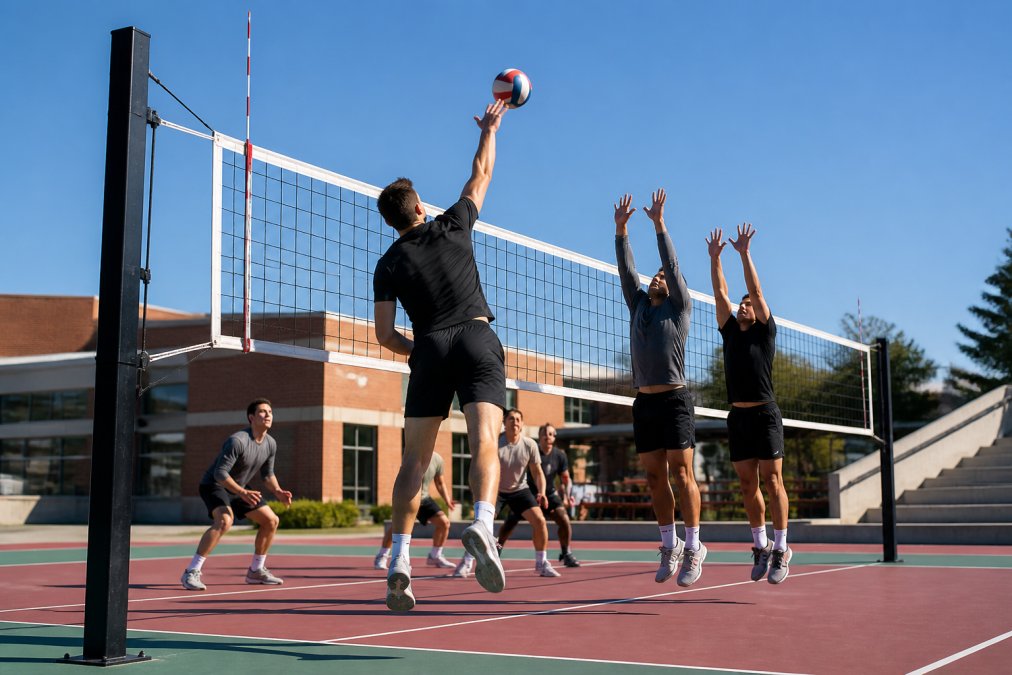
The 2-3/8" OD variant offers a middle ground, still heavy-duty, but with slightly more flexibility for facilities that need to relocate systems seasonally or for special events. Both versions maintain professional-level performance and include weather-resistant net construction that handles sun exposure and moisture without losing tension.
Portable Volleyball Net Systems with Professional Performance
Portable systems sacrifice some permanence for flexibility. The Gared Mongoose Wireless Volleyball System eliminates cables and complicated tensioning hardware, delivering tool-free setup that takes minutes rather than hours. This wireless design works on grass, sand, and hard courts, making it useful for multi-sport facilities or parks that rotate equipment.

The Mongoose Wireless provides consistent net tension without the cable-management headaches of traditional portable systems. For recreation programs, camps, and schools that run multiple courts simultaneously, this matters. Setup speed directly impacts facility scheduling and staff workload.
The Gared Mongoose Lt takes portability further. It's lightweight and affordable, designed explicitly for grass courts and recreational play. Backyards, parks, and recreational leagues use this system for casual and competitive games without the complexity of semi-permanent installations. The tradeoff is durability under heavy use, this system suits occasional or seasonal play better than daily tournament schedules.
Both Mongoose systems ship via common carrier. For facilities in Illinois managing equipment across multiple locations, portability becomes a practical advantage.
High School Volleyball Net Height Regulations and Compliance
Net height standards vary by age group and gender, and compliance matters for official play. High school volleyball follows specific height requirements that differ from elementary, middle school, and recreational settings.
For men's high school volleyball, the net height is 7 feet 11 5/8 inches. For women's high school volleyball, the standard is 7 feet 4 1/8 inches. These measurements are set from the top of the net at the center of the court, measured perpendicular to the ground.
Adjustable systems like the First Team Apollo accommodate multiple age groups and levels of play. The Apollo's telescoping uprights adjust from 5 feet to 8 feet, allowing schools to set proper height for different age groups during practice or recreational play. This flexibility is valuable for facilities serving multiple programs.
The Sideout semi-permanent systems work for dedicated courts, but schools running multiple programs may need adjustable systems or multiple net configurations.
Volleyball Net Tensioning Systems and Hardware
Consistent net tension is what separates professional performance from sagging nets and dead spots. Tensioning systems vary significantly between commercial options, and the difference affects playability, maintenance burden, and long-term cost of ownership.
The Sideout systems use steel cable tensioning with proper anchoring hardware. The cable-based approach is adjustable, you can tighten or loosen tension as needed for court conditions or net age. Cable hardware includes turnbuckles and anchor points rated for the tensioning load; proper installation ensures even force distribution across the net perimeter.
The Mongoose Wireless system eliminates cables entirely, using an internal tensioning mechanism that provides consistent tension without hardware management. For facilities that value simplicity and want to avoid cable maintenance, this wireless design reduces setup friction and eliminates seasonal adjustment cycles.
Gared Outdoor Volleyball System →
Net tapes, the reinforced edges of professional nets, work with tensioning hardware to distribute force evenly and prevent mesh tearing. Weather-resistant net construction used in commercial systems resists UV damage and moisture, maintaining tension stability longer than recreational nets. The Sideout Outdoor Volleyball Net uses weather-resistant construction for outdoor durability.
Replacement nets extend system life. A Sideout Outdoor Volleyball Net replacement (28-foot or 32-foot) is available. Cable systems allow net swaps without post removal; wireless systems also support quick net changes, making both options practical for long-term cost management.
Temperature and humidity can affect tension stability. Wireless systems eliminate some maintenance but offer no field adjustment if factory tension proves inadequate for your court's specific conditions.
Essential Volleyball Court Accessories for High Schools
A complete court setup extends beyond the net and posts. Boundary markers, ball storage, padding, and accessibility features contribute to safety, functionality, and legal compliance.
Storage and Equipment Organization
Ball storage racks keep equipment organized and accessible. The Gared 3-Tier Volleyball Ball Rack holds 12 balls and fits standard indoor facility spaces. For larger programs, the 4-Tier Volleyball Ball Rack accommodates 16 balls. The Gared All Sport Deluxe Ball Storage Cage serves multi-sport facilities managing basketball, volleyball, and other equipment in shared spaces. Organized storage reduces setup time and prevents equipment from becoming obstacles on court edges.
Net and Post Replacement Parts
Replacement nets extend system life. The Sideout Outdoor Volleyball Net in 28-foot and 32-foot lengths are compatible with specific post configurations. Knowing your post system's spacing determines which net size you need: a 32ft net pairs with 36ft post systems, while a 28ft net works with 32ft systems. Stocking replacement nets allows quick court recovery if mesh tears or UV damage occurs, minimizing downtime.
Safety Padding and Obstruction Management
Post padding protects players from contact with standards during play. Safety equipment like padding, boundary line markers, and ground-level obstruction padding should be part of your facility planning. Courts also benefit from proper ground preparation. Level surfaces reduce equipment stress and player injury risk.
ADA Compliance for Public Commercial Courts
Public facilities, schools, parks, recreation centers, must meet Americans with Disabilities Act (ADA) accessibility standards.
- Court access: Wheelchair-accessible routes to and around the court. A minimum 5-foot-wide clear path around the perimeter allows wheelchair users and mobility-aid users to navigate safely.
- Seating and viewing areas: At least 5% of spectator seating must be wheelchair-accessible, with companion seating nearby and unobstructed sightlines.
- Accessible parking and restrooms: Facilities must provide ADA-compliant parking spaces and restroom facilities within a reasonable distance of the court.
- Equipment storage: Ball racks and equipment storage must not obstruct accessible routes.
- Net post placement: Posts must not create trip hazards or obstruct accessible pathways. Ground sleeves used in semi-permanent systems should be flush with or slightly recessed below the court surface to prevent tripping.
How to Choose the Right System for Your Facility
Start by defining your court's primary use. Tournament play and daily practice demand semi-permanent or permanent systems with heavy-duty posts. Recreational leagues and multi-use facilities benefit from portable options that allow flexible scheduling.
Frequently Asked Questions
What features define a commercial grade volleyball net system?
Commercial grade systems are built for high-traffic use and frequent setup/takedown cycles. Key features include heavy-duty posts (typically 2-3/8 inch or larger OD standards), weather-resistant nets that maintain consistent tension, professional-grade hardware, and anchoring systems designed for stability. Semi-permanent and portable commercial systems use reinforced materials and tensioning mechanisms that withstand repeated use in schools, parks, and recreation facilities.
What are the standard height requirements for high school volleyball nets?
High school volleyball nets are set at 7 feet 11 5/8 inches for men and 7 feet 4 1/8 inches for women, according to NFHS standards. Many commercial systems include adjustable height features or telescoping uprights that accommodate different age groups and skill levels. When selecting a system for a high school facility, confirm that the net height can be precisely adjusted to meet these regulatory requirements.
How do indoor and outdoor commercial volleyball systems differ?
Outdoor systems use weather-resistant materials, reinforced posts, and tensioning hardware designed to withstand UV exposure, moisture, and temperature fluctuations. Indoor systems may use lighter materials and simpler tensioning mechanisms since they avoid environmental stress. Commercial outdoor systems typically feature semi-permanent or permanent installation, while portable outdoor systems offer flexibility for multi-sport facilities or temporary court setups.
What volleyball net tensioning systems work best for commercial facilities?
Commercial tensioning systems range from cable-based hardware to wireless, tool-free designs. Heavy-duty systems use ground sleeves, anchoring hardware, and cable tensioning for permanent installations. Portable commercial systems often feature simplified tensioning that maintains consistent net height without complicated setup. The best choice depends on your facility's needs: semi-permanent installations benefit from robust cable systems, while multi-use facilities prefer wireless or tool-free designs for faster transitions between sports.


Leave a comment
This site is protected by hCaptcha and the hCaptcha Privacy Policy and Terms of Service apply.