


Table of Contents
- Why Pickleball Court Maintenance Matters
- Pickleball Court Cleaning Tools You Actually Need
- Step 1: Clear Debris and Prevent Tripping Hazards
- Step 2: Clean the Surface Without Damaging It
- Step 3: Pressure Washing Guidelines for Pickleball Courts
- Step 4: Treat Mold, Mildew, and Algae Growth
- Pickleball Net Maintenance and Hardware Checks
- Seasonal Pickleball Court Care for Midwest Weather
- Frequently Asked Questions
Last Updated: September 19, 2026
Why Pickleball Court Maintenance Matters
Learning pickleball court maintenance is the difference between a court that plays true for a decade and one that cracks within a few seasons. Regular care protects players and your investment at the same time. This guide from Sports Vista USA covers the full routine, from weekly debris removal to Midwest winter prep.
Carbondale sits in a climate that swings hard. Humid summers feed algae growth. Freeze-thaw cycles in January pry open hairline cracks. A court left alone through both seasons ages fast.
Preventative maintenance costs far less than resurfacing. It also keeps the surface texture consistent, so the ball bounces the way it should.
Here's what most guides get wrong: they treat cleaning as cosmetic. It isn't. Dirt and grit grind into the acrylic coating every time someone plays.
Pickleball Court Cleaning Tools You Actually Need
The right pickleball court cleaning tools are simple and inexpensive. You don't need specialty equipment to keep a court in good shape, but the tool set should match the size of the job and the surface you're protecting.
Gather these basics:
- Leaf blower or push broom for debris removal
- Soft-bristle brush for scrubbing stains
- Mild detergent mixed with water
- Floor scrubber with a soft pad for larger courts
- Garden hose with a standard spray nozzle
- Trash bags for collected debris
Avoid wire brushes and harsh acids. They scratch the surface and strip the acrylic coating.
Match the Tool to the Court
A single residential court and a multi-court facility need different kits. Use this as a starting point:
| Court Setup | Debris Removal | Surface Cleaning | Notes |
|---|---|---|---|
| Single residential court | Leaf blower or push broom | Soft-bristle brush and hose | Hand tools are enough |
| Two to four courts | Leaf blower plus wide push broom | Walk-behind floor scrubber | Scrubber saves hours per pass |
| Multi-court facility | Tow-behind blower or rider | Walk-behind or ride-on scrubber | Plan a rotation so no court is skipped |
For facilities with multiple courts, a walk-behind floor scrubber saves hours. Smaller residential courts do fine with a broom and hose.
Don't Forget the Hardware Side
Cleaning tools only cover half the job. Court equipment wears too, and replacing it before it fails is cheaper than repairing the surface it damages. Sagging nets, loose posts, and worn hardware all change how the court plays and how long the surface lasts.
If your net is the weak point, the Dominator Heavy Duty Pickleball Net is a direct replacement option when yours starts sagging. For permanent setups, the Gared Outdoor In-Ground Pickleball System uses durable 3-inch round black posts with a regulation-ready net and is built for year-round outdoor conditions. If you remove posts seasonally, the Gared Pickleball Ground Sleeve Kit keeps sleeves clean and covered between uses.


The American Sports Builders Association publishes guidance on court surface care that's worth reviewing before you buy anything.
Step 1: Clear Debris and Prevent Tripping Hazards
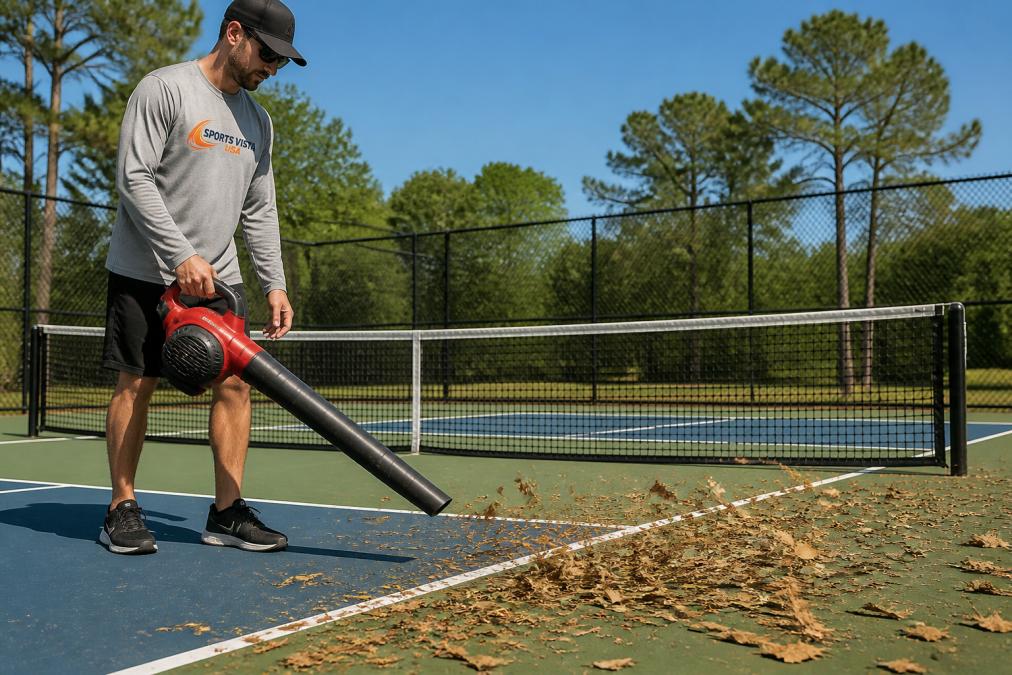
Debris removal comes first, every single time. Leaves, twigs, and sand create tripping hazards and hold moisture against the surface.
Start at one end and work toward the other. Use a leaf blower for dry debris and a broom for anything stuck.
Check these spots closely:
- Court corners where wind piles leaves
- Along the net line and post bases
- Drainage channels and low spots
- Expansion joints and cracks
Sand accumulation is the quiet killer. It acts like sandpaper under shoes and wears down surface texture fast.
Clear debris weekly during heavy leaf season. Twice a month is enough the rest of the year.
Step 2: Clean the Surface Without Damaging It
Surface cleaning is where most court owners cause damage without realizing it. Pressure washing too hard or using the wrong cleaner strips the protective coating.
Mix mild detergent with warm water. Apply with a soft-bristle brush or floor scrubber. Work in sections so the cleaner doesn't dry before you rinse.
For surface staining from leaves or berries:
- Wet the stain with plain water
- Apply a small amount of diluted detergent
- Scrub gently with the soft brush
- Rinse thoroughly
- Repeat if needed
Rinse the whole court when you finish. Leftover soap film attracts dirt and makes the surface slick.
Surface oxidation shows up as a chalky, faded look. It's normal with age and doesn't need aggressive treatment. A gentle clean restores most of the appearance.
Step 3: Pressure Washing Guidelines for Pickleball Courts
Pressure washing works, but only at low settings. High pressure etches the acrylic coating and shortens court life.
Follow these rules:
- Keep the nozzle at least 12 inches from the surface
- Use a wide fan tip, never a pinpoint stream
- Stay under 1,500 PSI
- Keep the wand moving constantly
- Never aim at cracks, seams, or net post bases
Work with the slope of the court, not against it. This pushes water toward drainage instead of pooling it.
One pass is usually enough. Two passes on stubborn areas, no more.
Over-washing is a real problem. Every pass removes a thin layer of coating. Do it twice a year at most, and only when the court genuinely needs it.
Step 4: Treat Mold, Mildew, and Algae Growth
Algae growth and mildew thrive in shade and humidity. Carbondale summers give both plenty to work with.
Signs to watch for:
- Green or black streaks near edges and shaded zones
- Slick patches that stay damp after rain
- Musty smell after wet weather
- Dark spots along fence lines
Treat these with a diluted bleach solution or a commercial court cleaner labeled for acrylic surfaces.
Pickleball Net Maintenance and Hardware Checks
Pickleball net maintenance protects both play quality and player safety. A sagging or loose net changes the game and creates injury risk.
Check these monthly:
- Net tension and height at center and posts
- Post stability and base condition
- Hardware tightness on all bolts and fittings
- Ground sleeves for debris or water buildup
| Task | Frequency | Time Needed |
|---|---|---|
| Debris removal | Weekly | 10-15 min |
| Surface cleaning | Monthly | 30-45 min |
| Net and hardware check | Monthly | 10 min |
| Pressure washing | 2x per year | 1-2 hours |
| Mold and algae treatment | As needed | 30-60 min |
Seasonal Pickleball Court Care for Midwest Weather
Seasonal pickleball court care in Carbondale means planning around two extremes: humid summers and freezing winters. Each season stresses the court differently, and the Midwest's freeze-thaw cycle is the single biggest driver of long-term surface damage.
Why Freeze-Thaw Is the Real Threat
Water seeps into hairline cracks, expansion joints, and low spots. When temperatures drop below freezing, that water expands, prying the crack wider. When it thaws, more water gets in. Repeat that cycle through a Southern Illinois January and small cracks become structural ones.
Drainage Is Your First Line of Defense
Standing water is what feeds both freeze-thaw damage and summer algae. Before each season, check that drainage channels and low spots are clear of leaves, grit, and debris. Water that sheets off the court in minutes does far less damage than water that pools overnight.
Season-by-Season Checklist
Spring: Inspect for freeze-thaw damage. Fill hairline cracks before they spread. Clear winter debris from drainage paths and expansion joints.
Regional Note for Southern Illinois
Carbondale's mix of humid summers and hard freezes is harder on courts than either extreme alone. Courts here tend to show algae in shaded zones by mid-summer and hairline cracking by mid-winter. Building a maintenance calendar around those two windows matters more than following a generic national schedule.
Frequently Asked Questions
How often should a pickleball court be inspected for damage?
A quick walk-through before each session catches surface grit, loose hardware, and small cracks. A full monthly inspection should cover the net tension, post stability, surface texture, and drainage. Scheduling a deeper check each season helps you catch freeze-thaw damage and surface oxidation before they spread. Regular inspections are the core of preventative maintenance and extend court longevity.
What tools are essential for routine pickleball court maintenance?
A leaf blower handles debris removal fast. A soft-bristle brush or floor scrubber works for surface cleaning with mild detergent. You also want a hose for rinsing, a broom for grit and sand accumulation, and basic hand tools for tightening net hardware. Pressure washing equipment helps for deeper cleaning, but only at the right pressure and angle.
How do seasonal changes in Illinois affect pickleball court surfaces?
Midwest weather swings hard between summer heat and winter freezes. Freeze-thaw damage opens cracks, and standing water from poor drainage speeds surface breakdown. Fall brings leaf litter and grit that trap moisture. Winterization and spring resurfacing checks are the two biggest steps to protect an outdoor court through a Carbondale-area winter.
Can I pressure wash a pickleball court surface?
Yes, but with care. Use a wide fan tip and moderate pressure to avoid stripping acrylic coating or etching the surface texture. Keep the wand moving and work in sections. Too much pressure on one spot can damage the coating and create uneven surface staining. For heavy mold or algae, treat the area first, then rinse at lower pressure.
Keeping a pickleball court in top shape takes consistent effort, and the payoff is a surface that plays true for years. Sports Vista USA carries the net systems, ground sleeves, replacement nets, and court lighting that make maintenance and play easier. Browse the pickleball collection to find permanent in-ground systems for parks and schools, or replacement parts for a backyard court. Check Out today and get your court ready for every season.


Leave a comment
This site is protected by hCaptcha and the hCaptcha Privacy Policy and Terms of Service apply.