


Table of Contents
- How Heat Damages Pickleball Paddle Cores
- Signs of Pickleball Paddle Core Crush and Heat Damage
- Why Honeycomb Core Expansion Matters
- Risks of Leaving Paddles in Hot Vehicles
- Pickleball Paddle Storage Tips for Heat Protection
- Cold Weather Impact and Material Fatigue
- Warranty Implications and Paddle Durability
- Frequently Asked Questions
Last Updated: September 21, 2026
How Heat Damages Pickleball Paddle Cores
Heat damages pickleball paddle core materials silently, causing structural failure that often goes unnoticed until permanent damage has occurred.

Pickleball paddles rely on composite materials and adhesives with thermal limits. High temperatures break down chemical bonds, causing core expansion, adhesive weakening, and dramatic performance loss.
Understanding heat damage helps you protect equipment and extend lifespan.
Thermal Expansion and Structural Stress
Heat causes materials to expand at different rates. In multi-layer paddles, this mismatch creates internal stress.
The honeycomb core expands more than outer layers when heated, creating uneven expansion that pulls the structure apart and causes invisible micro-fractures.
Thermal stress doesn't require extreme temperatures; sustained moderate heat causes cumulative damage.
Adhesive Degradation in Composite Construction
Adhesives holding composite paddles together have temperature thresholds. Once exceeded, the adhesive loses its grip.
Thermoformed paddles bond layers with specialized adhesives that cure during manufacturing. Heat exposure later causes them to soften or break down, leading to delamination, layer separation.
Delamination is irreversible. Once the adhesive fails, you cannot restore the bond without complete reconstruction. The paddle becomes unplayable.
Signs of Pickleball Paddle Core Crush and Heat Damage
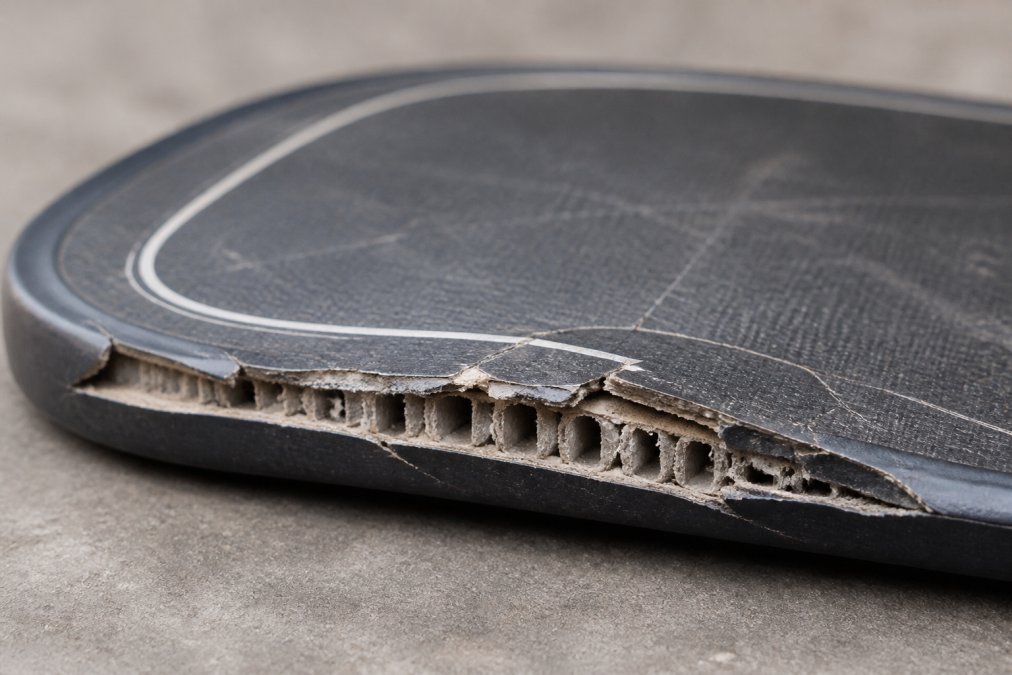
Heat damage signs appear immediately or develop over weeks. Learning to distinguish heat-related failure from impact damage or wear helps catch problems early.
Visual Inspection Checklist: Heat Damage vs. Impact Damage
Start with a close physical inspection of your paddle. The location and pattern of damage reveal the cause:
Heat-specific damage patterns:
- Discoloration or fading that appears uniform across the paddle face or concentrated at edges and perimeter (heat rises and concentrates at boundaries)
- Soft spots or areas that yield to gentle finger pressure, particularly near the edges where adhesive fails first
- Separation between layers visible at the paddle perimeter or along the edges, a clean gap rather than a jagged break
- Cloudiness or haziness inside the core when held to light, indicating honeycomb cell collapse or adhesive breakdown
- Warping or bowing of the paddle face when placed on a flat surface, suggesting uneven core expansion
- Grip area swelling, texture changes, or slight warping (heat affects handle materials differently than face materials)
- Dull or matte finish on the paddle face where it was previously glossy (adhesive breakdown changes surface appearance)
Impact damage (for comparison, different from heat):
- Localized cracks or splits in a specific area, often radiating from a point
- Sharp breaks or splintering at edges
- Indentation or denting in a concentrated zone
- Separation that follows a jagged or irregular pattern
General wear (normal, not damage):
- Surface scratches or scuff marks that don't affect structural integrity
- Minor cosmetic fading from UV exposure over years of play
- Slight grip texture wear from regular hand contact
Delamination often starts at edges where stress concentrates. Heat-induced separation appears as a uniform gap; impact-induced separation is jagged or localized.
Performance Changes You'll Notice During Play
Ball response and feel: Shots feel mushy as the honeycomb core loses rigidity and cells collapse. The bounce becomes inconsistent; off-center hits feel dramatically worse than normal.
Vibration and shock transmission: Heat-damaged paddles transmit more vibration to your hand and arm, causing increased sting and fatigue during play.
Sweet spot shrinkage: The effective sweet spot shrinks noticeably as core drift makes energy distribution uneven.
Spin and control loss: Delamination damages surface texture, reducing spin and dink control.
Consistency between paddles: A paddle that suddenly plays differently from your backup is a red flag for heat damage.
When to Stop Using a Damaged Paddle
Continued use accelerates heat damage; micro-fractures expand and delamination spreads inward.
If you notice multiple signs of heat damage, visual separation plus performance changes, retire the paddle from competitive play. Using a damaged paddle also increases injury risk; the unpredictable performance and increased vibration can strain your arm and wrist.
Why Honeycomb Core Expansion Matters
The honeycomb core is the paddle's skeleton. It provides structure, absorbs impact, and distributes force across the paddle face. Most modern paddles use honeycomb cores because they balance weight, durability, and performance.
Honeycomb cores consist of small hexagonal cells. These cells are mostly air, which makes the core lightweight. The cell walls are made of polymer material. Heat causes these polymers to soften and expand.
Grasp Pickleball Paddle - 16mm →
When core material expands, the cells lose their shape. They compress unevenly. Some cells collapse completely. This process is called core drift. Once it happens, the paddle's structural integrity is compromised. The core can no longer support the paddle face properly.
Core drift is particularly damaging because it's often permanent. The cells don't return to their original shape once they've been crushed by heat. The paddle remains weak even after cooling.
Risks of Leaving Paddles in Hot Vehicles
Hot vehicles are one of the most common sources of paddle damage. A car left in the sun can reach temperatures that exceed 140 degrees Fahrenheit inside. Your paddle sits on the back seat with no protection.
Heat builds quickly in a closed vehicle. Within 30 minutes on a warm day, interior temperatures can climb to dangerous levels for paddle materials. The paddle absorbs this heat directly. The core expands, adhesives soften, and damage begins.
The damage accelerates if the vehicle sits in direct sunlight for hours. A paddle left in a hot car during an afternoon tournament can suffer significant harm in just a few hours. By the time you retrieve it, the damage is done.
Never leave your paddle in a parked vehicle, even for short periods. Store it in a cool location or take it with you.
Pickleball Paddle Storage Tips for Heat Protection
Proper storage prevents heat damage before it starts. The goal is to maintain a stable, cool environment for your paddles year-round.
Year-Round Climate Management
Store paddles in a cool, dry location. The ideal storage temperature stays between 60 and 75 degrees Fahrenheit. Basements, climate-controlled closets, or interior storage rooms work well.
Avoid direct sunlight. UV rays accelerate material degradation and add heat. Store paddles away from windows and exterior walls.
Keep paddles away from heat sources. Don't store near radiators, heating vents, water heaters, or appliances that generate warmth.
Temperature Fluctuation Prevention
Temperature swings cause stress even if average temperatures stay moderate. A paddle stored in a garage experiences wild swings between morning cold and afternoon heat. This repeated expansion and contraction weakens materials.
Cold Weather Impact and Material Fatigue
Heat gets the attention, but cold causes problems too. Extreme cold makes composite materials brittle. Polymer materials lose flexibility when temperatures drop. The honeycomb core becomes rigid and more prone to cracking.
Warranty Implications and Paddle Durability
Most paddle manufacturers include warranties covering defects in materials and construction. Heat damage is often not covered by warranty because it results from user storage and handling practices rather than manufacturing defects. Understanding these distinctions helps you make informed purchases and know what protection you actually have.
What Warranty Typically Covers
Standard paddle warranties protect against:
- Manufacturing defects: adhesive failure that occurs within the first 30-90 days of normal use
- Material defects: composite face material that delaminates due to a flaw in the material itself, not environmental exposure
- Construction defects: structural failure caused by improper assembly or substandard components
Warranties typically do not cover:
- Environmental damage: heat, cold, humidity, or UV exposure
- User storage practices: leaving paddles in vehicles, uninsulated spaces, or direct sunlight
- Wear and tear: normal degradation from extended play
- Impact damage: accidental drops, collisions, or strikes against hard surfaces
- Thermal stress: damage from temperature fluctuations or extreme conditions
The distinction matters because a paddle that delaminates after sitting in a hot car for three hours will not be covered, even if the adhesive itself was manufactured correctly. The failure resulted from user storage, not a manufacturing defect.
How Manufacturers Determine Coverage
When you file a warranty claim for paddle damage, manufacturers investigate the failure pattern:
They look for evidence of heat exposure:
- Uniform discoloration across the paddle (heat signature) vs. localized damage (impact signature)
- Separation pattern: clean gaps at edges (heat) vs. jagged breaks (impact)
- Adhesive residue analysis: some manufacturers can determine whether adhesive failed due to manufacturing defect or thermal breakdown
They assess usage history:
- How long you've owned the paddle
- Whether you can document storage conditions
- Whether the damage pattern matches known manufacturing issues or environmental exposure
Extended Warranties and Heat-Resistant Options
Some manufacturers offer extended coverage for paddles stored in specific conditions. A few premium paddle lines include warranties that cover thermal stress if you maintain storage temperatures within specified ranges (typically 50-85°F). These extended warranties are rare and usually cost more upfront.
Frequently Asked Questions
Can pickleball paddles be left in a hot car?
No. Leaving paddles in hot vehicles exposes them to extreme heat that damages the honeycomb core, weakens adhesive bonds, and causes thermal expansion. Interior car temperatures can exceed 150°F on warm days, far exceeding safe storage limits. Even short periods in a hot vehicle can initiate internal cracking and delamination that compromises paddle performance and structural integrity.
What are the signs of a heat-damaged pickleball paddle?
Heat-damaged paddles show visible surface cracks, delamination (layers separating), discoloration, or a warped paddle face. You may also notice reduced bounce consistency, decreased spin control, and a dull sound on ball contact instead of a crisp pop. Internal cracking may not be visible initially but develops over time as adhesive bonds fail and the honeycomb core loses rigidity.
How should I store my pickleball paddle during summer?
Store paddles in a cool, dry location away from direct sunlight and heat sources. Keep them in a climate-controlled room (65-75°F is ideal) and avoid leaving them in cars, garages, or outdoor spaces. Use a paddle bag or case for protection, and store paddles flat or vertically, never under pressure. In humid climates, use a moisture-absorbing packet inside the storage case to prevent moisture absorption that weakens the composite materials.
Does extreme heat affect the pop and control of a paddle?
Yes. Heat damages the polymer bonds in the honeycomb core and weakens the adhesives holding composite layers together, reducing rigidity and bounce consistency. This causes loss of pop (reduced responsiveness on ball contact) and inconsistent control because the paddle face no longer returns to its original shape uniformly. Performance loss often occurs before visible damage appears, making proper storage critical for maintaining paddle durability.


Leave a comment
This site is protected by hCaptcha and the hCaptcha Privacy Policy and Terms of Service apply.