


Table of Contents
- Why Easy Setup Matters for School Volleyball Programs
- Portable Volleyball Net Systems for Gyms and Multi-Use Spaces
- High School Volleyball Net Height Regulations and System Compatibility
- Semi-Permanent Systems for Dedicated School Courts
- How to Maintain Sand Volleyball Court Padding and Equipment
- Quick Setup Comparison: What Works Best for Your School
- Conclusion: Choosing the Right Easy Setup Volleyball System
- Frequently Asked Questions
Last Updated: August 20, 2026
Why Easy Setup Matters for School Volleyball Programs
Setting up volleyball equipment shouldn't consume half your practice time. Yet many schools struggle with nets that take 20 minutes to tension, posts that require two people to install, and systems that demand tools you don't have on hand. The result: less actual playing time, more frustration, and equipment that sits unused because the hassle isn't worth it.
Easy setup volleyball systems solve this problem directly. At Sports Vista USA, we've worked with athletic directors and coaches who needed solutions that worked within real constraints: limited staff, tight schedules, and multi-use gymnasiums. The systems that win are the ones that get used consistently because they don't punish you for setting them up.
This matters more than most guides acknowledge. A system that takes five minutes to deploy versus thirty minutes changes whether your program runs one practice session or two on court-sharing days. It determines whether recreational leagues actually happen or stay theoretical. For schools managing tight budgets and overlapping sports schedules, setup speed directly impacts program viability.
Below, we'll examine the specific types of easy setup volleyball systems that work for schools, how they compare across different facility needs, and which option fits your situation. We'll also cover the regulatory standards you need to meet and practical maintenance strategies that keep equipment performing for years.
Portable Volleyball Net Systems for Gyms and Multi-Use Spaces
Portable volleyball net systems are built for facilities that can't dedicate a court to volleyball alone. Gymnasiums hosting basketball games, badminton leagues, and volleyball tournaments need equipment that moves on and off the court quickly without permanent installation.
The Gared Mongoose Wireless Volleyball System represents the modern approach to portable volleyball net systems for gyms. Its wireless design eliminates cable management entirely, meaning no tangled lines to untangle before each setup and no tension hardware that requires adjustment. Tool-free setup means your athletic director or a student manager can deploy it without calling maintenance. The system works on grass, sand, and hard courts, making it genuinely multi-purpose.

For schools managing shared court space, this approach saves real time. A traditional cable-tensioned system requires someone to walk the perimeter with a wrench, tightening each anchor point. A wireless system deploys in minutes because the tension mechanism is built into the uprights themselves.
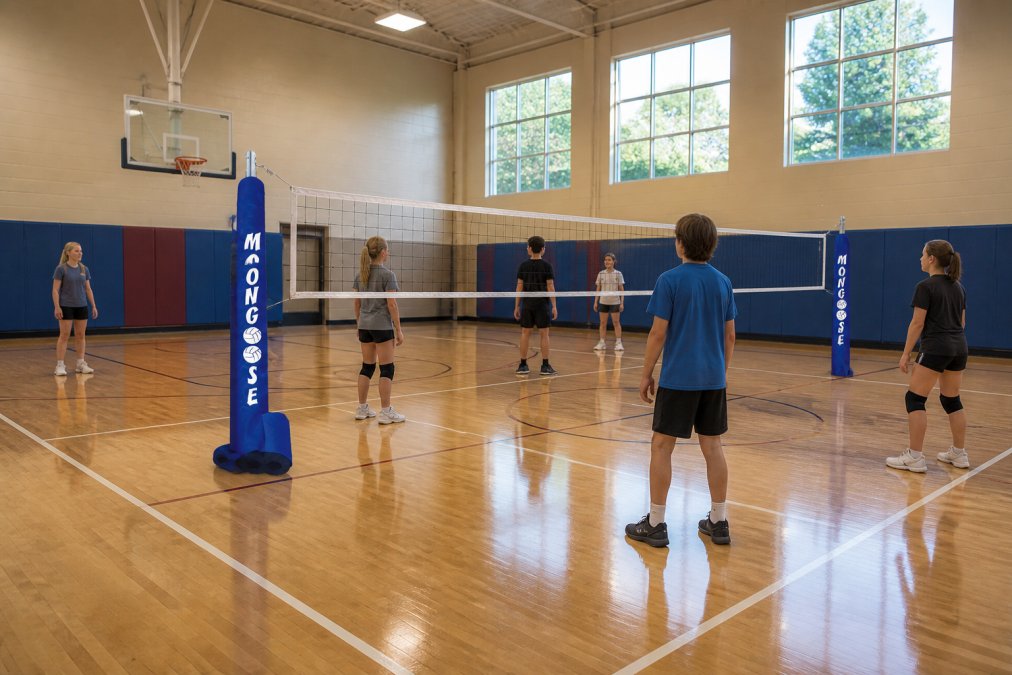
Wireless Systems: Hassle-Free Cable Management
Wireless volleyball systems eliminate the cables, pulleys, and tensioning cranks that make traditional setups complicated. Instead of managing cable tension across multiple anchor points, wireless systems use self-contained uprights where the net carriage locks at your desired height.
This design choice matters for multi-use facilities. When you're switching from basketball to volleyball to badminton within a single day, cable management becomes a bottleneck. A coach can't quickly transition courts if the previous user left cables partially loosened or twisted. Wireless systems remove that dependency entirely.
The Gared Mongoose Wireless System includes consistent net tension across the entire span. You're not adjusting tension at four different points; you set it once and the system maintains it. For competitive play, this consistency is essential. For recreational programs, it's the difference between usable equipment and equipment that feels loose or uneven.
Wireless systems do carry a higher upfront investment than basic portable options. However, schools that run multiple volleyball sessions per week recover that cost through time savings within one season. Less setup time means more practice time, which directly translates to better player development and higher participation rates.
Lightweight Portable Options for Grass and Outdoor Courts
Not every school has dedicated indoor court space. Many programs run outdoor volleyball on grass courts, parking lot installations, or sand courts during warmer months. For these settings, lightweight portable systems are the practical choice.
The Gared Mongoose Lt Volleyball System addresses this use case specifically. It weighs significantly less than semi-permanent systems, making it transportable by two people without equipment. The lightweight design doesn't sacrifice stability; it simply eliminates unnecessary material that outdoor recreational play doesn't require.
Grass court installations benefit from this approach because the setup process is genuinely simple. No ground sleeves to install, no concrete work required. You position the system where you want to play and begin. For schools running recreational leagues or summer camps, this speed matters. A coach can set up the court during lunch and have it ready for afternoon play.
The trade-off is durability under heavy competitive use. Lightweight systems work excellently for recreational volleyball, casual practice, and recreational league play. They're not designed for daily high-intensity competition where net tension and post rigidity face constant stress. For those applications, semi-permanent systems are more appropriate.
High School Volleyball Net Height Regulations and System Compatibility
High school volleyball programs must comply with specific net height standards. The National Federation of State High School Associations (NFHS) establishes these requirements, and they differ between men's and women's play.
Women's high school volleyball nets must be set at 7 feet 4⅛ inches. Men's nets are positioned at 7 feet 11⅝ inches. These aren't arbitrary numbers; they're standardized across all competitive high school programs to ensure fair play and consistent skill development.
Your easy setup volleyball system must accommodate these exact heights. Many portable systems include height indicators marked for different sports. The Gared Mongoose Wireless System and similar models include markings for women's and men's volleyball heights, eliminating guesswork. You align the net carriage to the correct mark, and you're compliant.

This becomes critical when schools host tournament play or invite competitive teams for matches. Visiting teams expect regulation height. If your system can't achieve it, you can't host competitive events. This limitation eliminates some of the cheapest portable options from consideration for schools serious about competitive programs.
Adjustable net height mechanisms are standard on quality portable systems. The mechanism should be smooth and require minimal force to adjust. Systems requiring two people to adjust height or tools to lock the height create friction that discourages proper setup. Look for push-button or crank-based systems that one person can operate.
Semi-Permanent Systems for Dedicated School Courts
Schools with dedicated volleyball courts, or courts shared with other sports where volleyball has priority, benefit from semi-permanent systems. These systems provide stability and consistent performance that portable options can't match, while still allowing seasonal removal if the court needs other uses.
Semi-permanent systems use ground sleeves or floor sockets installed permanently in the court surface. The posts themselves are removable, allowing you to take the system down during basketball season or for major court maintenance. The installation is more involved than portable systems, but the performance improvement is substantial.
The Gared Sideout Outdoor Volleyball System comes in two configurations: 2-3/8-inch OD standards for moderate-use facilities and 3-1/2-inch OD standards for high-traffic schools and parks. The larger diameter posts provide greater rigidity and wind resistance. For a school running daily volleyball practice plus competitive matches, the heavier-duty option makes sense.

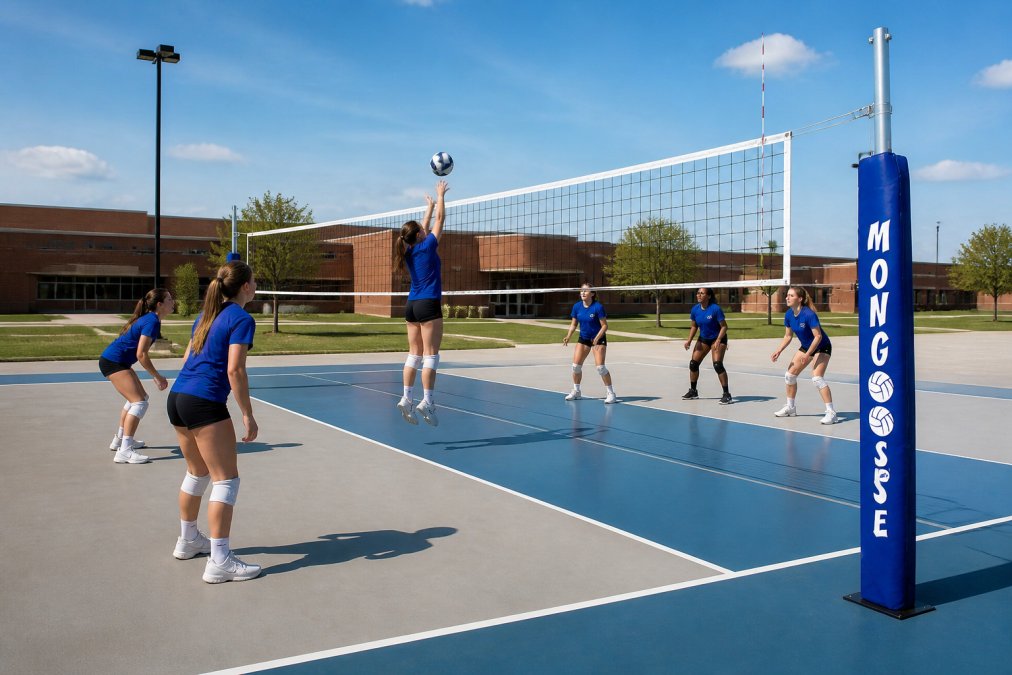
Semi-permanent installation typically requires professional support. You're setting ground sleeves or drilling anchor points, and mistakes here compromise safety and performance. The installation is a one-time cost that pays dividends across multiple seasons. Once installed, setup becomes as simple as inserting posts and attaching the net.
For schools managing outdoor courts that experience seasonal weather changes, semi-permanent systems prove their value. The posts don't shift with temperature changes the way portable systems can. The net tension remains consistent across the season. Maintenance becomes predictable because the system design is stable.
The durability advantage extends equipment life significantly. Portable systems experience wear from repeated transport and repositioning. Semi-permanent systems, once installed, face only the stresses of actual play. This translates to longer equipment life and lower replacement costs over a decade.
How to Maintain Sand Volleyball Court Padding and Equipment
Sand volleyball courts present unique maintenance challenges. The combination of sand, moisture, and constant foot traffic creates conditions that degrade equipment faster than traditional hard courts. Proper maintenance extends the life of your nets, posts, and padding significantly.
Net maintenance begins with regular inspection. Sand particles embed themselves in mesh, creating abrasion points that eventually weaken the net. Rinse your nets with fresh water after use, particularly if they've been in contact with sand. A gentle spray from a hose removes most embedded particles. For deeper cleaning, soak nets in fresh water for 30 minutes, then rinse thoroughly.
Post padding protects players from impact injuries and extends post life by preventing corrosion. Sand court posts face constant moisture exposure, making corrosion prevention essential. Inspect padding regularly for tears or separation. Sand particles work their way behind padding, accelerating deterioration. Replace damaged padding immediately rather than waiting for complete failure.
Ground sleeves and floor sockets in sand courts require attention that hard court installations don't. Sand migrates into these openings, creating buildup that makes post insertion difficult and stresses the locking mechanism. After each season or quarterly during heavy use, clear these openings of accumulated sand and debris.
The net tensioning system requires seasonal maintenance. If your system uses crank-based adjustment, apply light lubricant to the gears before the season begins. Sand particles find their way into mechanical systems, causing stiffness or grinding sounds. Preventive lubrication keeps the system operating smoothly and reduces maintenance emergencies mid-season.
For schools running multiple sand courts, a simple maintenance log tracks when each system was last serviced. This prevents the common pattern where one court gets maintained while others deteriorate. Consistency matters more than frequency; quarterly maintenance on all courts beats monthly maintenance on one court.
Quick Setup Comparison: What Works Best for Your School
Different school situations call for different system types. The right choice depends on your court configuration, usage intensity, and staff capacity.
| System Type | Best For | Setup Time | Portability | Durability | Cost Range |
|---|---|---|---|---|---|
| Wireless Portable (Mongoose) | Multi-use gyms, frequent setup/breakdown | 5-10 minutes | High | Moderate | Mid-range |
| Lightweight Portable (Mongoose Lt) | Outdoor grass courts, recreational play | 10-15 minutes | Very high | Moderate | Budget-friendly |
| Semi-Permanent 2-3/8" (Sideout) | Dedicated courts, moderate use | 15-20 minutes (post insertion only) | Low | High | Mid-to-high range |
| Semi-Permanent 3-1/2" (Sideout) | High-traffic schools, competitive programs | 15-20 minutes (post insertion only) | Low | Very high | Premium range |
For schools with limited storage and tight gym schedules, the Gared Mongoose Wireless Volleyball System wins. Its wireless design eliminates setup complexity while maintaining regulation height and tension. One person can deploy it, and it works on multiple court surfaces.
For outdoor recreational programs or summer camps, the Gared Mongoose Lt Volleyball System delivers affordability and portability without sacrificing basic performance. Setup is straightforward enough that student managers can handle it independently.
For schools committed to volleyball as a primary sport with dedicated court space, semi-permanent systems justify their investment. The 3-1/2-inch OD Sideout system provides the stability and durability that daily competitive play demands.
Many schools benefit from owning multiple system types. A portable wireless system handles multi-use gym situations, while a semi-permanent system serves the dedicated outdoor court. This flexibility allows different programs to operate simultaneously without compromising performance.
Conclusion: Choosing the Right Easy Setup Volleyball System
Easy setup volleyball systems aren't luxury features; they're practical necessities for schools managing complex schedules and shared facilities. The time you save on setup translates directly to more practice hours and better player development.
Sports Vista USA carries the complete range of volleyball systems that schools need: wireless portable options for flexible gym use, lightweight systems for outdoor recreational play, and durable semi-permanent installations for dedicated courts. Each system is designed to be deployed by your existing staff without requiring specialized expertise or external contractors.
The choice comes down to your specific situation. Multi-use gymnasiums benefit from the Gared Mongoose Wireless System's quick deployment and cable-free design. Outdoor recreational programs work best with lightweight portable options. Schools with dedicated volleyball courts maximize performance and longevity with semi-permanent systems.
Explore our complete volleyball equipment selection to find the system that matches your facility's needs and your program's intensity. Contact our team to discuss your specific setup requirements and get recommendations tailored to your school's situation.
Frequently Asked Questions
What features make a volleyball system easy to set up for PE teachers?
Look for tool-free assembly, wireless cable-free designs, and push-button height adjustment. Systems like the Mongoose Wireless Volleyball System eliminate complicated tensioning hardware, allowing PE staff to deploy equipment in minutes. Lightweight materials and included carry bags also reduce setup friction. The best easy setup volleyball systems for schools prioritize speed without sacrificing stability or net tension consistency.
Are portable volleyball systems stable enough for competitive school play?
Yes, quality portable systems deliver competitive-grade stability. Heavy-duty mesh construction, telescoping posts, and proper weight distribution ensure consistent net tension during organized matches. The Apollo Recreational Volleyball System includes protective post pads and boundary rope for safety. For higher-traffic school programs, semi-permanent standards with larger diameter posts provide even greater stability and durability than lighter portable options.
What is the standard net height for high school volleyball according to regulations?
High school volleyball net height regulations specify 7 feet 11 5/8 inches for boys and 7 feet 4 1/8 inches for girls. Multi-sport systems like the Voyager offer crank-adjustable height from 36 inches up to 7 feet 11 5/8 inches, making them ideal for schools serving multiple age groups and skill levels. Always verify your state athletic association rules, as some may have specific installation or equipment standards.
How do I maintain sand volleyball court padding to extend equipment life?
Inspect padding regularly for tears, compression, and wear patterns. Rake sand courts weekly to prevent uneven settling that stresses padding and posts. Remove debris and standing water promptly to prevent material breakdown. Protective post pads should be checked for damage and replaced if worn. Store replacement nets indoors during off-season to preserve weather-resistant coating. Proper maintenance of sand volleyball court padding extends equipment longevity and keeps courts safe for players.
Ready to upgrade your school's volleyball program? Check out our easy setup volleyball systems collection and find the right solution for your facility.
This article was written using GrandRanker


Leave a comment
This site is protected by hCaptcha and the hCaptcha Privacy Policy and Terms of Service apply.