

Table of Contents
- Why Sand Volleyball Court Padding Needs Regular Maintenance
- Volleyball Court Safety Standards Every Facility Should Follow
- Your Monthly Volleyball Court Inspection Checklist
- Step-by-Step: How to Clean Sand Volleyball Court Padding
- When to Schedule Volleyball Post Padding Replacement
- Seasonal Maintenance for Illinois Weather Conditions
- Essential Tools and Replacement Padding to Keep on Hand
- Frequently Asked Questions
Last Updated: September 16, 2026
Why Sand Volleyball Court Padding Needs Regular Maintenance
Sand volleyball court padding is the protective foam and vinyl wrap that covers post bases, net hardware, and boundary structures on a sand court, and it fails faster than most facility managers expect. Sand, sun, and constant contact wear the outer skin until the foam underneath breaks down.
That matters in Carbondale, where outdoor courts sit through humid summers and freeze-thaw winters. A split pad cover lets sand and moisture into the foam, and once that happens, the padding stops absorbing impact. What most guides miss is that padding rarely fails from one big hit. It fails from UV exposure and grit working into seams over months.
Below, we'll show you exactly how to inspect, clean, and maintain sand volleyball court padding so your court stays safe and playable year-round.
Volleyball Court Safety Standards Every Facility Should Follow
Volleyball court safety standards for padding focus on one job: absorbing impact where a player can strike a post, net hardware, or boundary structure. The American Society for Testing and Materials (ASTM) publishes voluntary standards for sports surfacing and playground equipment that most schools, parks, and recreation departments reference when they write padding specs. ASTM F1292, for example, is the widely cited standard for impact attenuation of surfacing systems, and ASTM F355 covers the drop-test method used to measure it. The ASTM standards for sports equipment and surfacing are voluntary, but your insurer, risk manager, or district safety officer will typically ask for evidence that post padding is intact, correctly fastened, and still absorbing impact.
The mechanism that matters is impact attenuation, how quickly a surface slows a falling body. Foam that has compressed flat or hardened from UV exposure stops attenuating and starts transmitting force straight into the player. That is why "the pad is still on the post" is not the same as "the pad is still doing its job."
Key compliance points for any facility:
- Padding must cover the full post base and any exposed hardware at player height, including turnbuckles, winches, and guy-wire anchors
- Fasteners must be recessed or covered so they cannot cut or snag skin on contact
- Padding must be secured so it cannot shift, rotate, or slide up the post during play
- Foam must still rebound after compression, a pad that stays dented has failed attenuation even if the cover is intact
- Damaged or compressed padding must be replaced, not patched indefinitely
For a Carbondale park or school gym, document every inspection with the date, the inspector's name, the finding, and the action taken.
Your Monthly Volleyball Court Inspection Checklist
A volleyball court inspection checklist turns a vague "looks fine" into a repeatable routine. Walk the court once a month during active season, and after every storm.
- Check post padding for tears, cracks, or exposed foam
- Press each pad to confirm it still compresses and rebounds
- Inspect straps, Velcro, and fasteners for wear or missing pieces
- Confirm pads sit flush against the post with no gaps
- Look for sand buildup packed behind the padding
- Check boundary lines and net tension for related wear
- Note any trip hazards around the base
- Record the date, findings, and any repairs needed
Step-by-Step: How to Clean Sand Volleyball Court Padding
Cleaning sand volleyball court padding takes about 20 minutes per post and requires only basic supplies. Do it at the start of the season and again mid-season.
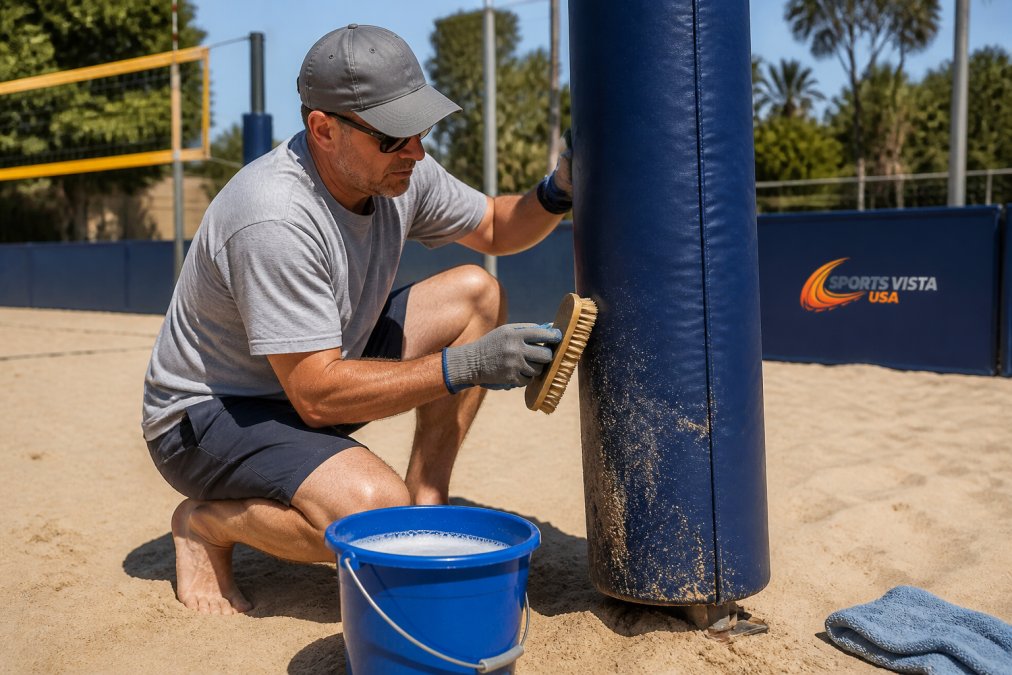
- Clear the base. Sweep sand away from the post footing with a soft-bristle broom so you can see the full pad.
- Rinse loose grit. Use a garden hose on low pressure to wash sand off the vinyl surface. High pressure can force water into seams.
- Scrub the surface. Mix mild soap with water and scrub with a soft brush. Avoid abrasive pads, which scratch the vinyl and speed up UV damage.
- Clean the seams. Work a soft brush along stitched edges and Velcro strips where grit collects.
- Rinse and dry. Rinse with clean water and let the padding air-dry fully before play. Trapped moisture under a pad encourages mold.
- Re-secure the pad. Check straps and fasteners, then confirm the pad sits tight against the post.
A common mistake is using a pressure washer on padded posts. It strips the protective coating and drives water behind the cover, which shortens the pad's life instead of extending it.
When to Schedule Volleyball Post Padding Replacement
Volleyball post padding replacement is due when the foam no longer rebounds, the cover is torn through, or fasteners can no longer hold the pad tight. Don't wait for a full failure.
Replace rather than repair when:
- Foam is compressed flat and stays that way after you press it
- The vinyl cover has a tear longer than a few inches
- Straps or Velcro have lost their grip
- Padding has hardened from sun exposure
- The pad shifts when a player contacts it
Seasonal Maintenance for Illinois Weather Conditions
Illinois weather is hard on outdoor padding. Summer UV degrades vinyl, and winter freeze-thaw cycles crack foam that has absorbed moisture.
Seasonal priorities for Carbondale facilities:
- Spring: full inspection after winter, replace any cracked pads before the season starts
- Summer: clean monthly, watch for UV fading and brittleness
- Fall: deep clean and dry pads before cold weather, tighten all fasteners
- Winter: if the court stays outdoors, remove or cover removable padding to protect it from ice
Essential Tools and Replacement Padding to Keep on Hand
Most sand volleyball maintenance guides assume you have a commercial sifting machine and a full grounds crew. Backyard owners, small parks, and church leagues do not. The gap in many articles is padding-specific repair and small-scale tooling, the stuff you actually need to keep foam and vinyl alive between full replacements.
Small-scale tooling for backyard and small-facility courts
You do not need commercial equipment to maintain padding and the sand around it. A few inexpensive tools cover almost every job:
- Soft-bristle brush or a dedicated vinyl brush, scrubs the pad cover without scratching the protective coating
- Garden hose with a low-pressure nozzle, rinses grit; a pressure washer is the wrong tool here
- Mild liquid soap, lifts organic grime without attacking the vinyl
- Kitty-litter scoop or a small hand sifter, the DIY answer to a commercial sand screener for spot-sifting debris around post bases
- Stiff-bristle push broom, levels sand and pulls it back off the pad base after play
- Cordless drill with a nut driver, tightens recessed fasteners without stripping them
- Inspection log (paper or shared spreadsheet), tracks wear so you replace on a schedule, not on a failure
- Spare straps, Velcro strips, and fasteners, re-secure a pad the same day it loosens
Padding-specific repair protocols
These are important repairs. Do them before the damage reaches the foam.
What to keep on hand
| Tool or Item | Purpose | Frequency of Use |
|---|---|---|
| Soft-bristle brush | Scrub vinyl without scratching | Every cleaning |
| Garden hose with low-pressure nozzle | Rinse sand and grit | Every cleaning |
| Mild soap | Lift grime and organic matter | Every cleaning |
| Vinyl repair patch or marine-grade tape | Seal small cover tears | As needed |
| Spare straps, Velcro, and fasteners | Re-secure loose pads same-day | As needed |
| Hand sifter or scoop | Spot-sift debris around post bases | Monthly |
| Inspection log | Track wear and repairs | Every inspection |
| Replacement pad set | Swap damaged padding fast | As needed |
For replacement padding and court accessories, Sports Vista USA carries volleyball padding, nets, posts, and court equipment for schools, parks, and recreation departments. Ordering replacement pads before the season starts avoids mid-season downtime.
Keep one spare pad and one spare strap set per court on the shelf. A single damaged post should not be the reason a court sits closed for a week while you wait on an order.
Frequently Asked Questions
How often should you inspect volleyball court safety equipment?
Inspect padding and posts before every organized event and conduct a full safety check monthly. Look for cracks, fading, loose straps, and exposed hardware. After storms or heavy use, do a quick visual check. Keep a written log so you can track wear over time and replace padding before it fails. Regular inspections prevent injuries and extend the life of your volleyball court padding.
What are the signs that volleyball post padding needs replacement?
Replace padding when you see deep cracks, crumbling foam, fading color, or straps that no longer hold tight. If the padding slides down the post or feels hard and compressed, it has lost its protective value. Also replace any padding with cuts or tears that expose the inner foam. Addressing these signs early keeps your court compliant with volleyball court safety standards and protects players.
Can weather affect the durability of volleyball court padding?
Yes. UV rays break down foam and fabric over time, while rain and freezing temperatures can cause cracking and water damage. In Illinois, freeze-thaw cycles are especially hard on outdoor padding. Choose weather-resistant padding and inspect it after every storm. Storing removable padding indoors during winter extends its life and reduces the need for frequent volleyball post padding replacement.
How do you clean outdoor volleyball court padding?
Mix mild soap with water and scrub the padding using a soft brush. Rinse with a garden hose and let it air dry completely before use. Avoid harsh chemicals or pressure washers, which can damage the outer vinyl. For stubborn stains, use a vinyl-safe cleaner. Regular cleaning removes sand, dirt, and organic matter that can degrade the padding and keeps your volleyball court padding in good shape.
Maintaining sand volleyball court padding comes down to routine: inspect monthly, clean properly, and replace damaged pads before they fail. Sports Vista USA supplies volleyball padding, nets, posts, and complete court systems built for schools, parks, and recreation programs, along with the replacement components that keep a court safe season after season. Check Out our volleyball court equipment and get the right padding for your facility.


Leave a comment
This site is protected by hCaptcha and the hCaptcha Privacy Policy and Terms of Service apply.