


Table of Contents
- Why Commercial Basketball Court Lighting Solutions Matter for Player Safety
- Basketball Court Lighting Standards Every Facility Should Know
- LED Sports Court Lighting: Efficiency, Output, and Long-Term Value
- Outdoor Basketball Court Light Pole Placement and Layout Planning
- Solar vs. Wired Court Lighting: Which Fits Your Facility?
- Zoning, Light Pollution, and Photometric Analysis: What Most Buyers Miss
- Conclusion: Choosing the Right Lighting for Your Court
- Frequently Asked Questions
Last Updated: September 18, 2026
Why Commercial Basketball Court Lighting Solutions Matter for Player Safety
Commercial basketball court lighting solutions are the engineered systems of poles, fixtures, and controls that deliver safe, playable illumination across a full court surface after dark. For facilities in Carbondale and across southern Illinois, lighting quality decides whether a court is usable after sunset.
Basketball Court Lighting Standards Every Facility Should Know
Basketball court lighting standards define how much light a playing surface needs, measured in foot-candles, and how evenly that light must be distributed. The Illuminating Engineering Society publishes the reference recommendations most designers work from, and IES recommended practice for sports lighting sets the baseline for recreational through professional play.
Foot-Candle Recommendations by Play Level
Foot-candles measure the intensity of light landing on a surface. Higher play levels demand more, from recreational play at the low end to broadcast requirements at the top.
| Play Level | Typical Foot-Candle Target | Primary Use |
|---|---|---|
| Recreational / park | 20-30 | Casual play, community courts |
| High school competition | 30-50 | Games, practices, PE |
| Collegiate / semi-pro | 50-75 | Competitive games |
| Professional / broadcast | 75-100+ | Televised play |
Understanding Uniformity, Glare, and Spill Light
Three properties decide whether a court plays well.
- Uniformity is the ratio between the brightest and dimmest points on the court. A high max-to-min ratio means dark pockets where players lose the ball.
- Glare is light hitting the eye directly from a fixture, blinding shooters and making the ball hard to track.
- Spill light is illumination that escapes the court boundary onto neighbors, roads, or adjacent fields.
LED Sports Court Lighting: Efficiency, Output, and Long-Term Value
LED sports court lighting has replaced metal halide as the default for new and retrofit installations because it delivers more usable light per watt, holds output longer, and responds instantly when switched on.
Metal Halide vs. LED: What Changes on a Retrofit
In commercial retrofits, a facility often replaces a metal halide fixture with a lower-wattage LED fixture and still measures equal or higher foot-candles on the court. The reason is optical efficiency: metal halide lamps emit light in all directions and lose much of it inside the housing, while LED fixtures use directional emitters and shaped optics that push more light onto the playing surface.
Three practical consequences follow:
- Pole and circuit reuse. LED fixtures typically draw less current than the metal halide fixtures they replace, so existing branch circuits and pole wiring can often be reused rather than upsized. Confirm with your electrical engineer.
- Instant restrike. Metal halide fixtures that lose power mid-game need a cool-down and restrike period; LED fixtures return to full brightness immediately, which matters for scheduled games and tournaments.
- Aim and uniformity reset. LED optics throw a different beam pattern, so fixtures must be re-aimed and the layout re-verified against the uniformity target.
Key Specifications: Lumens, Color Temperature, CRI, and IP Ratings
When comparing fixtures, these specifications decide performance:
- Lumen output is total light produced. Match it to your foot-candle target and pole height, not a marketing headline; the same fixture produces very different foot-candles at 20 feet versus 30 feet of mounting height.
- Color temperature is measured in Kelvin. Courts typically sit in the 4000K-5000K range, which reads as crisp white without a harsh blue cast. Mixing color temperatures across poles makes one end of the court look different from the other.
- CRI (Color Rendering Index) describes how accurately colors appear under the light. Higher CRI helps players and officials read uniforms and court markings, and matters more for indoor courts where video is a consideration.
- IP rating describes resistance to dust and water. An IP65 rating means the fixture is protected against dust ingress and water jets, which matters for outdoor courts exposed to rain and irrigation.
| Specification | Why It Matters | What to Verify |
|---|---|---|
| Lumen output | Sets achievable foot-candles at a given height | Delivered lumens, not raw LED lumens |
| Color temperature (K) | Visual consistency across the court | Same Kelvin value on every fixture |
| CRI | Color accuracy for players and officials | Higher value for video and broadcast use |
| IP rating | Dust and water survival outdoors | IP65 or better for exposed courts |
| Lumen maintenance | Output retained over years of nightly use | Published lumen maintenance curve |
| Certification | Tested performance and safety | DLC listing and UL listing |
Look for fixtures carrying DLC certification and UL listing. These confirm the product has been tested against published performance and safety criteria, and often determine eligibility for utility rebate programs.
Matching Fixtures to Court Type
Indoor and outdoor courts place different demands on the same fixture category. Indoor courts are shielded from weather, so IP rating is less critical, but ceiling height, roof structure, and glare off a low ceiling drive beam angle choice. Outdoor courts face wind loading, temperature swings, and direct precipitation, so the pole, mounting bracket, and fixture housing carry more of the durability burden.
Outdoor Basketball Court Light Pole Placement and Layout Planning
Outdoor basketball court light pole placement determines whether the court plays clean or forces players to shoot through glare. The governing principle: light the court from the sides and corners, never from behind the backboard or directly in a player's sightline down the court.

How Many Poles Does a Full-Size Court Need?
A full-size court generally needs four poles for balanced coverage, placed at or near the four corners and set back from the sidelines. Two-pole layouts can work for smaller or half-court setups, but they concentrate light and tend to produce uneven coverage.
Key layout variables:
Dominator 100W LED Solar Court Light →
- Mounting height: higher poles spread light more evenly and reduce glare, but require fixtures with sufficient output and a beam angle matched to the coverage area.
- Setback distance: poles placed too close to the sideline throw light across the court at a shallow angle, creating glare for players on the far side.
- Beam angle: narrow beams concentrate light and suit high mounting; wider beams cover more area at lower heights.
- Aim points: fixtures should aim across the court, not down at the court directly beneath them.
Solar vs. Wired Court Lighting: Which Fits Your Facility?
Solar court lighting suits facilities where running electrical service to the court is impractical, expensive, or slow, while wired systems suit sites with existing power and a need for unlimited runtime. That is the real dividing line, not cost alone.
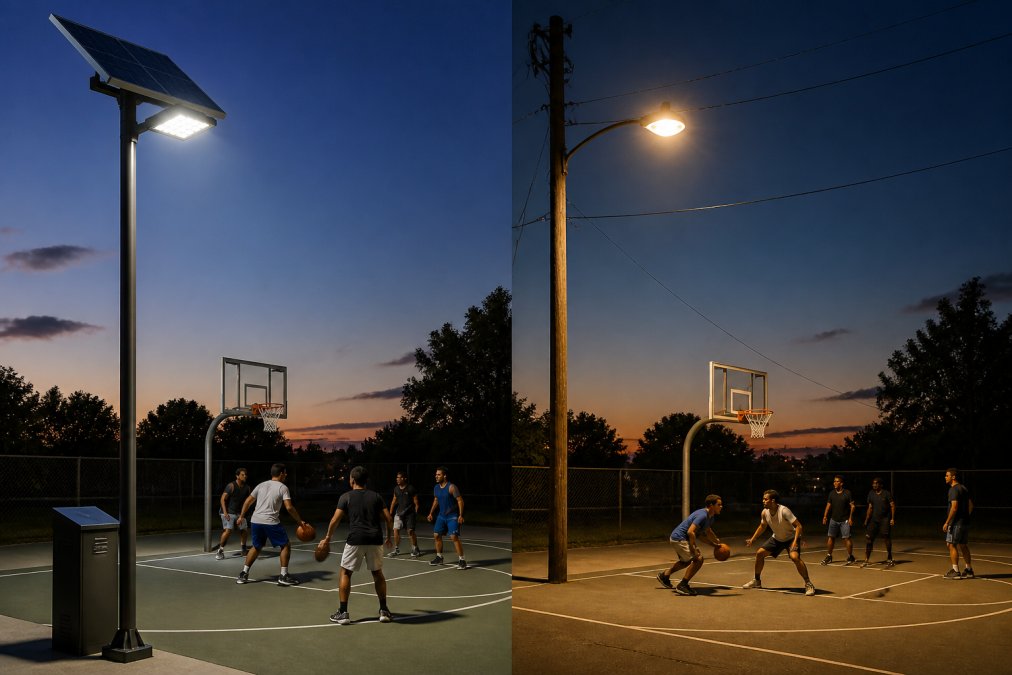
| Feature | Solar | Wired |
|---|---|---|
| Electrical trenching | Not required | Required |
| Runtime | Limited by charge and battery | Continuous while powered |
| Ongoing utility cost | None | Metered usage |
| Best for | Remote or power-limited sites | Sites with existing service |
Zoning, Light Pollution, and Photometric Analysis: What Most Buyers Miss
Two technical steps separate a court that gets approved and plays well from one that generates complaints: a photometric analysis and a review of local lighting ordinances. Most buyers skip both, and most lighting guides never explain either. This part of a commercial project determines whether the hardware you buy is even permitted on your site.
What a Photometric Analysis Actually Contains
Photometric analysis is a computer-simulated study that models your actual court dimensions, pole positions, mounting heights, and fixture specifications to predict foot-candle levels and uniformity before anything is purchased. It shows you the dark spots and glare problems on paper, when they are still free to fix.
- Court dimensions and orientation, including run-off space beyond the sidelines and baselines.
- Pole locations, heights, and setback distances from the court edge.
- Fixture photometric files, the manufacturer's IES-format light distribution data for the exact model being specified. A plan built from a generic fixture profile does not describe your installation.
- Aim points and tilt angles for every fixture on every pole.
- The target play level, which sets the foot-candle and uniformity goals the plan is measured against.
Light Pollution Ordinances and Spill Light Limits
Light pollution ordinances are local rules limiting how much light escapes a property. Many municipalities cap spill light at the property line, restrict upward light, or set curfews on court illumination. Requirements vary by jurisdiction, so confirm the rules for your site with your local planning or zoning office before finalizing a layout.
The three controls that most ordinances regulate are:
- Spill light at the property line, usually measured in foot-candles or as a percentage of on-court illuminance. Facilities near residential property face the strictest scrutiny.
- Upward light, often expressed as a percentage of total lumens emitted above horizontal. Full-cutoff and shielded fixtures aimed downward solve most of this.
- Curfew hours, which limit when court lights may operate at all. Timers and dimming controls are the standard way to comply without turning the court dark for legitimate evening use.
Smart Controls as a Compliance and Management Tool
Smart control integration serves double duty: it cuts energy draw and demonstrates good-neighbor compliance to a zoning board. Motion sensors, timers, and remote dimming let a facility run court lights only when the court is in use.
The Approval Sequence That Saves Money
- Confirm the play level and target foot-candles for your court.
- Draft a pole layout consistent with safe sightlines and setback from the playing surface.
- Run the photometric analysis using the actual fixture models you intend to buy.
- Check the plan against local spill light, upward light, and curfew rules with your planning office.
- Adjust pole positions, fixture aim, or shielding until the plan passes both the performance target and the ordinance limits.
- Only then order hardware.
Sports Vista USA supplies complete court lighting packages, including solar and wired fixtures, mounting poles, and the accessories that finish an installation, alongside the basketball goals, backboards, padding, and court equipment that make a facility playable. If you are planning a court in Carbondale or anywhere in southern Illinois and need help matching a lighting layout to your space, our team can walk through the options with you.
Conclusion: Choosing the Right Lighting for Your Court
The hard part of court lighting is not picking a fixture. It is sequencing the decisions correctly: run a photometric analysis, confirm local zoning limits, choose solar or wired based on your site's power reality, then select fixtures that meet the foot-candle and uniformity targets your play level demands.
Frequently Asked Questions
What are the lighting requirements for a commercial basketball court?
Commercial basketball courts typically need 50 to 100 foot-candles for competitive play, with uniform illumination across the entire playing surface. The Illuminating Engineering Society (IES) provides recommended foot-candle levels based on play level, from recreational to professional. LED sports court lighting should also minimize glare and spill light to protect players and neighbors. A photometric analysis helps confirm your layout meets these targets before installation.
Why is LED lighting preferred for outdoor basketball courts?
LED sports court lighting uses less energy than metal halide or halogen fixtures while delivering high lumen output and consistent color temperature. LEDs are flicker-free, which supports player visibility and video recording. They also have longer lifespans, reducing maintenance costs. Many LED fixtures carry DLC certification and UL listing, confirming they meet performance and safety standards. For commercial facilities, these factors lower long-term operating expenses.
How many light poles are needed for a full-size basketball court?
A full-size outdoor basketball court typically requires four to six poles, depending on court dimensions, mounting height, and beam angle. Pole placement should be symmetrical to achieve uniform illumination and reduce shadows. A photometric analysis can determine the exact number and position based on your fixture's lumen output and light distribution. For multi-sport courts, additional poles may be needed to cover all playing areas.
How can I minimize light spill for neighboring properties?
Minimizing light spill starts with proper fixture selection, including shielded or full cut-off designs that direct light downward. Mounting height and beam angle also affect spill. Local zoning ordinances often set limits on spill light and glare, so check your municipal code before installation. A photometric analysis can model spill light before you buy, and lighting controls with timers or motion sensors reduce unnecessary nighttime output.


Leave a comment
This site is protected by hCaptcha and the hCaptcha Privacy Policy and Terms of Service apply.