


Table of Contents
- What Makes Professional Grade Pickleball Court Lighting Different
- Pickleball Court Lighting Standards and Illumination Requirements
- Understanding Footcandles and Uniformity Ratios
- Outdoor Pickleball Court Illumination Levels and Design
- Energy Efficiency and Cost Considerations
- Light Spill, Glare Control, and Neighbor-Friendly Design
- Professional Grade Pickleball Court Lighting Systems and Installation
- Frequently Asked Questions
Last Updated: August 31, 2026
What Makes Professional Grade Pickleball Court Lighting Different
Professional grade pickleball court lighting isn't just brighter, it's engineered to solve the specific challenges that recreational setups miss. The difference comes down to uniformity, control, and reliability under match conditions.
A standard backyard light might illuminate a court, but it won't deliver the consistent footcandles across the playing surface that competitive play demands. Professional systems maintain strict uniformity ratios, minimize glare, and provide the color temperature that lets players track the ball without eye strain. They're built to handle weather, resist corrosion, and operate reliably for years without degradation.
The real distinction separates setups designed for casual play from those engineered for league matches, tournaments, or facility operations. When your court hosts regular games, whether in Carbondale or anywhere else, the lighting becomes part of your competitive advantage. Players see better, courts stay safer, and your facility operates within the technical standards that governing bodies expect.
Below, we'll walk through what separates professional systems from basic options, how to evaluate lighting requirements, and which configurations work best for different court types and locations.
Pickleball Court Lighting Standards and Illumination Requirements
Professional grade pickleball court lighting must meet specific illumination standards to be considered tournament-ready. The standard baseline is 50 footcandles minimum across the entire playing surface, with a uniformity ratio no worse than 4:1 (meaning the brightest point is no more than four times brighter than the dimmest).
For league play and competitive events, many facilities target 75 footcandles or higher. This elevation improves ball visibility dramatically, especially during evening matches when natural light fades. The uniformity requirement becomes even stricter at higher light levels, a 3:1 ratio is preferred for premium installations.
Color temperature matters more than many facility managers realize. Most professional setups use 5000K to 6500K (Kelvin) color temperature, which mimics natural daylight and reduces eye fatigue during extended play. Warmer light (3000K) can make the ball harder to track against certain court surfaces.
Flicker-free operation is non-negotiable. Professional LED fixtures eliminate flicker entirely, while older HPS or metal halide systems sometimes produce subtle flicker that fatigues players over time. This becomes especially noticeable during fast-paced rally exchanges.
Local regulations in Illinois may impose additional requirements. Some municipalities have lighting ordinances that limit brightness, control light spill into residential areas, or restrict operating hours. Carbondale facilities should verify zoning compliance before installation, as these rules vary by jurisdiction and can affect system design.
Understanding Footcandles and Uniformity Ratios
Footcandles measure the intensity of light falling on a surface, specifically, one lumen of light distributed over one square foot. For pickleball, this metric directly determines whether players can see the ball clearly and react to its movement.
Think of footcandles as the foundation of court visibility. At 30 footcandles, recreational play is possible but challenging during twilight hours. At 50 footcandles, most casual and league matches work well. At 75+ footcandles, you're in premium territory where even fast-moving balls remain crisp and clear.
The uniformity ratio describes how evenly light spreads across the court. A 4:1 ratio means the brightest spot is four times brighter than the dimmest. This matters because dark corners create dead zones where players lose sight of the ball momentarily, a safety hazard and a competitive disadvantage.
Professional systems achieve tight uniformity through strategic pole placement, fixture beam angles, and photometric analysis. Poor uniformity forces players to adjust their positioning or squint, which increases fatigue and reduces performance.
Measuring footcandles requires a light meter, a tool most facility managers don't have on hand. Professional lighting designers use photometric software to model how fixtures will perform before installation. This predictive approach prevents costly mistakes and ensures the final system meets specifications.
Outdoor Pickleball Court Illumination Levels and Design
Outdoor courts face unique challenges that indoor facilities avoid: natural light variability, weather exposure, and the need to balance brightness with neighbor relations.
The ideal outdoor setup delivers 50-75 footcandles across the playing surface while minimizing light spill into surrounding areas. This range supports competitive play without creating excessive glare or disturbing nearby properties, a critical consideration in Carbondale residential neighborhoods.
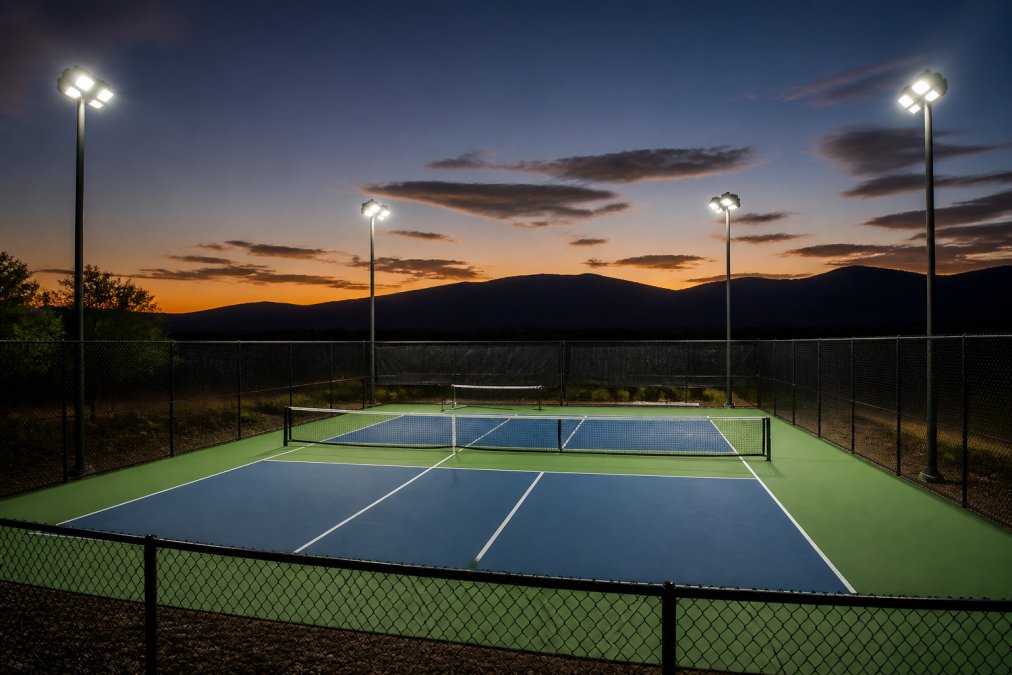
Pole Height and Fixture Placement
Standard pole heights for outdoor pickleball courts range from 20 to 30 feet. A 25-foot pole is the most common compromise, tall enough to spread light evenly across the court while low enough to control light spill and manage structural stress.
Four-pole configurations are standard for single-court installations. Poles positioned at the four corners of the court create the most uniform light distribution. For multiple courts side-by-side, staggered pole placement or taller poles (28-30 feet) can serve adjacent playing surfaces.
Beam angles matter significantly. A 60-degree beam angle concentrates light tightly on the court. A 120-degree beam spreads light more broadly, which can increase spill into adjacent areas. Professional designers select beam angles based on court dimensions and surrounding environment.
Foundation depth and concrete specifications are critical for stability. A 25-foot pole typically requires a 4-foot foundation hole with reinforced concrete. Wind loads, soil conditions, and local building codes all factor into foundation design. In Carbondale, frost depth and soil composition should be verified before installation.
LED vs. Traditional Lighting for Courts
LED fixtures dominate professional court lighting today because they outperform older technologies across nearly every metric.
Traditional metal halide systems deliver brightness but consume significant power, generate heat, and require frequent maintenance. Bulbs degrade over time, color temperature shifts, and warm-up periods delay operation. A typical metal halide system might run 400-1000 watts per fixture.
LED fixtures consume 40-60% less energy while delivering superior light quality. A 100W LED fixture often outperforms a 400W metal halide system. LEDs reach full brightness instantly, produce zero flicker, and maintain consistent color temperature throughout their lifespan.
The lifespan difference is dramatic. LED fixtures last 50,000+ hours (10-15 years of typical use). Metal halide bulbs last 10,000-15,000 hours (2-3 years). This means fewer replacement cycles, less downtime, and lower total maintenance cost.
Solar-powered LED systems offer an alternative for facilities without electrical infrastructure or those seeking to eliminate grid dependence. The U.S. Department of Energy solar technology guide outlines how solar systems work for outdoor applications. A solar court light stores energy during the day and operates independently at night.
Sports Vista USA offers solar-powered options like the Dominator 100W LED Solar Court Light with Pole, which combines high-output LED fixtures with integrated solar panels and motion sensing. This approach eliminates trenching, wiring, and electrical permits, a significant advantage for facilities in areas where electrical infrastructure is limited or expensive.

Energy Efficiency and Cost Considerations
LED lighting reduces operational costs substantially compared to traditional systems. Lower wattage means lower electricity consumption, which translates to reduced monthly utility bills.
Many facility managers underestimate the total cost of ownership. Energy consumption is just one component. Add in bulb replacement frequency, maintenance labor, downtime when fixtures fail, and disposal costs for old equipment. LED systems win decisively on these combined metrics.
A typical outdoor pickleball court with four 400W metal halide fixtures running 6 hours per day consumes significant electricity. Switching to 100W LED fixtures cuts consumption by roughly 75%, reducing annual energy costs considerably.
Maintenance schedules differ dramatically. LED systems require minimal upkeep, occasional cleaning to remove dust and debris. Metal halide systems need regular bulb replacement, ballast maintenance, and more frequent cleaning as performance degrades.
Incentive programs in Illinois sometimes offset the higher upfront cost of LED systems. Check with local utilities about rebates for energy-efficient outdoor lighting. Some programs cover a portion of installation costs for qualified systems.
Light Spill, Glare Control, and Neighbor-Friendly Design
Light spill, unwanted light extending beyond the court into surrounding areas, creates friction with neighbors and may violate local ordinances in Carbondale. Professional systems address this through fixture selection, beam control, and strategic placement.
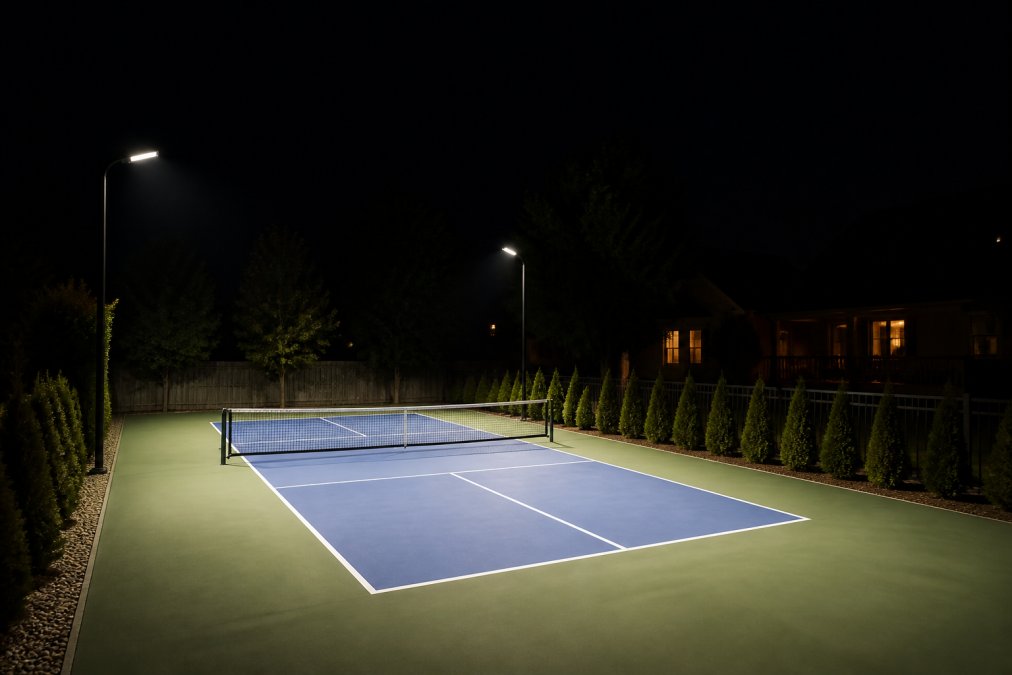
Fully shielded fixtures direct light downward and inward, preventing upward light escape. A cutoff angle of 90 degrees or steeper ensures light doesn't shine into the sky or onto neighboring properties. This is a standard requirement for professional installations and often mandated by municipal lighting codes.
Glare, direct light entering a player's eyes, reduces visibility and causes discomfort. Anti-glare louvers inside fixtures scatter light more evenly, reducing harsh bright spots. Proper pole placement also minimizes glare by positioning fixtures outside the player's direct line of sight.
Color temperature influences neighbor perception. Warm white (3000K) light feels less intrusive to nearby residents than cool white (6500K). However, cool white performs better for ball tracking. Professional systems sometimes compromise at 4000-5000K to balance performance and community relations.
Motion sensors and dimming controls reduce nighttime light output when courts aren't in use. Many facilities dim lights to 50% brightness during off-peak hours, cutting energy consumption and light pollution while maintaining minimal visibility for security.
Illinois municipalities may require lighting plans submitted before installation. Carbondale facilities should verify local requirements early. Some jurisdictions require photometric reports proving that light spill meets specified limits. Professional lighting designers can generate these reports using simulation software.
Professional Grade Pickleball Court Lighting Systems and Installation
A complete professional system includes fixtures, poles, control systems, electrical infrastructure, and foundation work. The components must work together to deliver consistent performance and reliability.
Fixtures are the core component. Professional LED floodlights rated for outdoor use feature weather-resistant housings, corrosion-resistant materials, and optical systems designed for uniform light distribution. Wattage ranges from 100W to 400W depending on pole height, court size, and desired illumination level.
Control systems manage operation and efficiency. Simple timer controls turn lights on and off at set times. Motion sensors add intelligence, lights activate when movement is detected and dim or shut off during idle periods. Smart systems integrate with facility management software, allowing remote control and data logging.
Poles support the fixtures and must withstand wind loads, weight, and environmental stress. Steel poles with powder-coat finishes resist rust and corrosion. Aluminum poles are lighter but less common for high-output installations. Foundation design varies based on soil conditions and local building codes.
Electrical infrastructure includes wiring, conduit, disconnect switches, and breakers. Trenching costs vary based on distance from the power source and soil conditions. Solar systems eliminate trenching entirely, making them attractive for facilities without nearby electrical service.
Sports Vista USA's court lighting solutions integrate all these components. The First Team Solar Powered [Court Light(/products/court-vision-solar-powered-court-light) product page | sportsvistausa.com] showcases a 14,800-lumen system with integrated solar power, hinged anchor base for ground-level assembly, and commercial-grade construction. This eliminates trenching and electrician requirements, a significant advantage for facilities in Carbondale seeking quick installation without disrupting existing infrastructure.
Installation typically requires professional contractors experienced with electrical work, concrete foundations, and structural assembly. Permits and inspections are required in most jurisdictions. Timeline varies from 1-3 weeks depending on site conditions and electrical complexity.
| Component | Purpose | Typical Consideration |
|---|---|---|
| LED Fixture | Primary light source | Wattage, beam angle, color temperature |
| Steel Pole | Fixture support | Height (20-30 feet), wind load rating |
| Foundation | Structural stability | Depth (3-4 feet), concrete specs, frost line |
| Control System | Operation management | Timer, motion sensor, smart integration |
| Electrical Infrastructure | Power delivery | Trenching, wiring, permits, disconnect switch |
| Solar Panel (optional) | Grid-independent power | Capacity, battery storage, weather resilience |
Professional grade pickleball court lighting transforms how players experience the game. The difference between adequate lighting and professional illumination is visibility, safety, and competitive fairness. When courts in Carbondale and beyond need reliable, efficient lighting that meets tournament standards, the investment in proper systems pays dividends through years of consistent performance.
The right system balances technical requirements, footcandles, uniformity, color temperature, with practical considerations like neighbor relations, energy costs, and installation complexity. Sports Vista USA provides court lighting solutions designed to meet these demands, from solar-powered systems requiring no electrical infrastructure to comprehensive LED installations supporting competitive play. Explore our court lighting options to find the system that fits your facility's needs and budget.
Frequently Asked Questions
Q: What are the illumination standards for professional grade pickleball court lighting?
A: Professional grade pickleball courts often target 50 footcandles minimum on the playing surface, with a uniformity ratio (max/min ratio) no worse than 4:1. The Illuminating Engineering Society (IES) provides guidelines to ensure consistent visibility and fair play. Color temperature should typically be 5000K to 6500K for accurate ball tracking. These requirements apply whether you're lighting a residential court or a commercial facility.
Q: How many lumens are needed for a pickleball court?
A: A standard pickleball court (20 feet by 44 feet) typically needs 14,000 to 20,000 lumens total output from LED fixtures, depending on pole height and fixture spacing. The exact lumen requirement depends on your desired footcandle level and the efficiency of your LED floodlights. Solar-powered options like the Dominator 100W LED Solar Court Light deliver 14,800 lumens and can illuminate a court without requiring trenching or electrical connections.
Q: What is the difference between residential and professional grade pickleball lighting?
A: Residential pickleball lighting typically uses single or dual fixtures with lower lumen output and less precise uniformity, suitable for casual play. Professional grade systems use multiple high-output LED floodlights, steel light poles, and photometric design to achieve strict uniformity ratios and consistent illumination across the entire court. Professional systems also include weather-resistant construction, corrosion-resistant materials, and often smart controls or timer functions for extended play schedules.
Q: Are there specific light spill regulations for outdoor pickleball courts?
A: While the International Dark-Sky Association and some municipalities encourage light spill reduction, regulations vary by location. Many areas recommend keeping light spill below 0.1 footcandles at the property line. Proper fixture shielding, beam angle control, and pole placement help minimize light pollution while maintaining court visibility. Check local zoning ordinances in your area, as some jurisdictions have adopted specific outdoor lighting standards for residential and recreational facilities.
This article was written using GrandRanker


Leave a comment
This site is protected by hCaptcha and the hCaptcha Privacy Policy and Terms of Service apply.