


Last Updated: October 23, 2026
Quick Summary
A heavy duty basketball rim is built from reinforced steel with advanced fastening systems to withstand repeated dunking, weather exposure, and years of competitive play without bending or degrading. Unlike standard rims, heavy-duty models hold structural integrity through countless impacts, meaning fewer replacements and lower long-term costs for facilities and home courts.
- Measure your backboard's bolt-hole spacing, plate dimensions, and rim offset before shopping to ensure compatibility with your existing system.
- Heavy-duty rims differ in steel gauge, weld quality, bracket design, and hardware; compare these specific features rather than relying on marketing labels alone.
- Breakaway rims with spring-loaded hinges absorb dunk impact and protect the backboard, while fixed rims suit recreational settings with light shooting activity.
- Outdoor rims require thicker steel or stainless construction with enhanced finishes to withstand temperature swings, moisture, and UV exposure.
- Replace the mounting bracket along with the rim if it shows rust, elongation, or cracks to preserve the durability of your new heavy-duty system.
Table of Contents
- What Makes a Heavy Duty Basketball Rim Worth the Investment
- Understanding Basketball Rim Mounting Pattern and Compatibility
- Breakaway Basketball Rim vs. Fixed Rim: Key Differences
- Fixed Basketball Rim Options for Recreational Play
- Choosing Basketball Hoop Replacement Parts for Durability
- Indoor Versus Outdoor Heavy Duty Rims
- Common Mistakes When Selecting a Replacement Rim
- Conclusion: Making Your Heavy Duty Rim Selection
- Frequently Asked Questions
What Makes a Heavy Duty Basketball Rim Worth the Investment
A heavy duty basketball rim is built to withstand repeated dunking, weather exposure, and years of competitive play without bending or degrading.
A rim that flexes under impact wears faster, creates inconsistent bounce, and eventually fails.
When selecting a replacement rim for an existing system, compatibility is critical.
At Sports Vista USA, we help facilities and homeowners find heavy-duty rims that fit their specific systems.
Understanding Basketball Rim Mounting Pattern and Compatibility
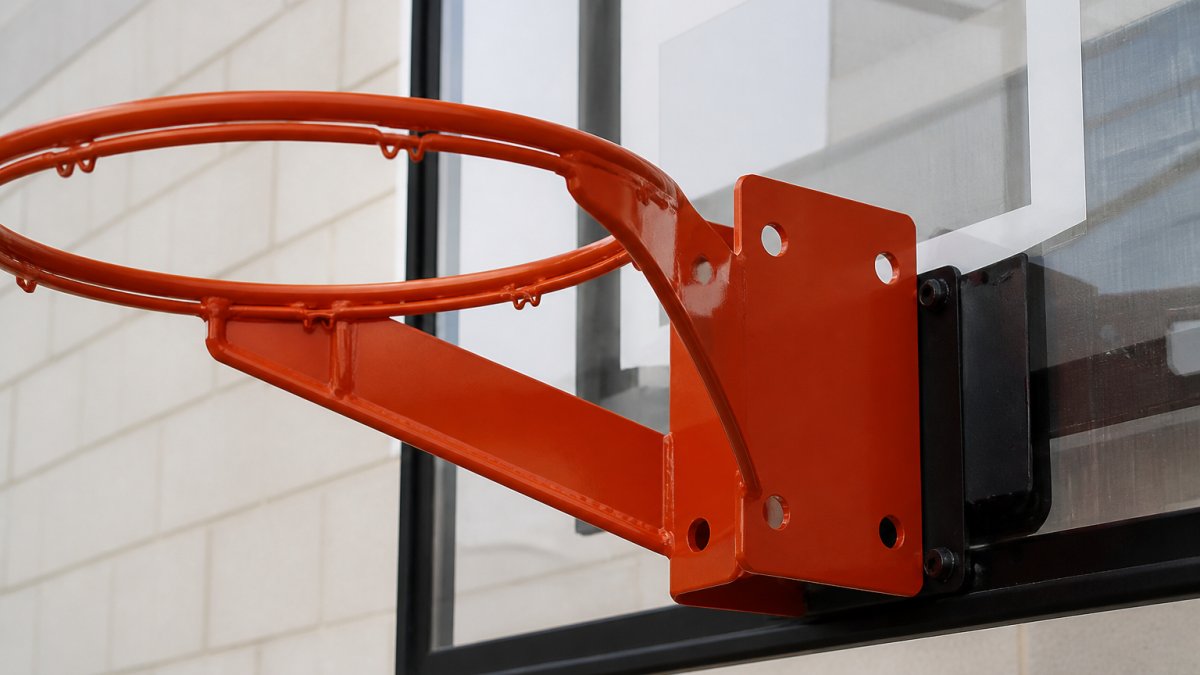
Your existing backboard has a specific mounting pattern: the distance between bolt holes and the shape and size of the mounting plate. A replacement rim must match it. Mismatched patterns mean you cannot bolt the rim securely, even if the backboard is otherwise sound, and this is the most common reason a replacement rim gets returned or sits unused.
Measuring bolt spacing alone is not enough. You need four measurements and one photo set before you can confidently match a rim to a backboard.
The Four Measurements That Decide Fit
Before shopping, capture these four numbers in inches:
- Horizontal bolt-hole spacing, center of the leftmost hole to center of the rightmost hole on the mounting plate.
- Vertical bolt-hole spacing, center of the top hole to center of the bottom hole.
- Mounting plate width and height, the outer edges of the metal bracket, not the holes.
- Rim-to-backboard offset, the distance from the face of the backboard to the front of the rim, measured on your current setup.
Photograph the plate from the front, back, and both sides. When you review a product listing or contact Sports Vista USA, these four numbers plus the photos confirm compatibility without guessing.
Standard 18-Inch Diameter and Bolt-Hole Spacing
Basketball rims come in one standard size: 18 inches in interior diameter, consistent across recreational, competitive, and professional play.
Bolt-hole spacing, however, varies by system. Common patterns on residential and commercial backboards include rectangular plates with holes spaced at roughly 4.5 inches, 5 inches, or 6 inches horizontally, and some commercial systems use wider spacing.
Measuring Your Existing Backboard
Take these steps to measure your backboard's mounting pattern:
- Locate the mounting plate on the back of your backboard (the metal bracket holding the current rim).
- Measure the distance between the center of the leftmost bolt hole and the center of the rightmost bolt hole.
- Measure the distance between the center of the top bolt hole and the center of the bottom bolt hole.
- Measure the overall width and height of the mounting plate at its outer edges.
- Note the overall shape: rectangular, square, or custom.
- Photograph the plate from multiple angles for reference.
Write these down before shopping so you have exact data to confirm compatibility with Sports Vista USA or in product specifications.
Compatibility Checklist: Backboard, Rim, and Net
Use this checklist to catch mismatches before you order:
- Backboard material and thickness, a rim rated for a thick tempered-glass or steel backboard may not be appropriate for a thin acrylic residential board. Confirm the rim is intended for your backboard type.
- Mounting plate dimensions, the new rim's plate should match or exceed the footprint of your existing plate so the bolt holes align and the load spreads across the same area.
- Bolt-hole pattern, horizontal and vertical spacing must match your measurements. A plate with slotted holes can accommodate minor variation; a plate with fixed holes cannot.
If your current mounting plate shows rust, elongation around the bolt holes, or cracks, replace the plate along with the rim. A new heavy-duty rim bolted to a compromised plate will not deliver the durability you are paying for.
The rim diameter is standard at 18 inches. Everything else, plate size, hole spacing, offset, and hardware, varies by system. Measure all four, photograph the plate, and match the rim to your numbers, not to a photo online.
Breakaway Basketball Rim vs. Fixed Rim: Key Differences
A breakaway basketball rim features a spring-loaded hinge that lets the rim rotate downward when dunked on, then spring back to horizontal. A fixed rim stays rigid. Breakaway rims absorb impact energy, reducing shock loads and extending the lifespan of the backboard and mounting hardware, which is why they are standard in competitive and professional settings. Fixed rims are simpler mechanically, with fewer moving parts, and suit recreational settings where dunking is light.
Fixed Basketball Rim Options for Recreational Play
A standard fixed rim uses a welded steel hoop with a solid mounting bracket: rigid, affordable, and low-maintenance, ideal where the primary activity is shooting rather than dunking. Some fixed rims use a slightly flexible design with a small amount of give under impact, offering modest protection while keeping the simplicity of a fixed design. When selecting a fixed rim for recreational use, prioritize corrosion resistance; look for powder-coated finishes or stainless steel construction that resist weathering.
Choosing Basketball Hoop Replacement Parts for Durability
Durability depends on materials, construction, and finish quality, but "heavy-duty" is not a regulated term.
A heavy-duty basketball rim should use thick-gauge steel, welded at stress points, with a mounting bracket that spreads load across the backboard. The bracket matters as much as the rim: a weak bracket can fail even if the rim is solid.
Explore a related guide on adjustable basketball systems to understand the full range of replacement and upgrade options available for your court.
What Separates Heavy-Duty From Recreational
Use these comparison points when reviewing any replacement rim:
- Steel gauge and wall thickness, thicker steel resists bending under dunk loads. Ask for the gauge or wall thickness if it is not listed.
- Weld quality, look for continuous welds at the rim-to-bracket junction and at the net hooks. Spot welds are a sign of lighter-duty construction.
- Bracket design, a reinforced, gusseted bracket distributes force better than a flat plate with no bracing.
Steel Construction and Weather Resistance
Steel is the standard material for heavy-duty rims. Stainless steel offers superior corrosion resistance but costs more; carbon steel with a powder-coat finish provides strong durability at a lower price point. The finish protects the steel from rust, and a degraded finish lets a rim rust from the inside out. Choose rims with finishes designed for all-weather use and inspect annually for chips or cracks.
Dunking Suitability and Load Considerations
Not every heavy-duty rim is designed for regular dunking. Fixed rims transfer the full impact of a dunk into the backboard and mounting hardware, while breakaway rims absorb some of that energy through a spring-loaded hinge. For courts where athletes dunk regularly, a breakaway rim protects the whole system, not just the rim. When evaluating a rim for dunking use, ask three questions: Does the manufacturer describe it as breakaway or fixed?
Net Compatibility and Attachment Options
Basketball nets attach to the rim using nylon loops that slip over the rim's hooks, or chain links that hang from the rim. When replacing a rim, verify your existing net's attachment method matches the new rim's design. Learn about backboard specifications that affect rim compatibility to ensure your net will attach properly.
If you are replacing a rim on a system that sees regular dunking, budget for new mounting hardware at the same time. Reusing old bolts and washers on a new heavy-duty rim is a common way to lose the durability you paid for.
The most common cause of rim replacement failure is incompatible mounting patterns, not poor rim quality. Measure twice, verify specifications, and confirm compatibility before ordering. For dunking courts, choose a breakaway rim with a reinforced bracket and grade 8 hardware.
Heavy-duty rims differ significantly in construction quality, so compare these specific features rather than relying on marketing labels alone.
| Feature | What to Look For | Why It Matters |
|---|---|---|
| Steel gauge and wall thickness | Thicker steel construction | Resists bending under dunk loads |
| Weld quality | Continuous welds at stress points | Spot welds indicate lighter-duty construction |
| Bracket design | Reinforced, gusseted bracket | Distributes force better than flat plate |
| Hardware | Grade 8 bolts and lock washers | Resists loosening under vibration |
| Finish | Powder coat, paint, or galvanizing | Protects steel from rust and weather |
| Breakaway mechanism | Spring-loaded hinge that returns reliably | Absorbs dunk impact, protects backboard |
| Material choice | Stainless steel or carbon steel with finish | Stainless costs more; coated carbon steel offers durability at lower price |
Indoor Versus Outdoor Heavy Duty Rims
Indoor rims face less environmental stress: temperature and humidity fluctuate less, and rain, snow, and UV exposure aren't factors, so standard steel with basic paint or powder coat works. Outdoor rims must withstand temperature swings, moisture, sunlight, and salt exposure in coastal areas, so outdoor-rated rims use thicker steel, stainless steel, or enhanced powder-coat finishes.
Understand in-ground backboard options when selecting between indoor and outdoor rim systems to make the best choice for your facility type.
Common Mistakes When Selecting a Replacement Rim
The biggest mistake is ordering without measuring. Standard 18-inch rims look similar, but mounting patterns vary. A second mistake is choosing on price alone: the cheapest rim often uses thinner steel, weaker welds, and basic finishes, while a slightly higher-quality rim lasts years longer. Another error is ignoring the mounting bracket, since a weak or corroded bracket will fail even if the rim is solid; replace it too if it shows rust or damage.
Ordering the wrong mounting pattern is the most common reason for returns and installation delays. Measure your bolt-hole spacing and photograph your current mounting plate before shopping.
Conclusion: Making Your Heavy Duty Rim Selection
Selecting the right heavy-duty basketball rim means understanding your backboard's mounting pattern, choosing between breakaway and fixed designs, and prioritizing durability through material and finish quality. For facilities and homeowners managing courts that see regular use, a heavy-duty rim built from thick-gauge steel with weather-resistant finishing delivers years of reliable performance.
Sports Vista USA carries a selection of heavy-duty basketball rims and replacement parts designed for residential, recreational, and commercial courts. Whether you're upgrading a school court, maintaining a park facility, or enhancing a home system, we help you find rims that match your existing backboard and fit your performance needs. Access a buying guide for school basketball goals that covers durability and replacement part selection, or contact our team to verify compatibility and discuss options for your specific court setup.
Frequently Asked Questions
How do I know which replacement basketball rim fits my hoop?
Start by measuring your backboard's mounting holes and the distance between them. Most residential hoops use a standard 18-inch diameter rim with bolt-hole spacing that matches common mounting plates. Check your backboard's specifications or measure the distance between the bolts on your existing rim. Once you have these measurements, compare them to the replacement rim's mounting pattern. If the bolt-hole spacing matches, the rim will fit. When in doubt, contact Sports Vista USA with your backboard dimensions for compatibility confirmation.
What is the difference between a fixed rim and a breakaway basketball rim?
A fixed basketball rim remains stationary when contact is made, making it ideal for recreational play and practice. A breakaway rim pivots or flexes downward when dunked on, then springs back up, reducing stress on the backboard and extending equipment life. Breakaway rims are better for competitive play and high-impact dunking, while fixed rims work well for casual shooting and younger players. Choose based on your court's primary use and the intensity of play you expect.
Can I replace a basketball rim without replacing the backboard?
Yes, you can replace just the rim if the backboard and mounting plate are still in good condition. The rim bolts directly to the mounting plate, so as long as the plate is secure and the bolt-hole spacing matches the new rim, you can swap the rim independently. However, inspect the backboard for cracks or damage while you have the rim off. If the backboard is deteriorating or the mounting plate is rusted or bent, replacing those components along with the rim will give you better long-term durability.
What should I look for in an outdoor replacement basketball rim?
For outdoor use, prioritize weather-resistant materials and corrosion-resistant finishes. Look for heavy-duty steel construction with powder-coat or galvanized finishes that withstand rain, UV exposure, and temperature swings. Ensure the rim is rated for all-weather use and check that the net attachment points are reinforced. Breakaway rims are often better for outdoor courts because they reduce stress on the backboard from weather expansion and contraction. Verify that replacement parts and nets are readily available for your chosen rim model.
When you're ready to upgrade your court with a heavy-duty rim that matches your backboard's specifications and performs reliably for years, Sports Vista USA has the selection and expertise to guide you. Check Out our basketball rim collection and find the right replacement for your system.


Leave a comment
This site is protected by hCaptcha and the hCaptcha Privacy Policy and Terms of Service apply.