


Last Updated: October 24, 2026
Quick Summary
An essential volleyball court maintenance checklist is a written, recurring set of inspection and care tasks that keeps a court safe, playable, and compliant with inspection standards. It assigns a name, a frequency, and a record to every task, separating daily walk-throughs from weekly, monthly, and annual reviews.
- Daily walk-throughs scan for debris, check net height at both posts, and confirm boundary lines are visible.
- Sweep before mopping, and never leave standing water at seams or expansion joints.
- Inspect boundary lines weekly for fading, lifting tape, and curling edges.
- Sort repair tickets into urgent, watch, and routine buckets to set priority.
- Assign every task to a role, not a person, so coverage holds when staff turn over.
Table of Contents
- Why Volleyball Court Maintenance Fails Without a Written Checklist
- The Volleyball Court Inspection Checklist Every Facility Manager Needs
- Indoor Volleyball Court Maintenance: Flooring, Markings, and Net Systems
- Outdoor Volleyball Court Maintenance: Posts, Drainage, and Seasonal Wear
- Net, Post, and Padding Checks That Prevent Injuries
- Building an Athletic Facility Maintenance Log Template That Gets Used
- Assigning Inspection Frequency and Task Ownership Across Your Staff
- Restocking Replacement Nets and Posts Before the Season Starts
- Frequently Asked Questions
Why Volleyball Court Maintenance Fails Without a Written Checklist
An essential volleyball court maintenance checklist for facility managers is a written, recurring set of inspection and care tasks that keeps a court safe, playable, and compliant with inspection standards.
A written checklist fixes that because it assigns a name, a frequency, and a record to every task.
Below, we'll walk through the tasks, the inspection rhythm, and a log template you can copy today. For a broader look at volleyball court maintenance best practices, see the full guide.
The Volleyball Court Inspection Checklist Every Facility Manager Needs
A volleyball court inspection checklist is a tiered document that separates daily walk-throughs from weekly, monthly, and annual reviews. Each tier catches different problems: daily checks catch hazards, monthly checks catch wear, annual checks catch structural decline.
Daily Walk-Through Items
These take minutes and prevent the most common incidents:
- Scan the playing surface for debris, standing water, and loose tape.
- Check net height at both posts and confirm the net is centered.
- Look for exposed post bases, cracked padding, or loose hardware.
- Walk the sidelines and approaches for slip hazards.
- Confirm boundary lines are visible and unbroken.
Weekly and Monthly Inspection Items
Weekly and monthly rounds go deeper. Tighten net tension, inspect post anchors, check padding seams, and log any damage with a photo. Monthly, review court markings, clean high-touch areas, and confirm drainage grates on outdoor courts are clear.
Watch out: skipping the written record is the mistake that undoes all of this. A task nobody logged is a task nobody can prove happened when an inspection or incident review arrives.
Indoor Volleyball Court Maintenance: Flooring, Markings, and Net Systems
Indoor volleyball court maintenance centers on three systems that fail in different ways: the playing surface, the painted lines, and the net assembly. Treat them as separate maintenance tracks with separate owners and schedules, because a fix that helps one can damage another.
Surface-Specific Cleaning by Floor Type
Synthetic sports flooring and wood gym floors need different routines. Using the wrong one is the most common cause of premature wear.
| Floor Type | Routine Care | Products to Use | Products to Avoid |
|---|---|---|---|
| Synthetic (PVC/rubber) | Dry-mop or sweep daily; damp-mop high-traffic zones weekly | Neutral pH cleaner, microfiber pads, auto-scrubber with soft brush | Solvent-based cleaners, abrasive pads, excess water |
| Wood gym floor | Dust-mop daily; damp-mop with a wood-floor cleaner as needed | Manufacturer-approved wood floor cleaner, microfiber mops | Standing water, oil-based cleaners, harsh strippers |
| Modular tile | Sweep daily; damp-mop seams and edges weekly | Mild detergent, soft brush | High-pressure washing, solvent cleaners |
Two rules apply to every surface: sweep before mopping (grit acts like sandpaper under a mop), and never leave standing water at seams or expansion joints. Water that seeps under synthetic flooring or into wood seams causes cupping, adhesive failure, and slip hazards near the attack lines where players land hardest.
Moisture Control for Indoor Courts
Indoor humidity drives most wood-floor problems. When relative humidity swings, wood planks expand and contract, opening seams and loosening finish. Keeping indoor relative humidity in a stable mid-range band, checked with a wall hygrometer, can help prevent seasonal gapping. Pair that with entry mats at every door and a no-street-shoes rule on the court; dust and grit tracked onto the surface are the leading cause of slip incidents near the attack lines.
Court Markings and Line Maintenance
Painted and taped lines take abuse from pivots and dives. Inspect boundary lines weekly for fading, lifting tape, and curling edges. Restripe or re-tape before lines fade enough to confuse players, and schedule the work in the off-season so it never lands mid-league. Keep a small line-maintenance kit on hand: matching tape or paint, a straightedge, and a layout diagram so replacement lines land in the same place every time.
Net Systems and Hardware
Net systems deserve the same attention as the floor. Check tension at both posts and at the center, inspect for fraying and worn cables, and replace worn hardware before it fails. Padding on indoor posts must be secured, not just present; a loose pad slides on impact and exposes the post. Antennas and referee stands are part of the same check: confirm antennas are straight and attached, and that the referee stand is stable and clear of the playable area.
For facilities that also run outdoor courts, the same net and padding checks apply, but the surface and drainage routines differ; see the outdoor section below.
Outdoor Volleyball Court Maintenance: Posts, Drainage, and Seasonal Wear
Outdoor volleyball court maintenance is dominated by posts, drainage, and weather. Semi-permanent standards sit in the ground year-round, so the base and anchor points take the brunt of seasonal movement.
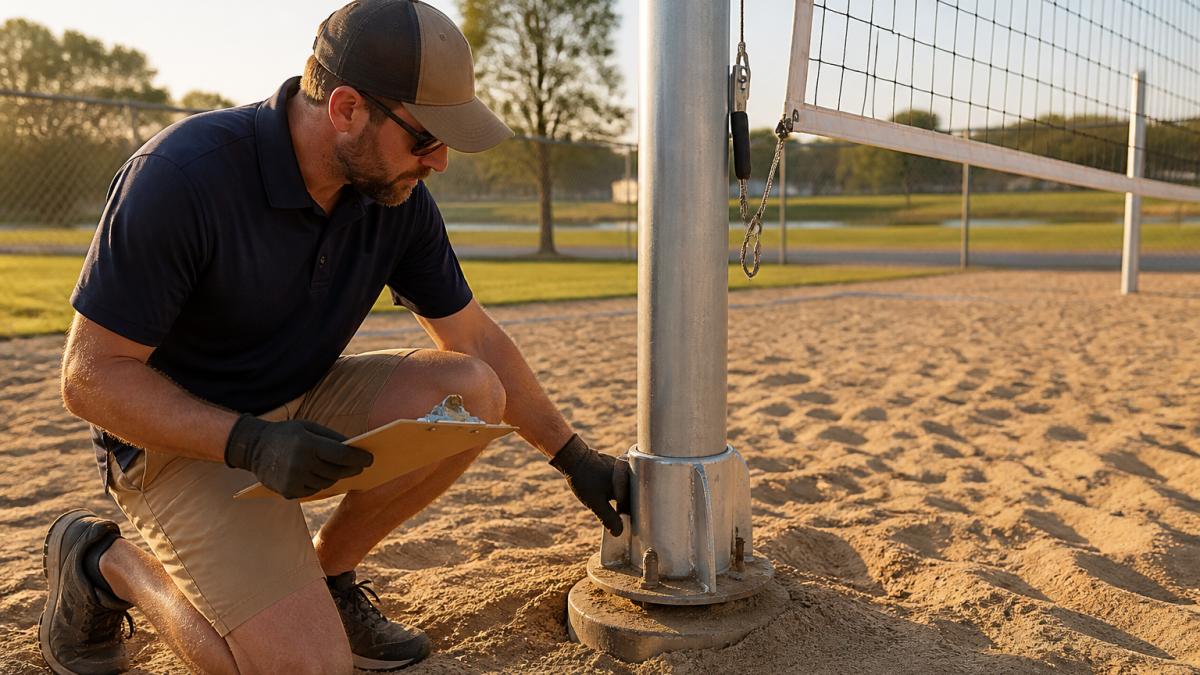
Start with drainage. Standing water after rain signals a grading or clogged-drain problem, and wet sand or soil softens post footings. For sand courts specifically, this guide on maintaining sand volleyball court padding goes deeper.
Choosing Outdoor Systems That Hold Up to Inspection
The best defense against constant repair is buying standards built for outdoor duty. A semi-permanent system with heavier standards resists movement and holds net tension better than a light recreational setup.
Two options worth comparing:
| System | Standard Size | Best For |
|---|---|---|
| Gared Sideout Outdoor Volleyball System - 2-3/8in OD | 2-3/8in OD | Backyards, parks, recreation centers |
| Gared Outdoor Volleyball System - 3-1/2in | 3-1/2in OD | Schools, high-traffic facilities |
Both use semi-permanent installation, so you get stability without a permanent footing project. Facility managers who want a system that survives inspection season after season can evaluate the semi-permanent outdoor volleyball system.
Gared Sideout Outdoor Volleyball System - 2-3/8in OD Semi-Permanent Standards →

Net, Post, and Padding Checks That Prevent Injuries
Net, post, and padding checks are the safety core of any volleyball court maintenance routine.
Check net tension at the posts and center. Facilities that want a more durable setup can review professional volleyball net tensioning systems.
Watch out: padding that looks fine from the sideline can hide a failed fastener underneath. Push on it, don't just glance at it.
Building an Athletic Facility Maintenance Log Template That Gets Used
An athletic facility maintenance log template works only if it is short enough to complete and specific enough to be useful. Build it around a small set of columns, add a priority field, and review it on a fixed rhythm. The format matters less than the habit of logging and the discipline of turning notes into scheduled work.
The Core Log Columns
| Field | What to Record | Why It Matters |
|---|---|---|
| Date and time | When the check was completed | Proves the task happened during an inspection or incident review |
| Task | The specific check (e.g., net height at both posts) | Keeps the record comparable week to week |
| Frequency tier | Daily, weekly, monthly, seasonal, annual | Ties the entry to the schedule |
| Owner (role) | Opening staff, maintenance lead, facility manager | Holds coverage when staff turn over |
| Result | Pass, adjust, or repair ticket | Separates routine from actionable |
| Priority | Routine, watch, urgent | Drives what gets fixed first |
| Notes and photo | Short description plus a photo of damage | Speeds repair and supports warranty or vendor conversations |
Keep it digital if your staff will use a tablet, paper if they won't. A shared spreadsheet or a form tool works; the goal is one log per court, not one per person.
Prioritizing Repairs and Tracking Recurring Issues
Not every repair ticket deserves the same urgency. Sort them into three buckets:
- Urgent: anything that can cause injury or cancel play, such as a loose post anchor, torn padding over exposed hardware, or a net that will not hold tension. Fix before the next scheduled session.
- Watch: wear that is not yet a hazard, such as fading lines, a fraying cable, or a soft spot in the sand. Schedule within the current maintenance cycle.
- Routine: cosmetic or housekeeping items. Fold into the next planned round.
Review the log weekly and look for repeats. A net that needs retensioning every week is not a tension problem; it is a worn cable or a moving post. Recurring entries are the signal to escalate from repair to replacement.
Lifecycle Planning From the Log
Over a season, the log becomes a lifecycle record. Count how often each component appears: nets, cables, padding, hardware, line tape, and post bases. Components that recur on the watch list are candidates for replacement at the next budget cycle rather than repeated repair. Share that summary with the facility manager once a season so replacement planning is based on the court's own history, not on guesswork.
For facility managers restocking between seasons, the log also tells you what to order first: the components that appear most often on the watch list are the ones to replace before opening day.
Assigning Inspection Frequency and Task Ownership Across Your Staff
Inspection frequency and task ownership decide whether your volleyball court maintenance checklist actually gets done. Assign every task to a role, not a person, so coverage holds when staff turn over.
Split the work into three ownership layers: opening staff handle daily walk-throughs, a maintenance lead owns weekly and monthly inspections, and the facility manager owns seasonal and annual reviews plus the budget. In Carbondale, where parks and school facilities often share staff across multiple courts, that structure prevents the "someone else checks it" gap.
A common mistake is assigning everything to one person. Spread the load, and put the log where every owner can see it.
Restocking Replacement Nets and Posts Before the Season Starts
Restocking before the season beats emergency ordering mid-league. Inventory your nets, posts, padding, and hardware now, and replace anything showing wear before the first match.
Nets fail first. Match the net to your post spacing: a 28ft outdoor volleyball net fits 32ft post systems, while a 32ft outdoor volleyball net fits 36ft systems.

If your whole system is aging, replacing standards and net together is often the cleaner move.
Frequently Asked Questions
What should be included in a volleyball court maintenance checklist?
A working checklist covers surface condition, boundary lines and court markings, net height and net tension, post stability, padding, debris and wet areas, walkways, and surrounding fencing or landscaping. Add equipment inspection for nets, standards, and hardware, plus a line for logging damage and repair status. Keep daily items short and visual, then push deeper checks like post anchoring and surface wear into a weekly or monthly slot so the list stays realistic for staff to finish.
How often should a volleyball court be inspected?
Most facilities run a short visual walk-through before each scheduled session, a fuller weekly inspection of nets, posts, and padding, and a monthly review of flooring, markings, drainage, and surrounding grounds. Add an annual deep inspection before the season opens. The right frequency depends on facility usage: a high-traffic school gym or park court needs more frequent checks than a backyard setup. Record the date of each inspection so gaps are obvious.
How do you maintain an indoor volleyball court?
Indoor volleyball court maintenance centers on the flooring and the net system. Sweep or dust-mop the court surface on a routine schedule, clean up spills immediately to remove slip hazards, and check boundary lines for peeling or fading. Inspect net height and net tension before play, confirm posts are secure in their sleeves, and look over padding on posts and walls. Keep dry areas dry, mark wet areas for repair, and log anything that needs a vendor.
How do you maintain an outdoor volleyball court?
Outdoor volleyball court maintenance adds weather and grounds work to the indoor list. Check post bases for looseness or rust, clear debris from the court surface, confirm drainage paths are open after rain, and inspect the net for sagging or frayed edges. Trim landscaping back from the play area, check fences and walkways, and note potholes or low spots. Semi-permanent systems such as the Gared Sideout Outdoor Volleyball System with 2-3/8in OD standards are built for outdoor courts at schools, parks, and recreation centers, so inspect the standards and hardware as part of the same routine.
How should volleyball court maintenance be documented?
Use a simple athletic facility maintenance log template with columns for date, area inspected, task completed, issue found, who owns the repair, and status. Keep one log per court so history is easy to read, and store it where staff actually work, whether that is a clipboard at the court or a shared digital sheet. A consistent log turns scattered repairs into a repair prioritization list and makes it far easier to justify replacement nets, posts, or padding when the time comes.
Running a safe, inspection-ready court takes more than good intentions. It takes the right standards, nets, and padding behind the checklist. Sports Vista USA supplies semi-permanent outdoor systems, weather-resistant replacement nets, and court accessories for schools, parks, and recreation facilities, so your maintenance plan starts with equipment built for outdoor duty. Get started with Sports Vista USA and build a court that holds up season after season.


Leave a comment
This site is protected by hCaptcha and the hCaptcha Privacy Policy and Terms of Service apply.