


Table of Contents
- Why Court Lighting Matters for School Athletics
- LED Sports Court Lighting Requirements for Schools
- Outdoor Basketball Court Lighting Layout and Design
- Light Spill and Glare Control for Schools
- LED vs. Traditional Lighting Technologies
- Energy Efficiency, Maintenance, and Durability
- Budget, Compliance, and Multi-Sport Flexibility
- Recommended Court Lighting Solutions
- Frequently Asked Questions
Last Updated: September 5, 2026
Choosing court lighting for schools is a high-stakes decision for athletic directors and facility managers in Carbondale and across Illinois. The right system extends usable play hours, improves player safety, and keeps neighbors satisfied, while a poor layout creates glare, light trespass, and unnecessary energy costs. This guide walks through the technical requirements, design principles, and compliance factors that should drive your decision.
Court lighting for schools is about delivering consistent, usable light across the playing surface while controlling what happens beyond the court lines. Many facilities default to the cheapest fixture count, but the measurable outcomes that matter are illumination levels, uniformity, and glare control, which we break down below.
Why Court Lighting Matters for School Athletics
The quality of your lighting directly influences how safely and effectively students can play after sunset. Inadequate illumination forces players to misjudge ball trajectories, increasing the risk of injury during evening practices or games. Beyond safety, consistent lighting ensures that scheduled events run on time rather than being cut short by fading daylight.
Poor lighting also creates liability exposure. A player who trips or collides because of a dark spot could raise questions about whether the facility met accepted lighting design standards. Properly designed lighting reduces that risk and demonstrates a duty of care toward students and community users.
Lighting quality also shapes community perception. A well-lit facility encourages broader use by local leagues and residents, strengthening the school's role as a neighborhood hub, while a dim or unevenly lit court gets avoided after dark.
LED Sports Court Lighting Requirements for Schools
LED sports court lighting requirements for schools center on three measurable criteria: illumination level, uniformity, and color quality. These specifications determine whether a system is suitable for recreational play or competitive training.
Understanding Lux and Lumen Output
Lux is the measure of illuminance, or how much light actually lands on the playing surface. Lumens describe the total light output of a fixture before distance and optics are considered. For school-level outdoor basketball, a target of roughly 75 to 150 lux is common for recreational and training play, while competitive venues may require higher levels.
A fixture's lumen output only matters when paired with proper mounting height and beam optics. A 14,800-lumen fixture mounted at the correct height can light a court effectively, while the same fixture placed too low creates glare and hot spots. Illuminating Engineering Society recommended practices for sports lighting provides detailed guidance on appropriate lux targets by sport and level of play.
Color Rendering Index and Light Quality
Color rendering index, or CRI, measures how accurately a light source reveals the true colors of objects compared to natural sunlight. For outdoor sports, a CRI of 70 or higher is generally considered acceptable, though higher values improve visibility of the ball and teammates' jerseys.
Light quality also includes color temperature, expressed in Kelvins. Many schools prefer fixtures in the 4000K to 5700K range, which produces crisp, white light that supports visual acuity during fast-paced play against varied backgrounds.
Outdoor Basketball Court Lighting Layout and Design
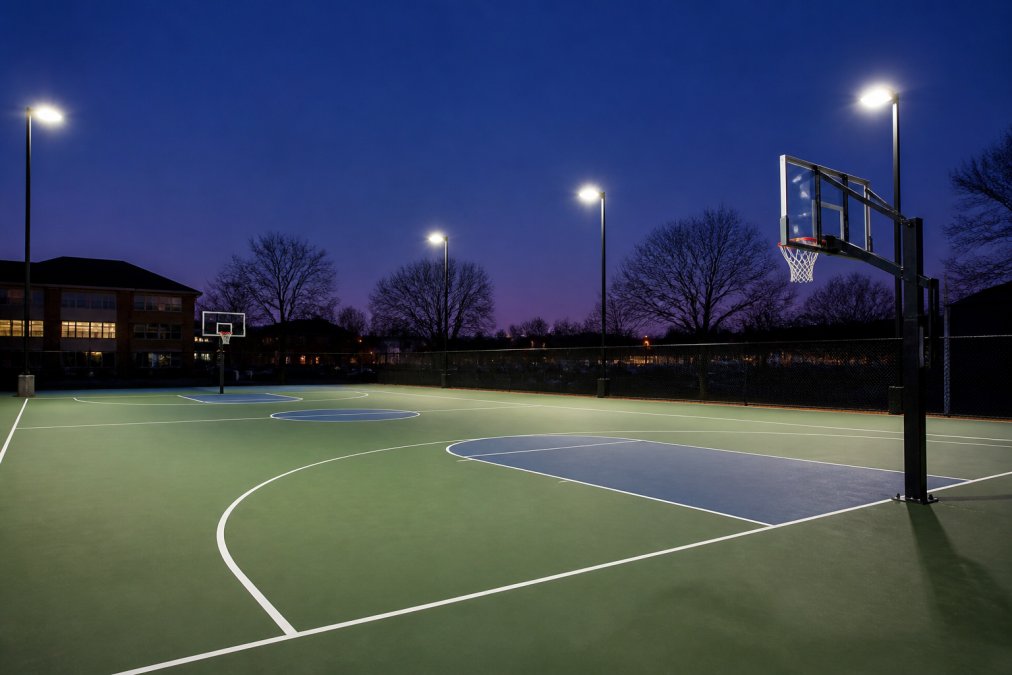
The physical layout of poles and fixtures determines whether a lighting system performs as intended. A well-designed outdoor basketball court lighting layout distributes light evenly across the playing area while minimizing shadows and dark corners.
Pole Height and Fixture Placement
Taller poles, typically 20 to 30 feet for outdoor courts, allow light to spread over a larger area with reduced glare for players looking up. Shorter poles concentrate light but create more pronounced shadows and hot spots directly beneath.
Fixtures should be positioned to aim across the court rather than straight down. This cross-lighting technique reduces shadows cast by players and keeps the ball visible during high-arcing shots. For a standard high school court, four to six poles at the corners and midpoints often deliver adequate coverage.
Beam Angle and Light Distribution Patterns
Beam angle controls how tightly or widely a fixture spreads its light. Narrow beam angles, around 15 to 30 degrees, suit tall poles where light must travel a long distance to the court. Wider angles, from 60 degrees upward, work better on shorter poles where the fixture sits closer to the playing surface.
Light distribution patterns describe the shape of the illuminated area on the ground. Asymmetric distributions are ideal for court perimeters, directing light onto the court while limiting spill into adjacent areas. Symmetric distributions work well for center-court coverage. A photometric analysis, which simulates the exact light pattern for your court dimensions, is the most reliable way to confirm the layout before installation.
Light Spill and Glare Control for Schools
Light spill and glare control for schools is often the difference between a successful installation and a source of neighborhood complaints. Uncontrolled light that crosses property lines can violate local ordinances and strain relationships with adjacent residents.
Managing Spillover Into Neighboring Properties
Spill light, sometimes called light trespass, occurs when illumination extends beyond the intended property boundary. Schools surrounded by homes face the highest risk of complaints, especially when evening games run late. Selecting fixtures with precision optics and aiming them carefully reduces spill without sacrificing court coverage.
Many municipalities now include lighting restrictions in their zoning codes. Before finalizing a layout, verify whether your local ordinances set specific limits on illumination at the property line. DarkSky International guidance on responsible outdoor lighting offers practical strategies for minimizing light pollution while maintaining adequate sports illumination.
Glare Reduction and Uniformity Standards
Glare occurs when bright light sources enter the eyes directly, reducing visibility. For players, glare can obscure the ball at critical moments; for neighbors and passing motorists, it creates a nuisance and potential safety hazard.
Uniformity, expressed as a ratio of average to minimum illuminance, measures how evenly light covers the court. A ratio of 3:1 or better is a common target for school-level play, meaning the darkest area is at least one-third as bright as the average. Higher uniformity reduces eye strain and helps players track movement consistently across the full court. U.S. Department of Energy fact sheet on LED sports lighting design outlines how fixture selection and layout influence both glare and uniformity outcomes.
LED vs. Traditional Lighting Technologies
The shift from metal halide or high-pressure sodium fixtures to LED is well underway. LED fixtures offer superior control over light distribution, instant-on capability, and significantly longer operational life.
Traditional fixtures require warm-up periods, produce light in all directions that must be redirected with reflectors, and degrade in output over time. LEDs provide directional light that integrates with precision optics, reducing wasted light and simplifying design.
LED fixtures are solid-state, meaning they have no fragile bulbs or filaments to replace. This resilience translates to fewer maintenance interruptions and more consistent performance, an important consideration for schools with limited facilities staff.
Energy Efficiency, Maintenance, and Durability
Energy efficiency is a primary driver for schools replacing aging lighting systems. LED fixtures consume a fraction of the electricity of traditional options while delivering comparable or better light output.
Operating Costs and Long-Term Savings
Operational savings come from reduced energy consumption and lower maintenance frequency. LED fixtures also support advanced controls like motion sensing and dimming, which further reduce energy use during low-activity periods.
High-quality LED fixtures commonly deliver 50,000 hours or more of useful life, meaning a system used for evening practices and games could operate for well over a decade. This longevity reduces total cost of ownership compared to traditional lamps requiring periodic replacement.
Weather Rating and Lifespan
Outdoor fixtures must withstand rain, snow, wind, and temperature extremes. Look for an IP rating that confirms the fixture is sealed against moisture and dust ingress. An IP65 rating or higher is a sound benchmark for Illinois weather conditions.
Thermal management also affects lifespan. LED performance degrades with excessive heat, so quality fixtures incorporate heat sinks to keep components cool and maintain light output and color consistency even during hot summer evenings.
| Consideration | Solar-Powered Fixture | Traditional Wired LED | Why It Matters |
|---|---|---|---|
| Installation | No trenching or electrical connection | Requires professional electrician | Solar reduces disruption and cost |
| Light Output | Up to 14,800 lumens per fixture | Varies by wattage and design | Sufficient for recreational play |
| Power Source | Integrated solar panel with battery | Grid-connected | Solar supports remote court locations |
| Controls | Motion sensing and timer options | Depends on control system | Automation cuts energy waste |
| Best For | Remote or new courts without wiring | Existing courts with power nearby | Match the solution to site conditions |
Budget, Compliance, and Multi-Sport Flexibility
Budget realities shape every school lighting project, but the cheapest upfront option rarely delivers the lowest total cost. Weighing installation, energy, and maintenance over the system's life provides a clearer picture of true affordability.
Local Zoning and Safety Regulations
Before purchasing fixtures, confirm your project complies with local zoning and building codes. Some Illinois municipalities require permits for pole installation, and setback requirements may dictate pole placement. Checking with the local planning department early prevents costly redesigns.
Poles must be anchored securely to withstand wind loads, and electrical connections must meet the National Electrical Code. For solar-powered systems that eliminate wiring, the electrical compliance burden is reduced, which is one reason they appeal to schools seeking a simpler installation path.
Funding Options and Grant Opportunities
Schools often pursue grants to offset the cost of athletic facility upgrades. Many districts have successfully secured funding through state and federal programs that support community recreation infrastructure. U.S. Department of Education resources for school facility improvement grants provides a starting point for identifying applicable programs.
Local partnerships also help close funding gaps. Youth sports leagues, booster clubs, and community foundations frequently contribute to projects that expand access to evening recreation. A clear plan documenting safety and community benefits strengthens any funding request.
Supporting Multiple Sports on One Court
Many school courts serve more than basketball, often hosting pickleball, tennis, or volleyball. Choosing lighting that accommodates multiple sports maximizes return on investment and extends the facility's utility.
Multi-sport flexibility depends on achieving illuminance levels that satisfy the most demanding sport played on the court. Pickleball is played on a smaller area, so lighting designed for a full basketball court will generally cover pickleball lines with ease, supporting year-round programming without additional fixtures.
Recommended Court Lighting Solutions
For schools seeking reliable illumination without the cost and complexity of trenching and electrical work, solar-powered LED fixtures offer a practical path. Sports Vista USA carries two systems that address different facility needs.
The Dominator 100W LED Solar Court Light with Pole combines a high-output LED fixture with an integrated solar panel, intelligent motion sensing, timer controls, and adjustable brightness. This unit suits schools that want automated operation and the flexibility to control light output based on scheduled activities.

For facilities that need a freestanding solution requiring no electrician, the First Team Solar Powered Court Light delivers 14,800 lumens of bright LED light mounted roughly 16 feet above the playing surface. Its commercial-grade solar panel charges enough to run for up to 16 hours without recharging, and the hinged anchor base allows full assembly at ground level before standing upright. This makes it a strong option for schools in Carbondale and throughout Illinois adding lighting to an existing court without major construction.

Both options provide the durability and weather resistance needed for outdoor installation, and their solar design reduces ongoing energy costs. When evaluating systems, confirm that the light output and mounting height align with the lux targets and uniformity ratios outlined in this guide.
Selecting the right court lighting for schools in Carbondale requires balancing illumination performance, energy efficiency, and neighborhood relations. A system that delivers even, glare-controlled light while respecting property lines will serve your athletic program for years. Sports Vista USA offers solar-powered court lighting solutions that simplify installation and cut operating costs. Browse our court lighting options and check out the systems that fit your facility's needs.
Frequently Asked Questions
What lux level is recommended for high school basketball court lighting?
High school competition courts typically require 50-75 lux for recreational play and 100-150 lux for varsity competition and broadcast events. The IES (Illuminating Engineering Society) provides standards based on sport type and competition level. Exact requirements depend on whether the court hosts practices, intramural games, or varsity matches. Consult your state athletic association for specific mandates, as some regions enforce stricter standards for official tournaments.
Why is LED lighting preferred for school court lighting?
LED sports court lighting offers superior energy efficiency, reducing operational costs by 50-70% compared to traditional metal halide fixtures. LEDs reach full brightness instantly with no warm-up time, provide better color rendering for video and broadcast, and last 50,000+ hours, minimizing maintenance frequency. They also produce less heat and support dimming controls and motion-sensing features, making them ideal for schools managing multiple courts and tight budgets.
How can schools minimize light spill affecting neighboring residential areas?
Position fixtures at appropriate pole heights (typically 25-35 feet for basketball courts) with full cutoff optics that direct light downward only. Use beam angles matched to court dimensions to prevent overspill. Install motion sensors and timers to eliminate unnecessary lighting during off-hours. Shield fixtures on sides facing residences and consider adding baffles. Verify compliance with local zoning ordinances, which often cap illumination at property lines. Glare control and strategic placement eliminate most neighbor complaints.
What weather rating and IP rating should school court lighting fixtures have?
Outdoor court fixtures should carry an IP65 rating minimum, protecting against dust and water jets from any direction. For areas with extreme weather, IP67 or IP68 ratings offer additional durability against heavy rain and flooding. Look for fixtures rated for UV resistance and corrosion protection, especially in humid or coastal regions. Aluminum construction with powder-coat finishes and tempered glass lenses ensure longevity. Check warranty coverage for environmental damage and verify that fixtures meet UL and ETL safety standards.
Can one lighting system support multiple sports on a school court?
Yes, with proper design. Basketball, pickleball, and volleyball require similar lux levels (50-100 lux for most play). Adjustable beam angles and dimming controls allow one fixture array to serve multiple sports by modifying brightness and distribution as needed. However, court layout and fixture spacing must accommodate all sports' dimensions. Work with a lighting designer to create a layout that meets each sport's specific requirements without repositioning poles. This approach saves installation costs and maximizes facility versatility.
What grants or funding programs help schools pay for court lighting upgrades?
Federal and state grants vary by location and sport. The USDA Rural Development program funds athletic facility improvements in eligible areas. State departments of education sometimes offer facility grants, and local parks and recreation departments may have matching-fund programs. Energy-efficiency rebates from utility companies can offset LED conversion costs by 20-40%. Athletic foundations and booster clubs often fundraise for lighting projects. Consult your state's education finance office and local utility provider to identify available programs and application timelines.
How do I know if a court lighting system meets local compliance and safety standards?
Verify that fixtures carry UL (Underwriters Laboratories) or ETL (Intertek) certification for electrical safety. Check your local building code and zoning ordinance for illumination limits at property lines and any restrictions on fixture height or brightness. Review IES standards for your sport and competition level. Request photometric reports from manufacturers showing lux distribution, uniformity ratios, and spill light calculations. Have an electrician review installation plans for code compliance. Contact your local building department before installation to confirm all requirements.


Leave a comment
This site is protected by hCaptcha and the hCaptcha Privacy Policy and Terms of Service apply.