

Table of Contents
- Understanding Pickleball Court Lighting Requirements
- Selecting the Right LED Fixtures and Wattage
- Pickleball Court Light Pole Placement and Height
- Reducing Glare and Improving Player Visibility
- Controlling Sports Court Light Spill Into Residential Areas
- Solar-Powered and Grid-Connected Lighting Options
- Implementation Checklist and Timeline
- Frequently Asked Questions
Last Updated: October 15, 2026
Understanding Pickleball Court Lighting Requirements
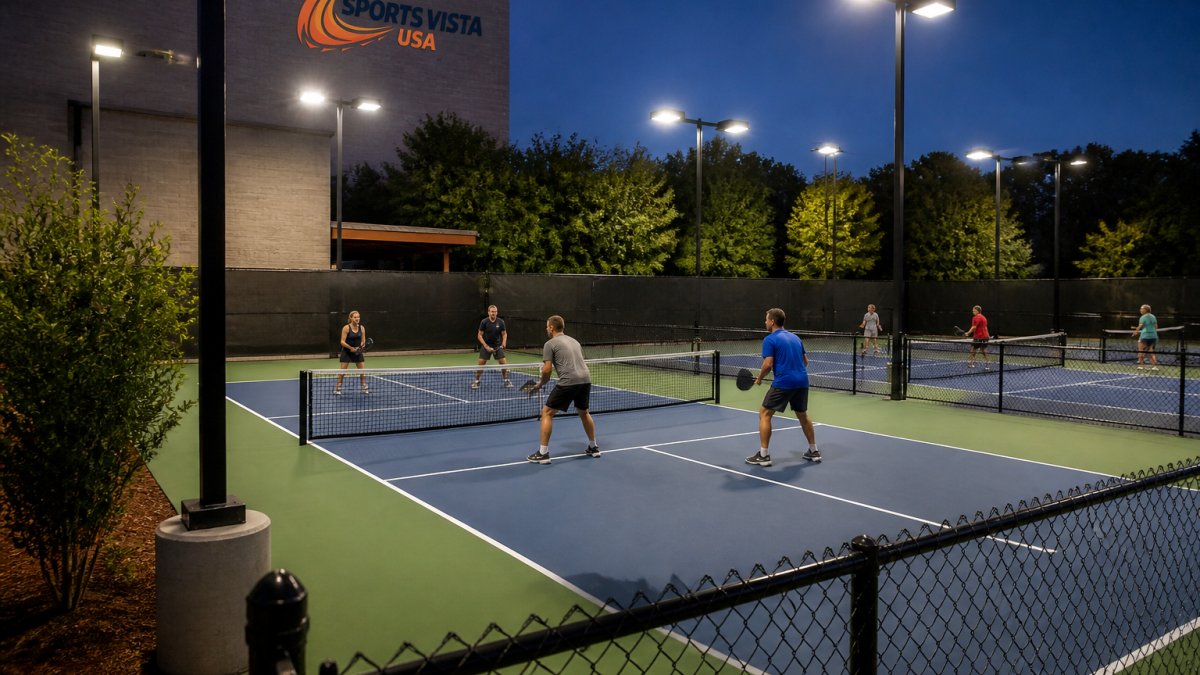
Proper pickleball court lighting is essential for safe, competitive play. Without adequate illumination, players struggle to track the ball, judge depth, and react to fast-moving shots. This guide covers how to select and implement pickleball court lighting for parks that balances performance, cost, and community impact.
At Sports Vista USA, we help parks and recreation departments find lighting systems for casual and competitive play. The challenge isn't just brightness, it's uniform distribution, glare control, and managing light spill into nearby residential areas. Parks in Carbondale and across Illinois face specific environmental and regulatory considerations that affect lighting choices.
Recreational play requires less intense illumination than league or tournament play. Most parks determine their primary use case, then select fixtures and placement that deliver the right light levels, aiming for visibility without excess brightness that strains eyes or disturbs neighbors.
Selecting the Right LED Fixtures and Wattage
LED fixtures are the standard for outdoor court lighting thanks to high efficiency, long lifespan, and excellent color rendering. When choosing fixtures for pickleball court lighting, focus on wattage, lumen output, and beam angle rather than brand alone.
Most outdoor court applications use fixtures ranging from 100W to 480W, depending on court size and desired illumination levels. A 100W LED fixture typically produces around 14,000 lumens, which works well for single-court installations or backup lighting.

The relationship between wattage and performance isn't linear: a 200W fixture produces roughly 1.5 times the light of a 100W model, not twice. Efficiency improves at higher wattages, but so do heat output and operating cost. For long-term use, the efficiency gains often justify the upfront investment.
Color temperature matters for visibility. LED fixtures rated 4000K to 5700K (cool white) provide the best contrast for tracking a pickleball. Warmer light (3000K) reduces glare but makes the ball harder to see against the sky. Most parks choose 5000K as a compromise.
Sports Vista USA offers solar-powered court lighting options that eliminate the need for trenching and electrical infrastructure. The Dominator 100W LED Solar Court Light with Pole provides remote-controlled operation, motion sensing, timer functionality, and adjustable brightness from 25% to 100%.
For larger park installations, grid-connected systems with higher-wattage fixtures deliver more consistent performance across multiple courts. The choice between solar and grid power depends on available infrastructure, budget, and long-term operating costs.
Pickleball Court Light Pole Placement and Height
Pole placement and height determine light distribution, glare, and shadows. Poor placement creates dark spots, uneven illumination, and excessive glare that makes play uncomfortable or unsafe.
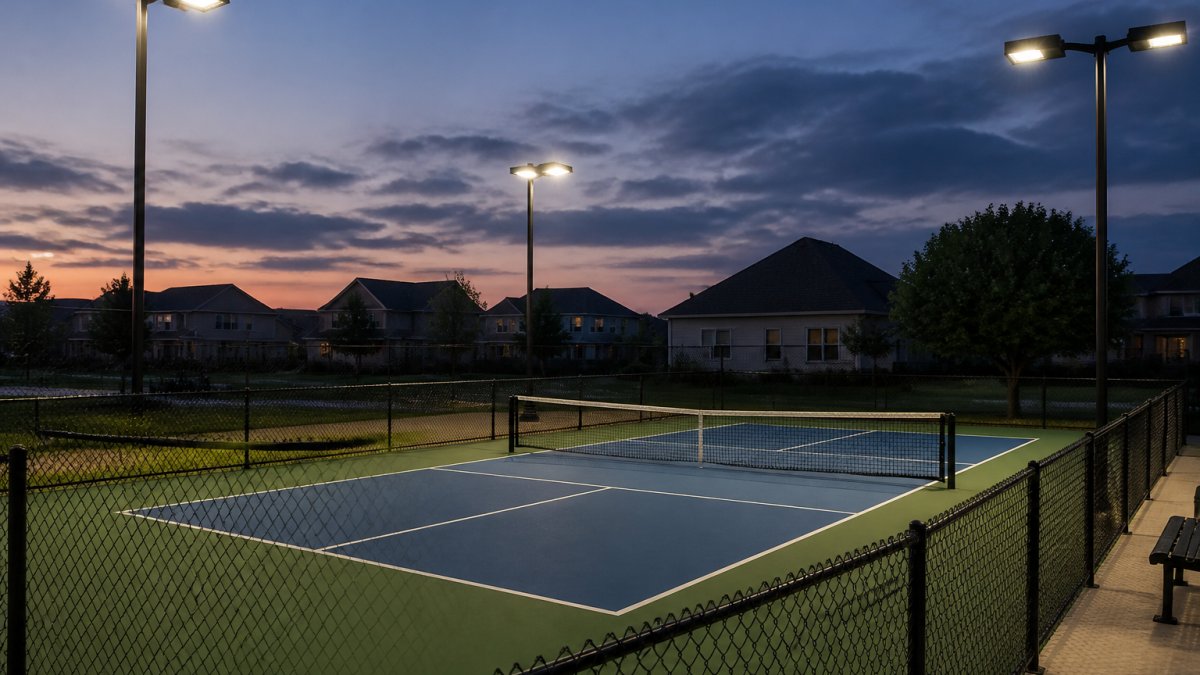
Most outdoor courts use poles mounted 20 to 22 feet high at the corners or sides of the perimeter. This height balances visibility across the court with acceptable glare angles. Poles too close create sharp shadows and hot spots; poles too far away require excessive wattage for uniform light.
For a standard pickleball court (20 feet by 44 feet), a common layout uses four poles just outside the boundary, one at each corner, providing even distribution with each fixture covering roughly half the court.
Pole-to-court-edge distance typically ranges from 10 to 20 feet. Closer placement reduces required wattage but increases glare; farther placement spreads light more evenly but requires higher-wattage fixtures.
Pole height affects the beam angle needed. Higher poles allow wider beams and better spread; lower poles require narrower, focused beams to avoid spill beyond the court. Most 20-foot poles use fixtures with 90- to 120-degree beam angles.
When planning pole locations in Carbondale parks, account for tree growth, future expansion, and sight lines from parking or seating areas. Poles should not obstruct views or create safety hazards during play.
Reducing Glare and Improving Player Visibility
Glare is the biggest complaint about outdoor court lighting, causing eye strain, reducing ball tracking, and making play uncomfortable. Controlling it requires attention to fixture type, beam angle, and shielding.
Shielded fixtures direct light downward and reduce light escaping above the horizontal plane, minimizing glare and spill to surrounding areas. Most modern outdoor court fixtures include built-in shields or visors.
Beam angle is critical. Narrow beams (30-45 degrees) create hot spots and dark areas; wider beams (120-150 degrees) spread light evenly but send more beyond the court boundary. Most parks find 90- to 110-degree beams work best.
Mounting angle also affects glare: vertical fixtures create more glare than those tilted slightly downward. A tilt of 5 to 15 degrees reduces glare without significantly affecting coverage.
The light source's height and position relative to eye level influence perceived glare: players looking directly at a fixture experience more glare than those viewing it at an angle. Pole placement outside the perimeter helps, but fixture shielding is essential.
Uniform illumination reduces eye strain and improves performance, since players adapt to consistent levels better than uneven distribution. Aim for light levels that vary by no more than 20% across the playing surface.
Controlling Sports Court Light Spill Into Residential Areas
Light spill into nearby homes is a common concern for parks in Carbondale and other residential neighborhoods. Excessive night light disrupts sleep, affects wildlife, and creates community friction. Controlling spill requires intentional fixture selection and operational discipline.
Shielded fixtures are the first line of defense. Full-cutoff fixtures direct all light downward and eliminate light above the horizontal plane, the most effective way to prevent light reaching neighboring properties.
Pole height and position matter significantly. Taller poles farther from residential areas reduce the angle at which light travels toward homes. A 22-foot pole 50 feet from a property line sends light at a much shallower angle than a 15-foot pole 20 feet away.
Operating hours are often the most practical control. Many parks limit court lighting to specific times, such as 6 p.m. to 10 p.m. in summer, reducing overall spill and letting neighbors enjoy darkness outside peak-use periods.
Dominator 100W LED Solar Court Light with Pole →
Fixture wattage affects spill intensity. Using the minimum wattage needed for adequate court illumination reduces light escaping the boundary; oversized fixtures create unnecessary spill and waste energy.
Some parks use directional fixtures that focus light on the court and away from residential zones. This requires careful design but can nearly eliminate spill to neighboring properties.
Local regulations in Carbondale and Illinois may limit light levels at property lines or restrict operating hours. Check with your local planning or parks department before finalizing a design; compliance prevents future disputes and keeps your system legally compliant.
Solar-Powered and Grid-Connected Lighting Options
Parks have two primary options for powering court lighting: solar and grid-connected systems. Each offers distinct advantages and trade-offs depending on site conditions, budget, and long-term operational plans.
Solar-powered systems eliminate trenching, underground conduit, and connection to the municipal grid, a substantial advantage where existing electrical infrastructure is distant or ground conditions make trenching difficult. Solar fixtures are self-contained units that charge by day and operate at night.
The Dominator 100W LED Solar Court Light with Pole from Sports Vista USA operates independently without AC connection, with motion sensing, timer controls, and adjustable brightness. Its integrated solar panel charges during daylight, and the fixture illuminates more than 2,000 sq. ft. under suitable conditions.

The First Team - Solar Powered Court Light provides 14,800 lumens of LED output mounted approximately 16 feet above the playing surface. It features a hinged anchor base for ground-level assembly and includes a wireless remote control.
Grid-connected systems draw from municipal electrical service and offer consistent, unlimited operation independent of weather or seasonal sunlight. They're ideal for parks expecting heavy use, hosting tournaments, or located in regions with limited sunshine.
The trade-off is infrastructure cost: grid systems require trenching, conduit, service upgrades, and ongoing utility bills. Initial installation is more expensive, but long-term operating costs are predictable and often lower than solar for high-use facilities.
Many parks use a hybrid approach: solar fixtures for backup or secondary courts paired with grid-connected systems for primary courts, balancing cost, reliability, and operational flexibility.
Implementation Checklist and Timeline
Planning a pickleball court lighting project requires coordination across multiple steps. A structured checklist keeps timelines realistic.
| Step | Duration | Key Actions |
|---|---|---|
| Site assessment | 1-2 weeks | Measure court dimensions, evaluate pole locations, assess existing electrical service |
| Design and permitting | 2-4 weeks | Select fixtures and wattage, create layout drawings, submit plans to local authorities |
| Procurement | 2-6 weeks | Order fixtures, poles, controls, and installation materials; confirm delivery dates |
| Installation prep | 1 week | Prepare site, mark pole locations, arrange equipment and crews |
| Fixture and pole installation | 2-5 days | Set poles, mount fixtures, connect wiring (grid systems) or verify solar charging (solar systems) |
| Testing and commissioning | 2-3 days | Test all fixtures, verify light levels and distribution, adjust controls and timers |
| Handover and training | 1 day | Train park staff on operation, maintenance, and troubleshooting |
Total timeline typically ranges from 6 to 12 weeks, depending on permitting requirements and procurement delays.
Before starting, verify local codes and zoning restrictions. Contact your Carbondale parks department or Illinois local authority to confirm lighting standards, operating hour limits, and required permits. Some jurisdictions require environmental review.
Site assessment is the foundation of a successful project. Measure the court precisely, identify pole locations that balance coverage and glare control, and evaluate existing electrical service.
Design around your primary use case: recreational play requires less intensity than league or tournament play, and oversizing wastes money and creates unnecessary light spill.
Procurement lead times vary; solar fixtures often ship faster than grid-connected systems with custom controls. Plan for 4 to 6 weeks and confirm delivery dates before scheduling installation.
Installation typically takes 2 to 5 days for a standard four-pole system, depending on site conditions and whether trenching is required. Solar systems install faster because they need no underground wiring.
After installation, test all fixtures and verify light distribution meets requirements. Adjust pole angles or fixture positions if needed, then commission controls and confirm timers, motion sensors, and dimming work as intended.
Pickleball court lighting transforms your park into a versatile recreational asset that extends play into evening and night hours.
Sports Vista USA offers solar-powered court lighting solutions that eliminate infrastructure barriers and provide immediate illumination without trenching or electrical upgrades.
Frequently Asked Questions
What lighting levels are recommended for recreational pickleball court play?
Recreational pickleball court lighting typically requires 30-50 foot-candles of average illuminance across the playing surface. This level allows players to see the ball and court lines clearly during evening play without excessive brightness. League and tournament play may require higher illumination for competitive standards. Uniform light distribution matters as much as total brightness, dark spots create safety hazards and affect gameplay quality.
How do I reduce glare on a pickleball court?
Glare reduction starts with fixture selection. Shielded LED fixtures and high-bay luminaires direct light downward and minimize upward spill. Pole height and angle matter too, fixtures mounted 20-22 feet high spread light more evenly than lower mounts. Position poles outside the court perimeter to keep direct light off players' faces. Avoid reflective backboard surfaces that bounce light toward spectators. Test the layout before final installation to identify problem angles.
What should I consider when choosing between solar and grid-connected pickleball court lighting?
Solar court lights require no electrical trenching or utility connection, making them faster to install and ideal for parks without existing power infrastructure. Solar fixtures like the Dominator 100W LED Solar Court Light with Pole illuminate over 2,000 sq. ft. and feature adjustable brightness and timer controls. Grid-connected systems offer consistent brightness regardless of weather or season but require electrical work and ongoing utility costs. Solar suits remote locations; grid power suits high-use facilities needing maximum uptime.
How much light spill should I allow in a pickleball court lighting design?
Light spill into neighboring residential areas should be minimized through fixture selection, pole placement, and shielding. Position poles at least 15-20 feet from property lines where possible. Use fully shielded fixtures that direct light only onto the court surface. Adjustable-wattage LED lights let you reduce brightness during off-peak hours. Check local zoning codes and neighbor agreements before installation, some municipalities have specific light-trespass limits for parks.


Leave a comment
This site is protected by hCaptcha and the hCaptcha Privacy Policy and Terms of Service apply.