

Table of Contents
- The Real Price Drivers Behind Professional Sports Equipment
- Raw Materials and Supply Chain: Where the Money Goes First
- Why Commercial Grade Basketball Hoops Command Higher Prices
- The Benefits of Tempered Glass Backboards That Justify the Cost
- R&D, Safety Standards, and Liability: The Invisible Price Tag
- Durability vs. Upfront Cost: The Long Game of Equipment Lifespan
- What Competitors Miss: Psychological Pricing and the Second-Hand Market
- Conclusion: Paying for Performance or Paying for a Name?
- Frequently Asked Questions
Last Updated: September 24, 2026
The Real Price Drivers Behind Professional Sports Equipment
Professional sports equipment costs more because of what goes into it before it ever reaches a court: raw materials, manufacturing tolerances, safety testing, liability coverage, and distribution. A regulation-size tempered glass backboard and a heavy-gauge steel post are not commodity items, and the price reflects that reality. This guide from Sports Vista USA breaks down exactly where the money goes, and why commercial grade basketball hoops carry a price tag that recreational sets never approach.
Raw Materials and Supply Chain: Where the Money Goes First
Steel, tempered glass, aluminum, and synthetic materials set the floor price of any serious system. A 6" x 8" steel post, like the one on the Gared All Pro Jam Direct Mount Basketball System, consumes far more raw material than a thin-walled residential pole. Freight costs matter too. Glass backboards and steel posts ship by LTL freight, not parcel, and logistics add real money to every unit.

Why Commercial Grade Basketball Hoops Command Higher Prices
Commercial grade basketball hoops cost more because they are engineered for continuous institutional use, not occasional driveway play. Schools, parks, and recreation departments in Carbondale and across Illinois run their courts daily, and equipment has to survive that.
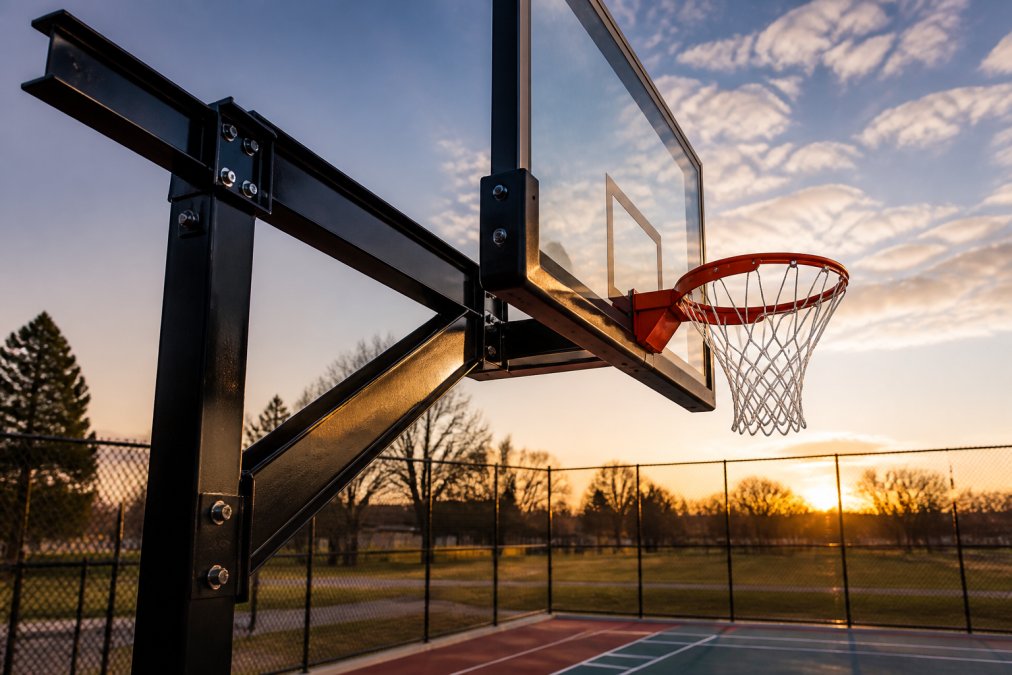
Steel Posts, Glass Backboards, and the Cost of Stability
Stability is the entire point. The First Team Legend Arena 42x72 Glass Basketball Hoop uses a 6" x 6" steel post and a 66" extension to create arena-style court spacing. That mass costs money, and it is the difference between a goal that flexes under a dunk and one that does not.

The Benefits of Tempered Glass Backboards That Justify the Cost
The benefits of tempered glass backboards come down to rebound authenticity and vibration control. Glass plays like the arenas players train in, and a direct-mount design reduces the shake that throws off a shooter's timing.
| System | Backboard | Post | Best For |
|---|---|---|---|
| Gared All Pro Jam | 42" x 72" tempered glass | 6" x 8" steel | Schools, training facilities, competitive outdoor courts |
| First Team Legend Arena | 42" x 72" tempered glass | 6" x 6" steel | Parks, churches, recreation facilities, premium home courts |
| Ironclad Elite 72" | 42" x 72" tempered glass | 6" x 8" one-piece steel | Driveway players, families with growing athletes |
R&D, Safety Standards, and Liability: The Invisible Price Tag
Research and development, safety certification, and commercial liability insurance are baked into every professional-grade unit, and they are the line items buyers never see on a spec sheet. Understanding them is the fastest way to tell engineered cost from marketing cost.
What R&D actually pays for on a commercial hoop
A residential goal can be designed once and sold for a decade. An institutional system gets re-engineered every time a rule, a rim standard, or a mounting preference changes. On a fixed-height arena-style system, the expensive engineering is not the backboard, it is the connection between the post, the extension arm, and the rim.
Three areas absorb most of that spend:
- Rim response and breakaway mechanics. A competition rim has to give under load and return to true. Spring rate, pivot geometry, and fatigue life all get tested, because a rim that stays bent is a rim a school has to replace.
- Structural load paths. The post-to-extension-to-backboard joint carries the entire dynamic load of a dunk. Engineers model that joint, not the pole, because that is where failures start.
- Finish durability. Powder-coat adhesion, salt-spray resistance, and UV stability determine whether a post looks new in year eight or rusts through in year four.
The standards and certifications that show up in the price
Professional and institutional equipment is expected to conform to published safety and performance standards. The two names that come up most often in basketball equipment specifications are ASTM International (which publishes voluntary consensus standards for sports equipment and playing surfaces) and UL Solutions (which tests and certifies products against published safety requirements). A manufacturer that pursues certification pays for sample units, lab time, documentation, and periodic re-testing, costs that get amortized across the product line and recovered in the unit price.
Why liability insurance is a real cost, not a scare tactic
A facility that installs a fixed-height, direct-bury system assumes ongoing exposure if a component fails under a player. That exposure flows backward into the supply chain: manufacturers, distributors, and installers all carry commercial general liability coverage, and premiums scale with the perceived risk of the product category. A heavy in-ground basketball system with a glass backboard sits in a higher-risk tier than a portable residential goal, and the insurance cost reflects it.
Durability vs. Upfront Cost: The Long Game of Equipment Lifespan
Durability versus upfront cost is a cost-benefit analysis most buyers get wrong, because they compare purchase prices instead of cost per year of service. A lower-priced system that needs replacement or repair in a few seasons costs more over its equipment lifespan than a heavier unit that simply keeps working.
Why heavier equipment lasts longer, the actual mechanism
Three physical differences separate a commercial system from a consumer one, and each one maps directly to lifespan:
Gared All Pro Jam Direct Mount →
- Wall thickness and weld quality. A 6" x 8" steel post with a thick wall resists bending fatigue far better than a thin-walled pole of the same outside dimension. Fatigue cracks start at welds, so weld penetration matters as much as gauge.
- Corrosion protection. Hot-dip galvanizing and multi-stage powder coating create a barrier that thin paint cannot. In humid or freeze-thaw climates, that barrier is the difference between a 20-year post and a 6-year post.
- Hardware grade. Stainless-steel and zinc-plated fasteners resist galling and rust. Cheap hardware fails first and takes the surrounding finish with it.
A practical maintenance schedule that protects the investment
Lifespan is not automatic, it is maintained. A simple annual routine keeps a commercial system in service far longer than an ignored one:
- Inspect anchor bolts and base plates each season. Re-torque to spec and replace any fastener showing corrosion.
- Check rim hardware and breakaway tension. A rim that no longer returns to true is a warning sign, not a cosmetic issue.
- Touch up powder-coat chips before rust starts. Small chips become large corrosion sites within a season.
- Clean glass backboards with a non-abrasive cleaner and inspect the frame-to-glass seal for separation.
- For in-ground systems, verify the concrete collar and drainage so water does not pool at the post base.
How to evaluate lifespan before you buy
The questions that separate a durable system from a disposable one are concrete:
- What is the post wall thickness, and is it hot-dip galvanized or powder-coated only?
- Is the backboard frame welded or bolted, and what gauge is the frame?
- Are the fasteners stainless steel?
- What does the warranty cover, the structure, the finish, or both?
- Is the system serviceable, meaning can individual components be replaced without replacing the whole unit?
Asset depreciation and the resale floor
Institutional systems hold usable value far longer than consumer sets. A quality steel post and tempered glass backboard can be re-mounted, re-finished, or re-sold, which means the true cost of ownership is the purchase price minus the residual value. That resale floor is a genuine advantage of professional sports equipment over disposable alternatives, and it is why buyers who plan to upgrade later should still buy the heavier system now.
Before you buy, ask whether the system is serviceable. A hoop that lets you replace a rim, a backboard, or a post cap individually will outlast one that has to be replaced as a unit.
What Competitors Miss: Psychological Pricing and the Second-Hand Market
Two forces rarely discussed in pricing breakdowns are psychological pricing and the circular economy. Status signaling drives some purchases: a facility or homeowner buys the elite-tier system partly because it signals serious play, and brands price accordingly.
Buying a used direct-bury system without inspecting the post for hidden corrosion is a common mistake. A pitted post can fail under load, and replacement cost often erases the savings.
Conclusion: Paying for Performance or Paying for a Name?
Separating performance from branding premium is the whole exercise. Some of the price is engineering, materials, and liability. Some is marketing. The buyer's job is to know which is which before signing off.
Frequently Asked Questions
Which sport has the most expensive equipment?
While sports like ice hockey, equestrian, and auto racing have high gear costs, basketball facility equipment ranks among the most expensive for schools and parks. A regulation-size in-ground basketball system with a tempered glass backboard and heavy steel post can cost between $2,700 and $4,300. The expense comes from raw materials, freight, and the engineering required to meet safety standards for competitive play.
Why is professional sports equipment more durable than entry-level gear?
Professional sports equipment uses higher-grade materials like 6061 T6 aluminum, tempered glass, and heavy-gauge steel. These materials resist rust, vibration, and impact far better than the plastic and thin metals in entry-level gear. For example, a commercial-grade pickleball system with stainless-steel hardware and a 5/32-inch post wall will outlast a portable net by years, even with daily outdoor use.
How does equipment quality impact athlete safety and performance?
Quality equipment directly affects both safety and play. A tempered glass backboard provides consistent rebound, helping players develop proper shooting form. A stable steel post reduces the risk of tipping during aggressive play. In pickleball, an adjustable net tension system prevents sagging that can cause tripping hazards. Professional-grade gear meets USA Pickleball standards and other safety certifications that entry-level equipment often ignores.
Is it worth investing in professional-grade gear for residential use?
For homeowners with serious players or long-term plans, professional-grade gear is often worth the investment. A bolt-down adjustable hoop like the Ironclad Elite 72" offers a lifetime warranty and a regulation-size backboard, so it grows with young athletes. Cheaper portable hoops may need replacement every few years, while a commercial-grade system can last decades with minimal maintenance.

Leave a comment
This site is protected by hCaptcha and the hCaptcha Privacy Policy and Terms of Service apply.